Lab Updates
2026

Acta Geotechnica Best Paper Award 2025
We are honoured and thrilled to receive the "Acta Geotechnica Best Paper Award 2025", for our paper titled “Estimation of compression behavior of granular soils considering initial density effect based on equivalent concept” (Acta Geotechnica, 2025, 20:1035-1048). The work was led by Dr Xiusong Shi, formerly working with us as a RAP at HKUST, then joining Hohai University with the award of "青千". He is now a full professor at Shenzhen University. This highly competitive award is granted annually by the journal’s editorial board to recognize papers of exceptional scientific merit and influence on the field. Since its establishment, typically only one or two papers are selected each year from all published articles, making it a highly competitive and prestigious honor within the international geotechnical engineering community. We thank the editor-in-chief, Prof Wei Wu, and his editor team for selecting our paper for the 2025 award. Congratulations to all co-authors.

Springer Nature Editor of Distinction Award (Author Service Award 2026)
Jidong is honored to receive the Springer Nature Editor of Distinction Award (Author Service Award 2026) for working with Granular Matter as an editor. This recognition reflects his deep commitment to serving authors with the same rigor and respect I’d want for my own submissions. In today’s shifting publishing landscape, he has focused on three principles while working as editor/associate editor for several journals: (1) Fairness & efficiency – unbiased triage, clear desk decisions, no lingering papers. (2) Timely, actionable feedback – firm decision windows, interim updates, specific comments. (3) Quality-driven decisions – weighing reviews critically, explaining rejections clearly. Jidong expresses his great appreciation to all reviewers. Despite soaring submissions, all reviewers have continued to offer their expertise selflessly, often late nights or weekends. They are the backbone and true heroes of all journals, and this award is yours as much as mine. Moving forward, his goal remains: every author leaves feeling respected, informed, and part of a fair process.

Talks in Japan and Keynote at WCPT10
Jidong has taken a talk tour in Japan in May. On 8 May 2026, he gave a talk titled "The Role of Particle Shape in Computational Modeling of Granular Media" at the "Advanced Digital Twin Technology for Particle Processing" Workshop held at The University of Tokyo. on 11 May 2026, he delivered a seminar "Computational modeling of fluid-particle-structure interactions: challenges and advances" at Kyoto University. He then gave an invited keynote talk at the 10th World Congress on Particle Technology held in Osaka from 11-15 May 2026. The conference was well attended by researchers and industrial practitioners from diversified areas on powder processing, pharmaceutical technology, advanced materials, nanotechnology, energy solutions, and sustainability.

Keynote at GAIA 2026
Jidong was invited to give a keynote speech titled "Challenges in Bridging Micro and Macro Multiphysics for Granular Media" at the 2nd International Workshop of Geomechanics Alliance in Asia held in Jinan from 27-30 March 2026. It was a great pleasure meeting and talking to young researchers and students who present exciting research. Also great to catch up with many old friends again in Jinan.
Changyi won NSFC grant and Award
Warm congrats to Changyi YANG for having been awarded the 2025 National Natural Science Foundation of China (NSFC) Young Student Basic Research Program (PhD Student) (totaling RMB 300,000). This honor not only recognizes Changyi's strong research potential but also reflects our department's ongoing commitment to nurturing outstanding young researchers.
The NSFC Young Student Basic Research Program (PhD Student) was established in 2023 to strengthen the training of early-career scholars, encourage independent thinking and innovation, and support their active engagement in scientific research. The grant provides two years of funding to help recipients explore new research directions, broaden their academic perspectives, and enhance their research capabilities and project management skills. Notably, HKUST has been included in the pilot institution list for the first time this year, making our students eligible to apply. A total of 6 HKUST student projects were award for this round. Changyi's funded project is titled "A Peridynamic-based Multiphysics Computational Framework for Seamless Phase Transitions and Fracture Dynamics". With the guidance of Prof. Zhao, it is expected that Changyi will carry out innovative research through this grant and contribute meaningfully to advancements in the field.
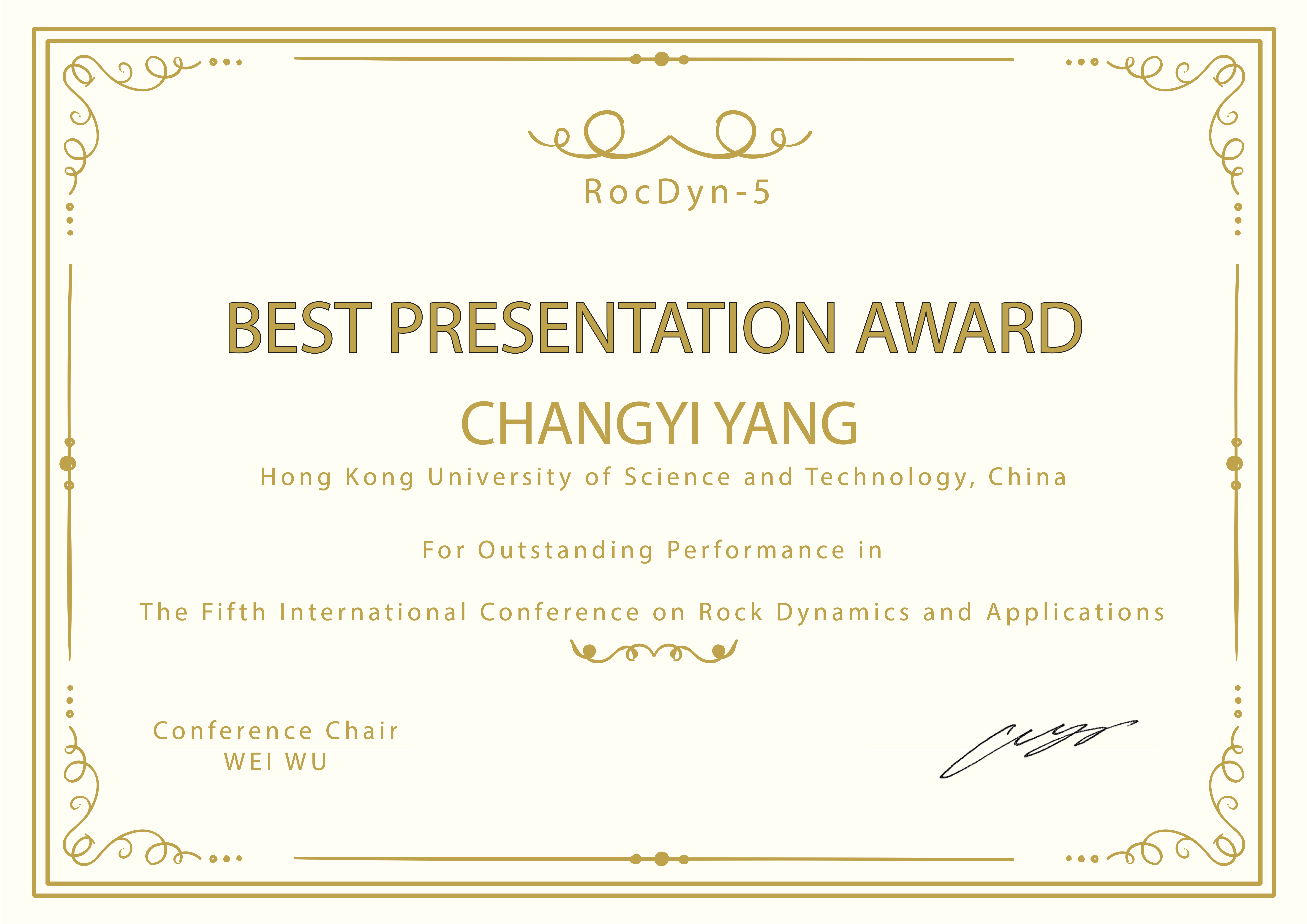
Moreover, Changyi has won a '"Best Presentation Award" in the "Fifth International Conference on Rock Dynamics and Application? (RocDyn-5) held in Singapore from 15-17 January 2026. Many congratulations! Well done, Changyi.
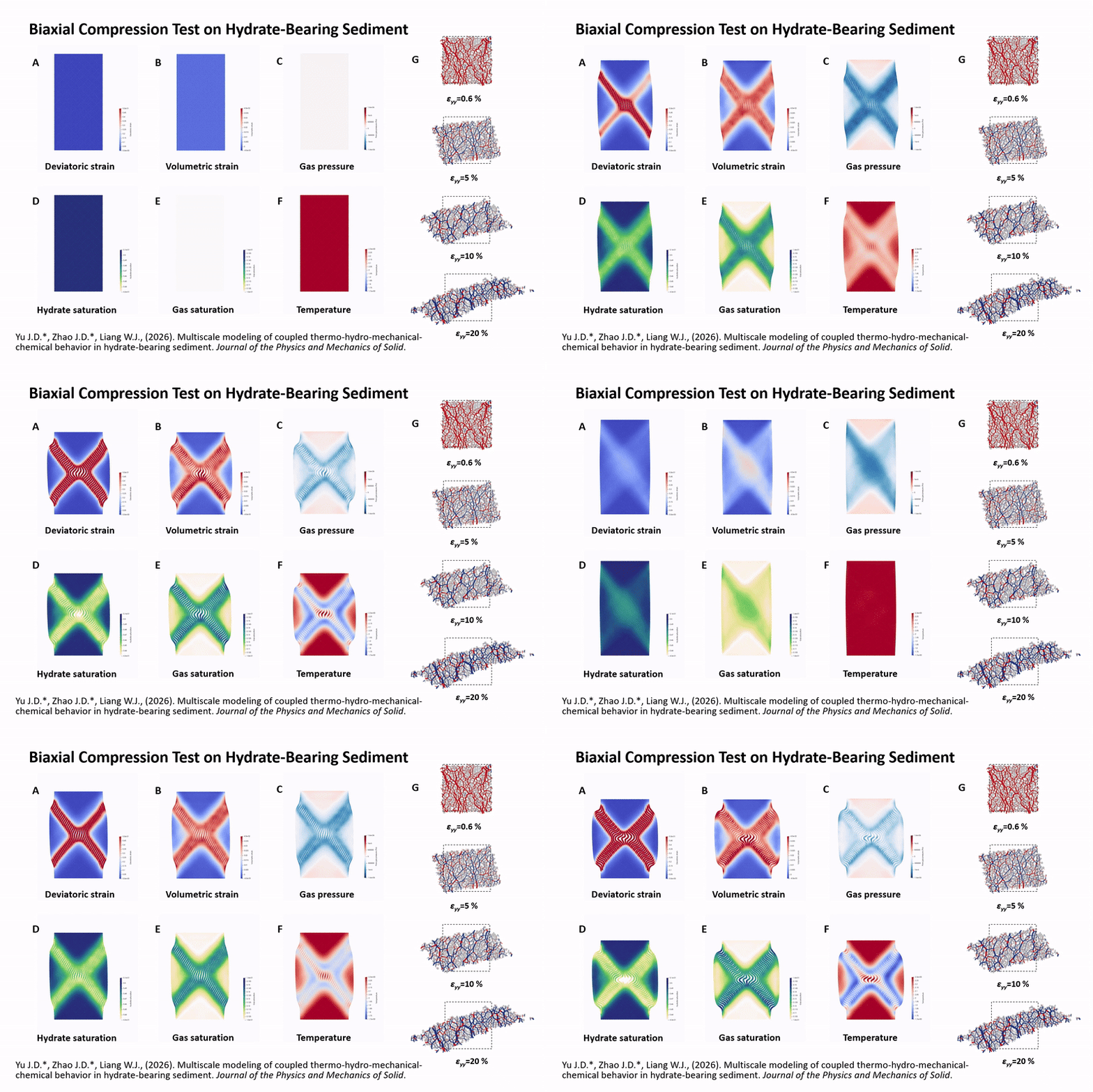
Multiscale modeling of Methane Hydrate Bearing Sediment
Jidu published his new research in Journal of the Mechanics and Physics of Solids (JMPS), in which he developed a multiscale MPM-DEM framework to model fully coupled thermo-hydro-mechanical-chemical (THMC) processes in hydrate-bearing sediments (HBS).
This work addresses a critical challenge in predicting sediment stability and hydrate dissociation, the processes vital for assessing submarine geohazards and optimizing gas hydrate extraction. By using DEM to represent microscale mechanisms, like hydrate bond degradation and particle rearrangement, we bypass traditional constitutive models and directly capture sediment behavior under large deformations. A hydrate saturation-dependent contact model within DEM successfully captures the characteristic shear and volumetric responses of HBS under various conditions. Key insights from the model simulations of HBS are: - Shear-induced dilation creates negative pore pressure, driving localized hydrate dissociation. - Higher hydrate saturation increases strength but promotes brittle failure and more dissociation. - Increased confining stress suppresses dilation and stabilizes the sediment. - The framework helps assess hydrate-related geohazards (e.g., submarine landslides) and informs safer gas extraction strategies.
Read the JMPS paper.
Lab Gathering and farewell members
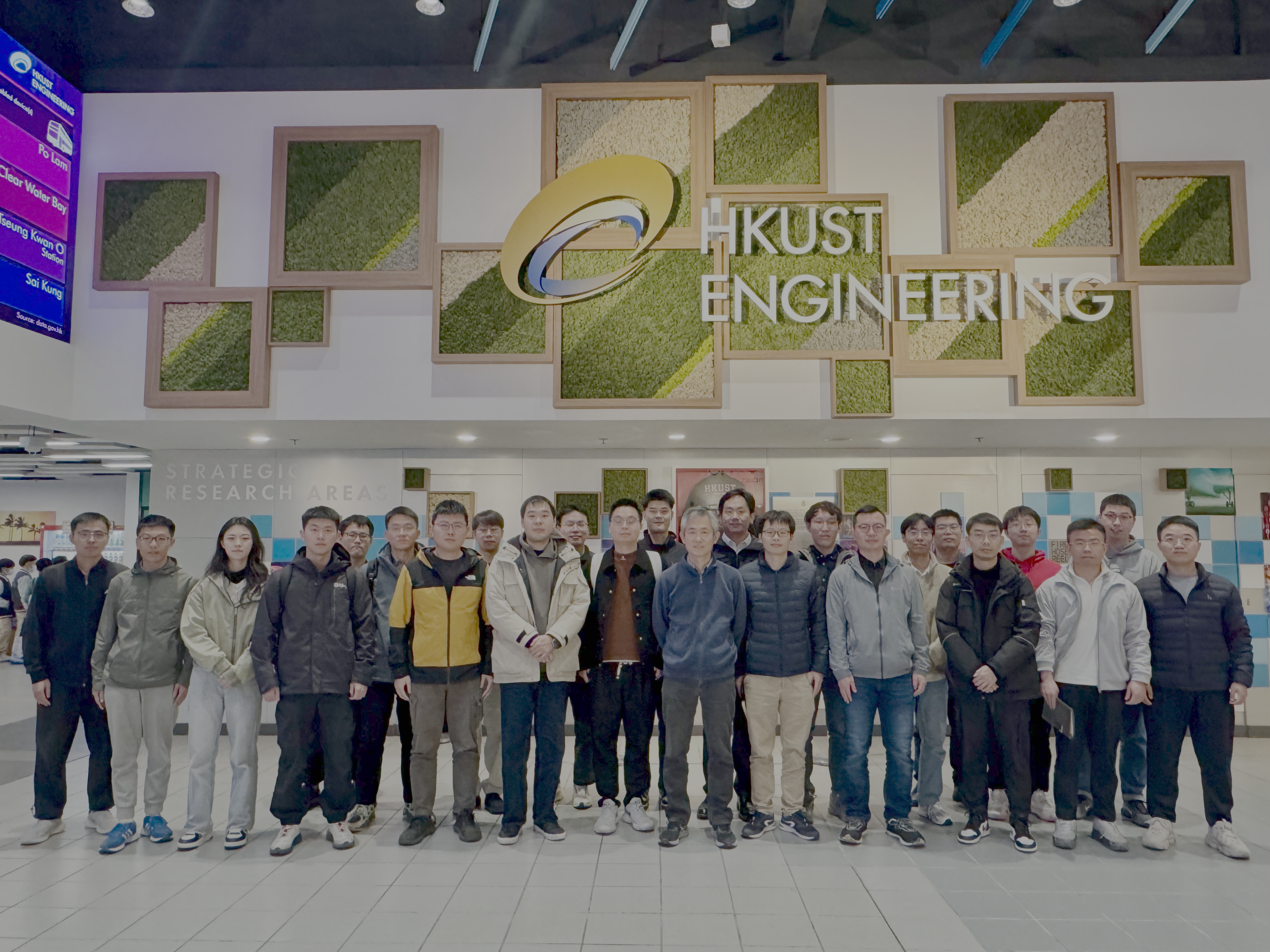
The HKUST Computational Granular Mechanics Lab (CGML) gathered for a New Year dinner to welcome 2026 and celebrate our collective progress and achievements. Thank you to every member of the group for your dedication and passion, which have driven forward multiple frontiers of computational granular mechanics and led to exciting breakthroughs throughout the past year.
This gathering was also an opportunity to farewell two key members who have begun faculty positions: Dr. Deyun Liu (joining Tongji University as tenured associate professor) and Dr. Yong KONG (joining Chengdu University of Technology as full professor). It has been a true pleasure collaborating with each of you. Thank you for your invaluable contributions to our lab. Wishing you all great success in your future academic careers!
SPH with angular momentum conservation
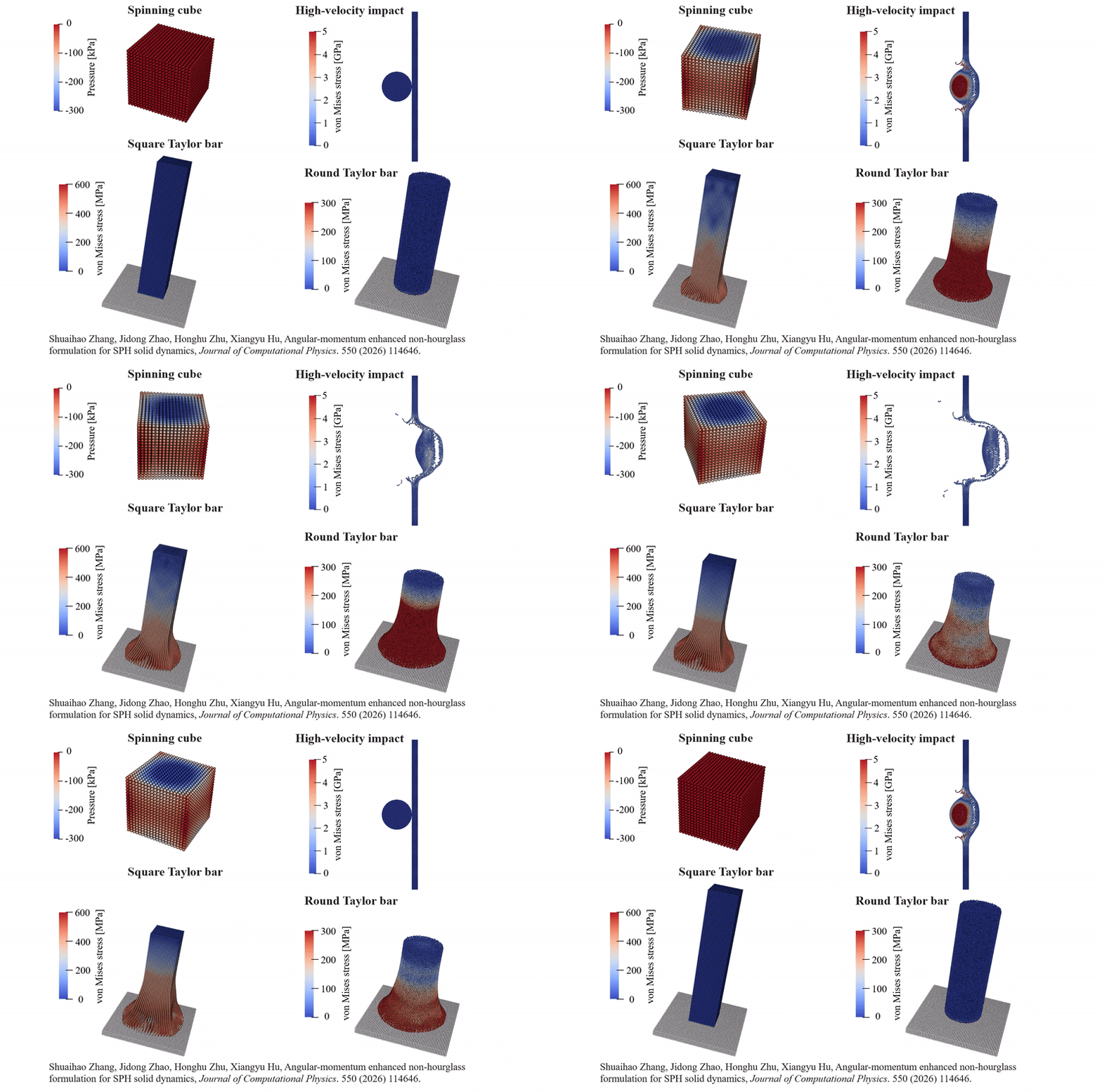
Shuaihao's new paper on computational solid dynamics by enhanced SPH with angular momentum conservation published in JCP. Updated Lagrangian SPH often suffers from hourglass instabilities, zigzag patterns that ruin simulations. While recent non-hourglass methods (SPH-ENOG and SPH-GNOG) fix this, they poorly conserve angular momentum, limiting their use in rotational scenarios. This paper presents SPH-ENOG-A (for elastic materials) and SPH-GNOG-A (unified for elastic & plastic materials) to tackle this issue while significantly improving accuracy in rotational problems.
By integrating Rodrigues' rotation matrices, these methods explicitly account for finite rotations during time integration, dramatically enhancing angular momentum conservation. Linear momentum is preserved by applying a globally averaged rotation matrix. The study features key advances, including the elimination of hourglass modes without sacrificing stability and significant reduction of angular momentum error. It enables more reliable simulations for problems involving large deformations, rotation, and impact, which are critical for aerospace, automotive, defence, and geotechnical engineering. The methods are open-sourced in the "SPHInXsys" library (https://www.sphinxsys.org). The work is a collaboration with Prof Hong-Hu Zhu and Prof Xiangyu Hu.
Read this JCP paper.
2025
Two seminars by outstanding Australian scholars
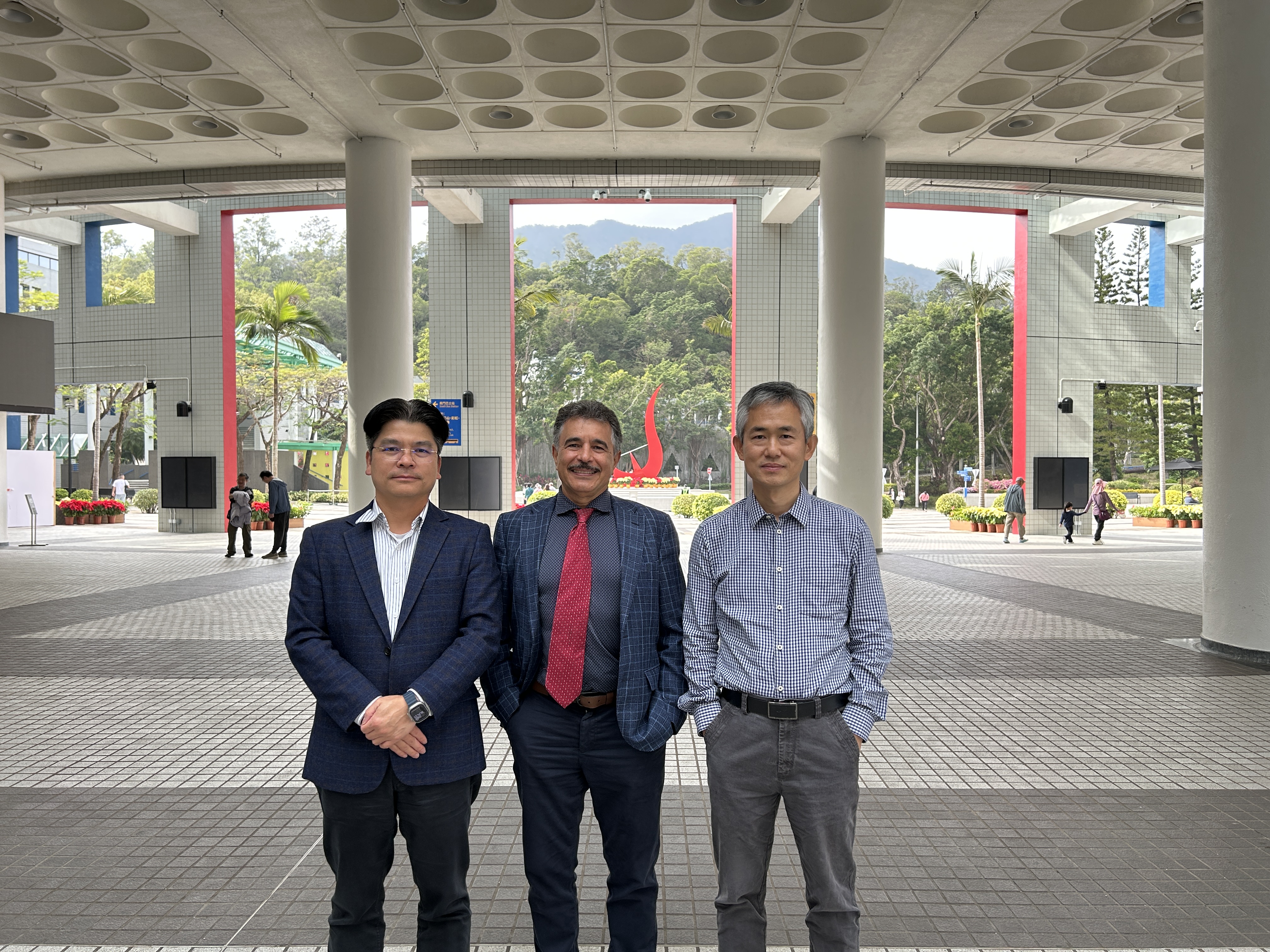
Great to have hosted two outstanding scholars at HKUST this morning for a brilliant seminar series! A huge thank you to Prof. Nasser Khalili (PSM Professor & Scientia Professor, UNSW) and Prof. Ha H. Bui (ARC Future Fellow & Head of Civil Engineering, Monash University) for their time and for sharing their groundbreaking research. In his talk on introducing "RIIS Hub: Resilient and intelligent infrastructure systems", Prof. Khalili showcased how innovative technologies and forward-thinking strategies can create smarter, more sustainable, and resilient infrastructure for the future. Prof. Bui delivered an impressive demonstration of his state-of-the-art developments in Smoothed Particle Hydrodynamics (SPH), exploring multiphysics modeling and failure mechanisms in geomaterials.
Despite being scheduled on a Sunday morning, we had a full house with 30 engaged participants, sparking insightful discussions after each talk. It was inspiring to see such strong enthusiasm for advanced research. Once again, thank you both for a truly inspiring morning!
Jidong Received 2025 Desai Medal
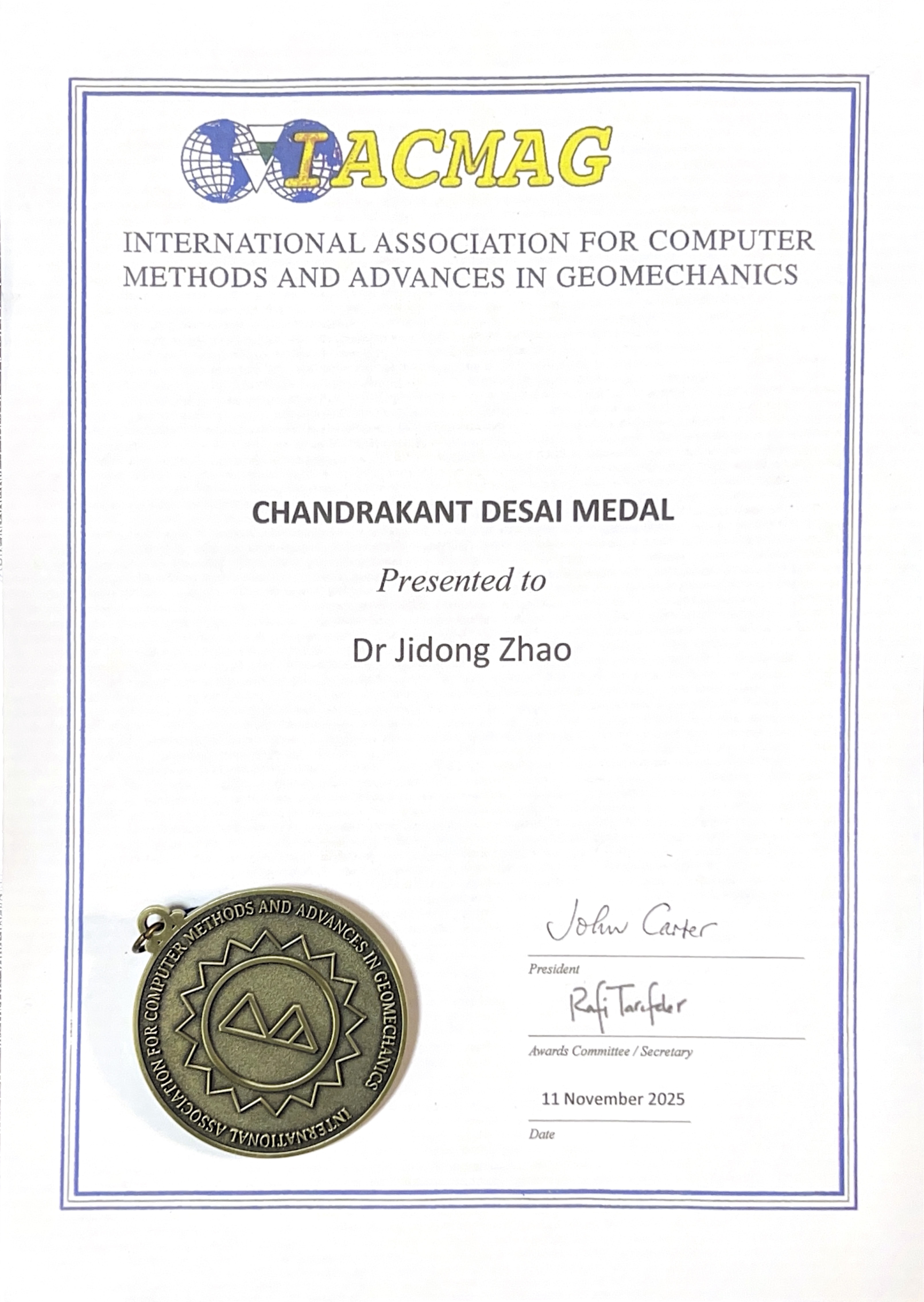
Jidong has been awarded the prestigious 2025 Chandrakant Desai Excellence Medal from IACMAG, presented by IACMAG President Professor John P. Carter at the 2025 conference hosted by Hong Kong Polytechnic University. Named in memory of the late Professor C.S. Desai, a true pioneer and legend in our field, this medal is a profound honour that I share with my collaborators, and students, past and present, whose support has made this journey possible.
The recognition from the International Association for Computer Methods and Advances in Geomechanics is especially meaningful to me, as it reflects a shared commitment to bridging disciplines and developing computational methods that address both fundamental questions and real-world geomechanics challenges. Jidong expressed his deep gratitude to IACMAG, his nominators, all students and postdocs, and colleagues at HKUST, and the wider geomechanics community.
Unified Peridynamics for Coupled THM Modeling
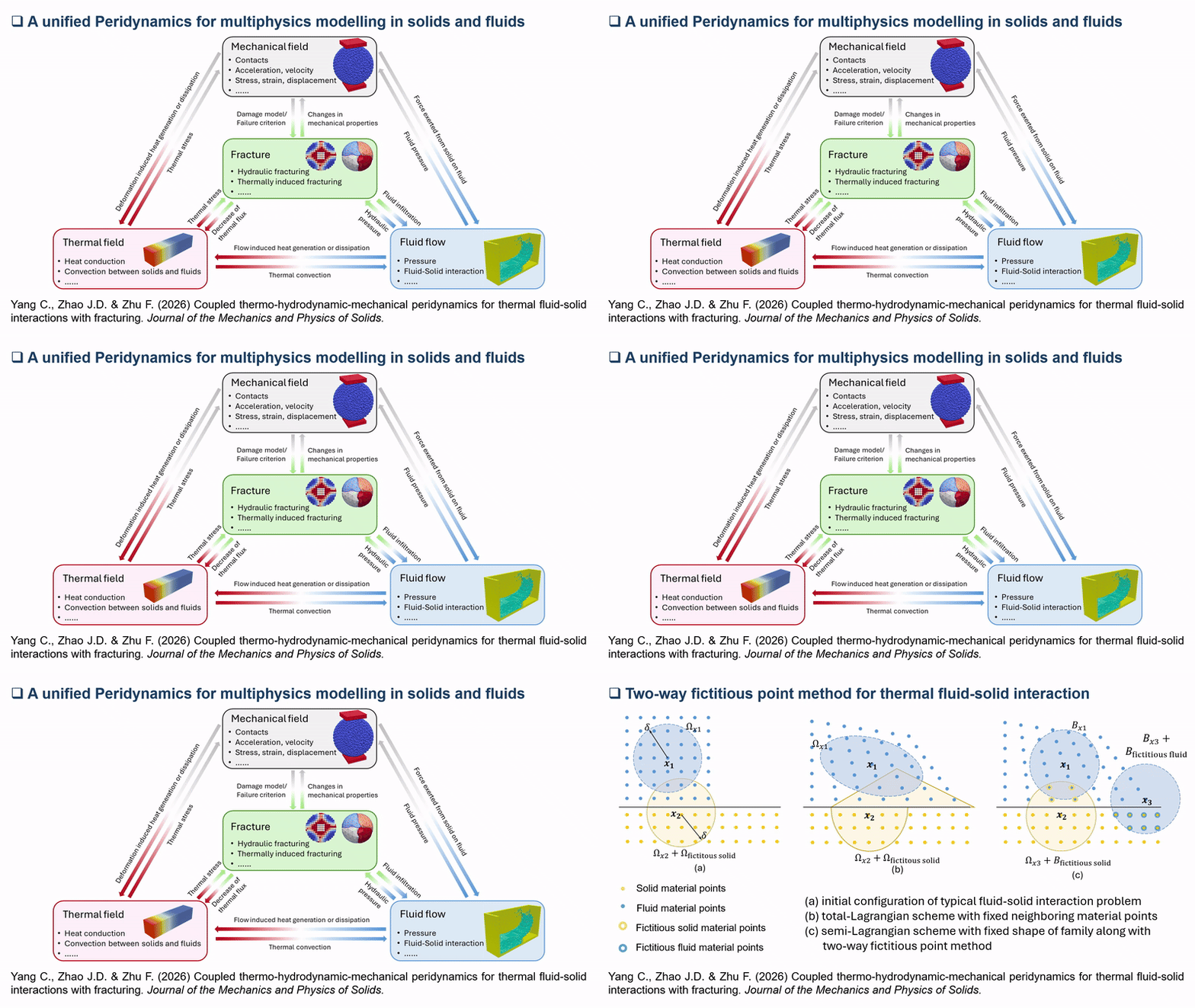
Changyi's latest research on Peridynamics (PD) has been published in JMPS, where we introduce a novel Thermo-Hydrodynamic-Mechanical (THM) Peridynamics framework capable of modeling complex thermal fluid-solid interactions, including fracture propagation, within a single, unified solver. Traditional methods often struggle with moving interfaces, free surfaces, and evolving discontinuities like cracks for multi-physics problems. Our proposed framework overcomes these challenges by: (a) Employing a semi-Lagrangian PD formulation for fluids and a total-Lagrangian PD approach for solids. (b) Introducing a two-way fictitious point method to seamlessly couple thermal and mechanical interactions across evolving interfaces. (c) Integrating a multi-horizon scheme to balance accuracy and computational efficiency across mechanical, thermal, and fluid fields.
Our study showcases key validations and applications of the THM-PD, including: Natural and mixed convection flows; Quenching processes in ceramics; Cold water injection into hot dry rock (geothermal energy); and Concurrent modeling of heat transfer, fluid flow, solid deformation, and fracture. The results demonstrate robust capability in capturing coupled THM phenomena, such as thermal shock-induced cracking and fluid-driven fracture networks, without the need for hybrid solvers or complex interface tracking. This work paves the way for more integrated and efficient simulation of multiphysics systems in areas like geothermal energy, nuclear engineering, and materials processing.
Read this JMPS paper.
Resolved CFD-DEM for coastal modeling
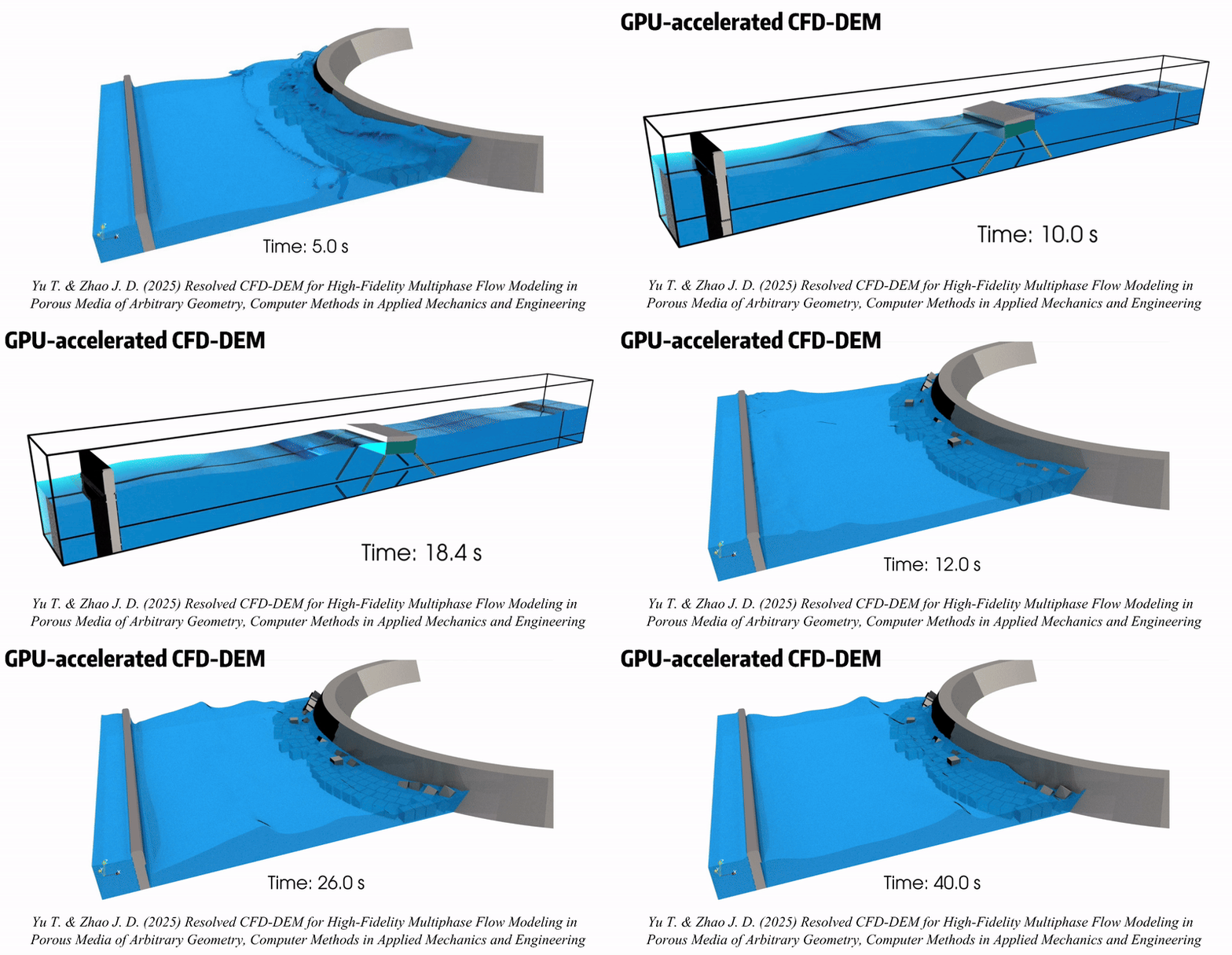
Tao Yu's new paper titled "Resolved CFD-DEM for High-Fidelity Multiphase Flow Modeling in Porous Media of Arbitrary Geometry" accepted for publication in CMAME. Design and maintenance of coastal and geotechnical infrastructure, like breakwaters, seawalls, and granular filters, relies on complex fluid-structure-seabed interactions that are notoriously difficult to model. Traditional numerical methods often treat porous structures as static, homogenized regions, missing the critical dynamics of moving bodies, arbitrary geometries, and real pore-scale physics. In this work, we developed a fully resolved, GPU-accelerated CFD-DEM framework that bridges this gap. Our key innovations include: (1) Unified micro-continuum formulation to integrates pure fluid regions with two types of porous media (coarse inertial & fine capillary-dominated) within one governing set. (2) Geometry-aware DEM coupling using STL-based shapes and a barrier-based contact model to prevent penetration, and a signed distance field for accurate solid fraction mapping, enabling simulation of arbitrarily shaped, moving porous solids. (3) Explicit resolution of mobile porous structures to model stationary and dynamically moving porous bodies (like floating breakwaters or armor units).
The framework was rigorously validated before being applied it to a large-scale coastal engineering scenario featuring wave generation, a curved seawall, and over 100 mobile cubic armor units. The simulations (see animation above) provided new quantitative insights into how permeability, entrapped air, and pore-scale flow significantly enhance wave energy dissipation, a crucial factor for designing resilient coastal defenses. This work provides a powerful virtual laboratory for high-fidelity analysis of multi-physics problems in coastal, geotechnical, and environmental fluid mechanics.
The research was supported by Research Grants Council of Hong Kong through TBRS project "A Digital Twin for Enhancing Coastal Resilience against Extreme Storm Surges in Hong Kong".
Read this paper.
Jidong elected new chair for ISSMGE TC103
Jidong has been elected to be the new Chair of the ISSMGE Technical Committee 103 (TC103) on Numerical Methods in Geomechanics. It is a privilege for Jidong to follow in the footsteps of distinguished predecessors and to have the trust of the International Society for Soil Mechanics and Geotechnical Engineering (ISSMGE). He looks forward to serving this vibrant community that sits at the crucial intersection of computational innovation and geotechnical engineering practice. His vision for TC103 is built on 3Is: Integration, Innovation, and Impact. In this new role, Jidong aims to: (1) Integrate multiscale and multiphysics modeling approaches to tackle grand challenges like climate-related geohazards and sustainable energy geotechnics. (2) Foster innovation through community benchmarking competitions and shared knowledge resources to advance robust numerical tools. (3) Expand impact by strengthening the bridge between academia and industry, ensuring our work remains grounded in real-world applications and needs.
Jidong expresses his appreciation to the ISSMGE leadership, his nominating Member Society HKGES, TC103 members, and all my colleagues for this opportunity. He is also grateful to the outgoing Chair, Prof. Akira Murakami, and his team Prof Ryosuke Uzuoka and Dr Francesca Ceccatonce for their outstanding work and dedication. He is excited to collaborate with the global TC103 community, our sister committees, and all stakeholders to cultivate the next generation of talent and drive our field forward.
Multiphase SPH for landslide-tsunami cascades modeling
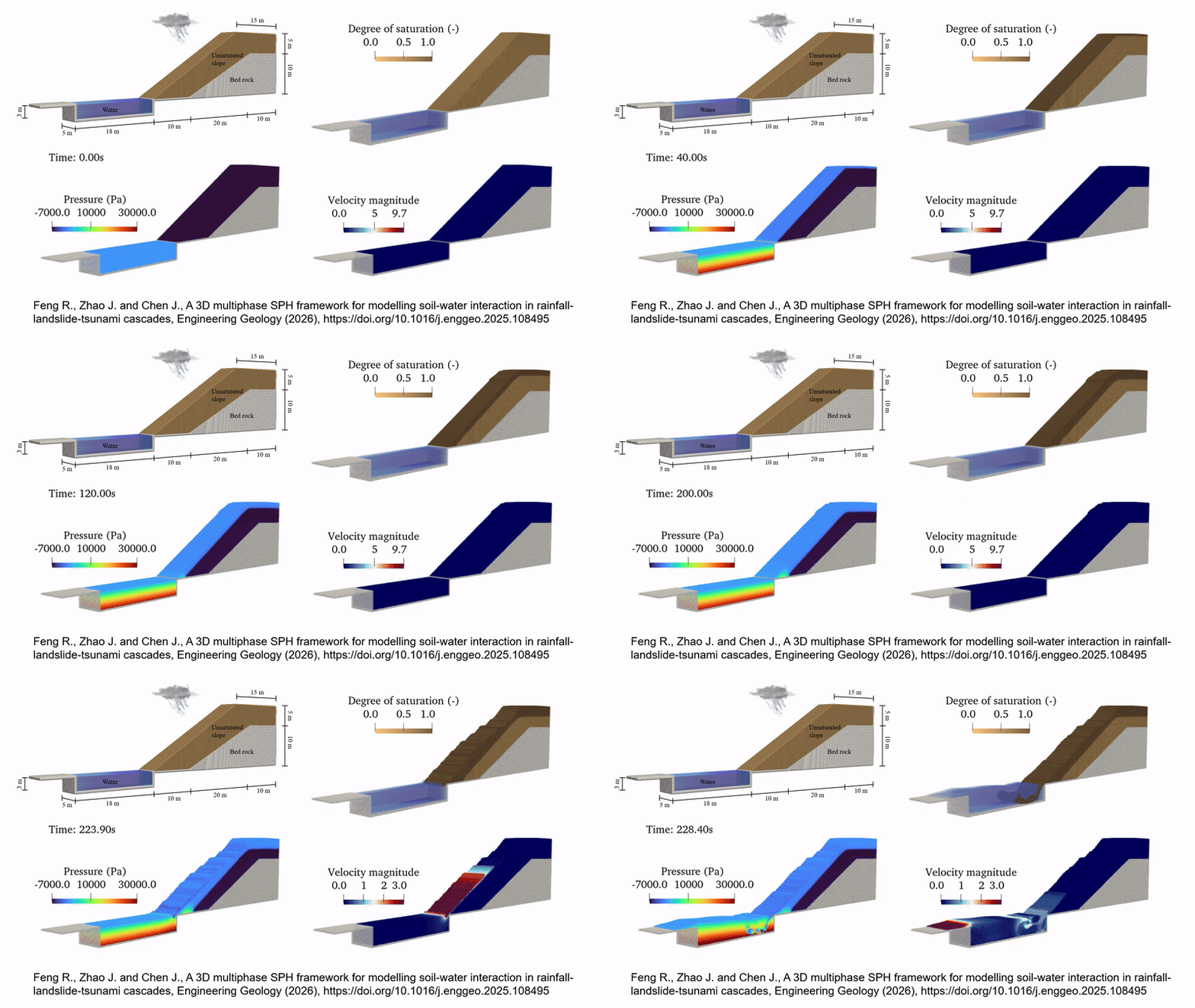
Ruofeng published new paper in Engineering Geology: "A 3D multiphase SPH framework for modelling soil-water interaction in rainfall-landslide-tsunami cascades." Multi-hazard cascades, like a heavy rainfall triggering a landslide, which then generates a tsunami, are among the most complex and destructive geophysical chains. Yet, modeling them has required fragmented approaches, simulating each hazard separately with significant empiricism and lost physics at the interfaces. This work introduces a unified, fully-coupled 3D Smoothed Particle Hydrodynamics (SPH) framework that captures the entire cascading process in a single simulation, from rainfall to the final landslide-induced flood.
Key innovations of the model: (1) Unified multiphase formulation: Integrates the "u-w-p" form of Biot's theory to model coupled pore water flow and soil deformation in saturated/unsaturated soils, alongside dynamic interaction with external water bodies. (2) Numerical density concept: A novel approach to mitigate instability at soil-water interfaces, ensuring smooth transitions. (3) Extended delta-SPH scheme: Delivers noise-free, stable pressure fields for both pore water and free-surface water flow. (4) Advanced 3D boundary treatments: Enables realistic simulation of triggers like rainfall infiltration and prescribed hydraulic conditions. (5) GPU-accelerated performance: Implemented in CUDA for large-scale 3D simulations with practical computation times.
Read this EG paper.
GeoDualSPHysics
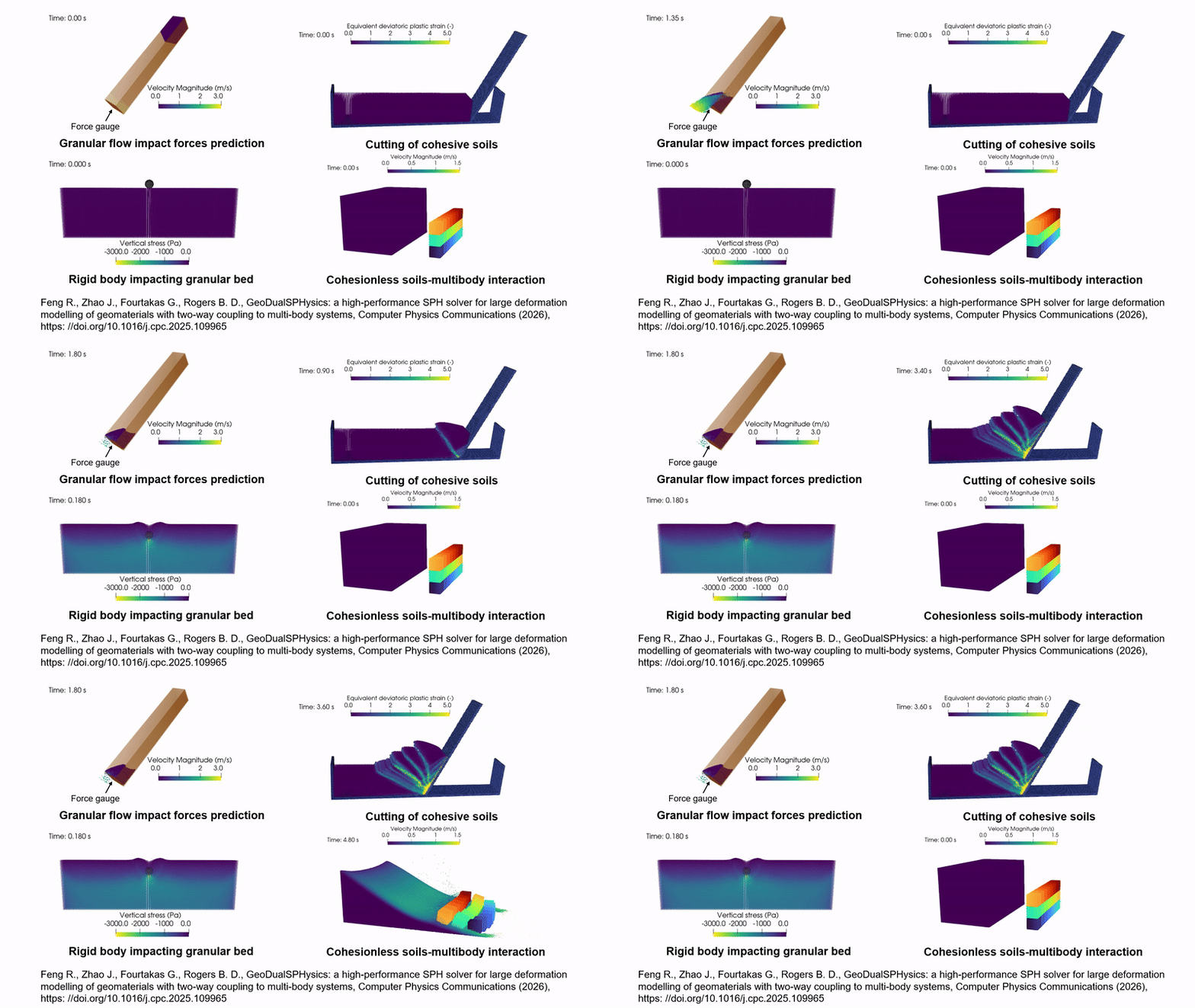
Ruofeng's new publication published in CPC: "GeoDualSPHysics: a high-performance SPH solver for large deformation modelling of geomaterials with two-way coupling to multi-body systems." Simulating large deformations in geomaterials, like landslides, debris flows, or soil-machine interactions, has long been challenging due to numerical instability, computational cost, and limited frameworks for coupling with moving structures. Our new opensource solver, GeoDualSPHysics, is designed to overcome these barriers. Built on the GPU-accelerated DualSPHysics framework, it introduces:
(1) A stabilized, noise-free stress treatment for accurate simulation of extreme deformations.
(2) First-order consistent solid boundary models (extended mDBC & cDBC) for reliable boundary resolution.
(3) Two-way coupling with Project Chrono to model interactions between geomaterials and multiple rigid bodies.
(4) High-performance GPU computation, enabling simulations with up to 86.7 million particles on a single GPU.
This tool opens new possibilities for high-fidelity simulations in geohazard analysis, terramechanics, and geotechnical operations. The open-source code is also released for the community to use, modify, and build upon.
Read this CPC paper.
Hybrid resolved/unresolved CFD-DEM modeling
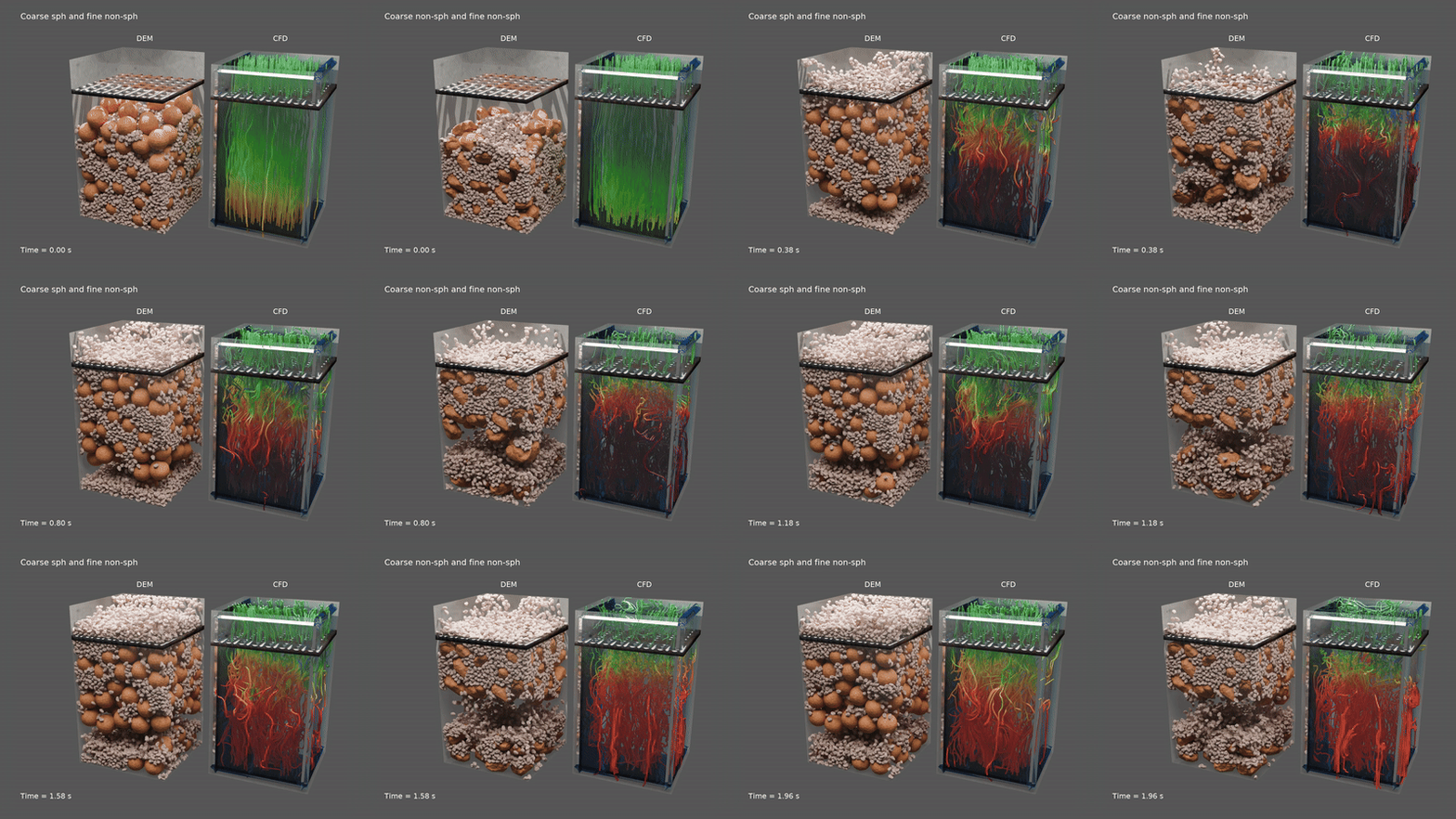
Hao and Shiwei's published new paper titled "Heterogeneous hybrid resolved-unresolved CFD-DEM coupling for fluid?particle interactions" in IJMS. Simulating the complex interplay between fluids and irregularly shaped particles, like real sand grains or industrial pellets, has long been a major computational challenge. Our team at HKUST has developed a novel hybrid framework that dynamically and intelligently switches between high-fidelity (resolved) and efficient (unresolved) coupling schemes based on the local particle size relative to the fluid grid. This "best of both worlds" approach optimizes computational resources without sacrificing accuracy with the following Key Innovations: (1) Shape-Aware DEM: Uses ray-tracing techniques for high-performance contact detection of arbitrarily shaped particles (even CT-scanned geometries!). (2) Robust Hybrid Coupling: A volumetric-weighted method ensures smooth momentum exchange between fluid and particles across different scales. (3) Heterogeneous CPU-GPU Acceleration: Leverages the strengths of both processors for maximum efficiency and scalability.
The framework has been rigorously validated against analytical solutions and experiments, and applied to challenging problems like fluid-driven clogging in gap-graded soils. It opens new doors for high-fidelity simulations in geomechanics, chemical engineering, and industrial processes. Shown animation above is a comparison of simulated internal clogging of (left) coarse spheres mixed with fine non-spheres, and (right) coarse non-spheres with fine non-spheres subjected to upwards flow from the bottom and a sieve from the top. We believe this work is a significant step forward for multiphase flow simulation.
Read this paper.
GPU-AMR for two-phase resolved CFD-DEM
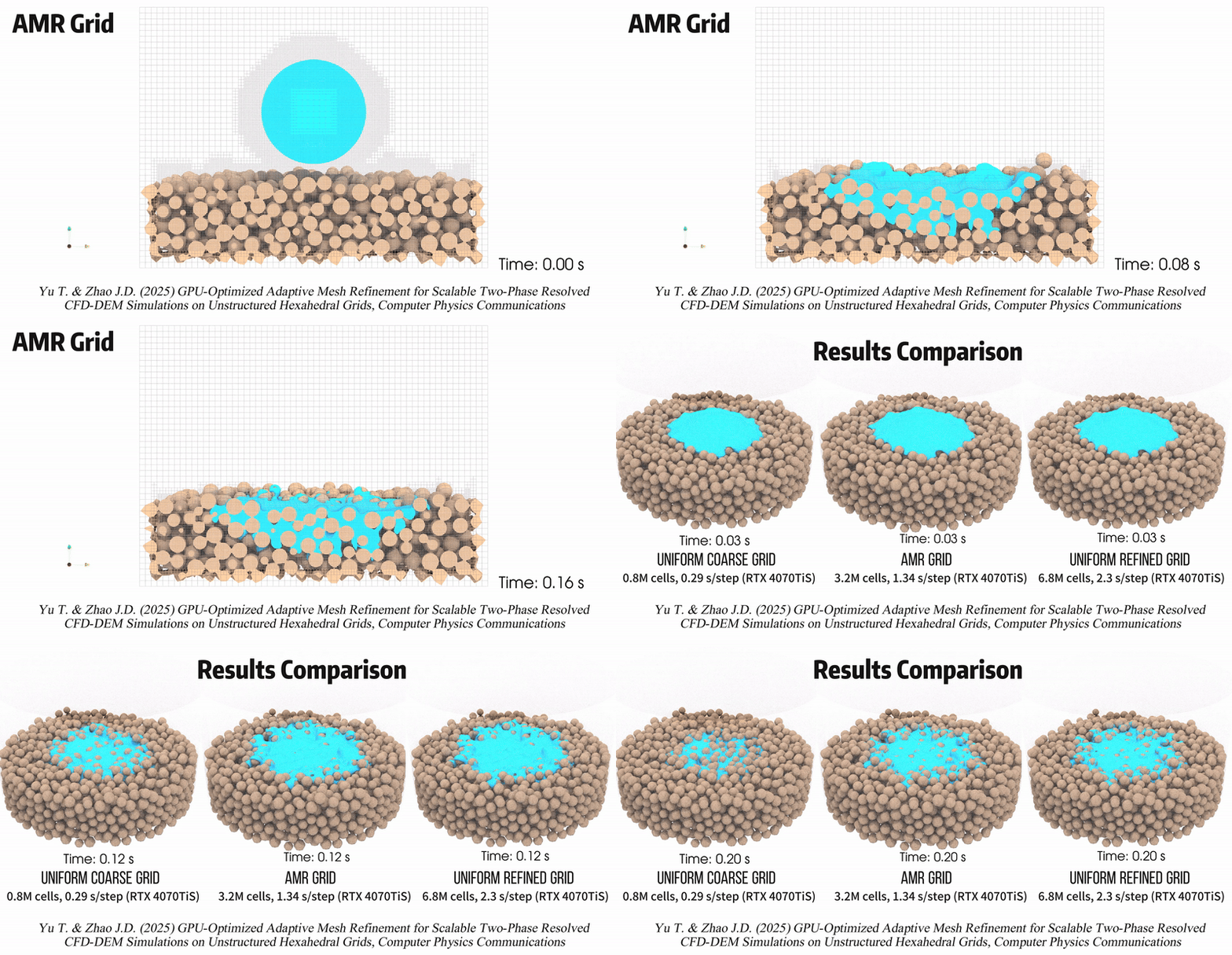
Tao's new paper accepted for publication in Computational Physics Communications: "GPU-Optimized Adaptive Mesh Refinement for Scalable Two-Phase Resolved CFD-DEM Simulations on Unstructured Grids." Simulating intricate interactions between fluids and particles, such as those found in powder-based 3D printing, can be computationally intensive and challenging. While Adaptive Mesh Refinement (AMR) is essential for achieving accuracy, traditional methods often create bottlenecks on modern GPU hardware, particularly when dealing with unstructured grids that represent real-world geometries. Our breakthrough in this study introduces a novel, GPU-native AMR algorithm that eliminates CPU-GPU transfers and significantly reduces grid management overhead, with the following key achievements: (1) Unprecedented Efficiency: Reduces AMR overhead to less than 25% of total simulation time. (2) Massive Speedup: Achieves over 20x acceleration in large-scale laser powder bed fusion simulations. (3) Accuracy Preserved: Produces results comparable to uniformly refined grids with approximately 50% less computational effort. (4) True Scalability: Demonstrates near-linear performance scaling, enabling extreme-scale simulations.
This work effectively bridges the gap between adaptive resolution and large-scale parallelism, paving the way for high-fidelity simulations of complex fluid-particle systems that were previously unattainable (see below simulation on a binder jetting featuring adaptive meshing applied to both the internal powder particles and the droplet interface).
Read this paper.
Stabilized explicit MPM for FSI simulations
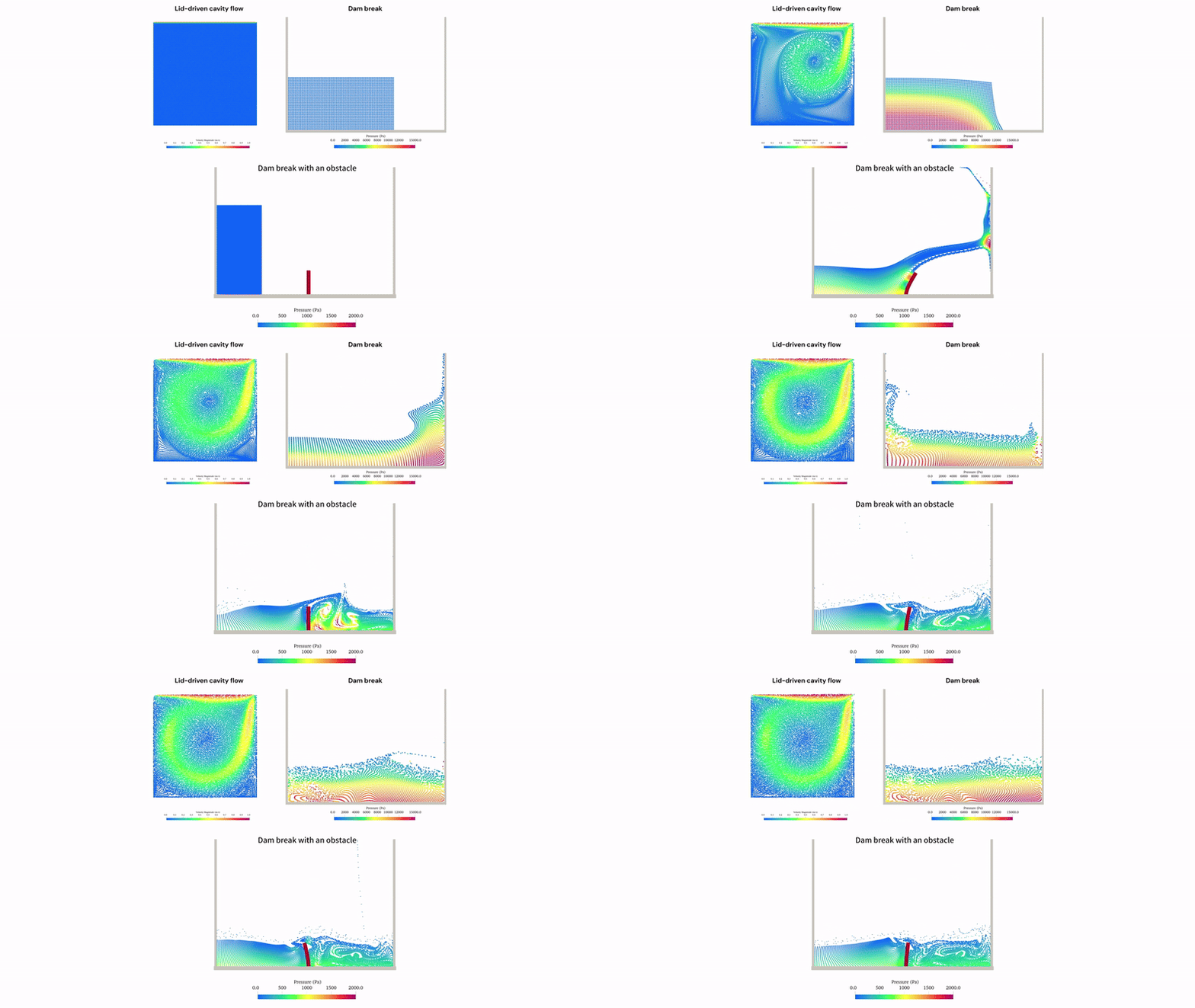
Zhang's got his first journal paper accepted by CMAME, titled "Stabilized Explicit Material Point Method for Fluid Flow and Fluid-Structure Interaction Simulations Using Dual High-Order B-Spline Volume Averaging". Simulating violent fluid-structure interactions (FSI), like water impacting flexible structures, is a major computational challenge. Traditional explicit Material Point Methods (MPM) often struggle with stability issues such as volumetric locking, cell-crossing errors, and excessive energy dissipation. To overcome these hurdles, we proposed a novel MPM framework featuring (1) Dual High-Order B-Spline Averaging to simultaneously smooths deformation and pressure fields to eliminate volumetric locking and cell-crossing instabilities; (2) Blended APIC/FLIP mapping to enhances energy conservation, enabling stable simulations even with coarse computational grids; and (3) A unified framework integrating delta-correction and specialized boundary handling for robust, high-accuracy modeling of free-surface flows and FSI.
We validated the method against classic benchmarks, from dam breaks to water impact on elastic obstacles (see animation below), and demonstrated a significant reduction in pressure oscillations and superior particle distribution compared to existing MPM approaches . This work establishes a more robust and efficient tool for tackling large-deformation problems in engineering, paving the way for more reliable digital twins in areas like offshore engineering and impact analysis.
Read this paper.
Fully coupled THMC MPM modeling of MHBS
Jidu Yu's new paper "A fully coupled THMC-MPM framework for modeling phase transition and large deformation in methane hydrate-bearing sediment" accepted for publication in JMPS.
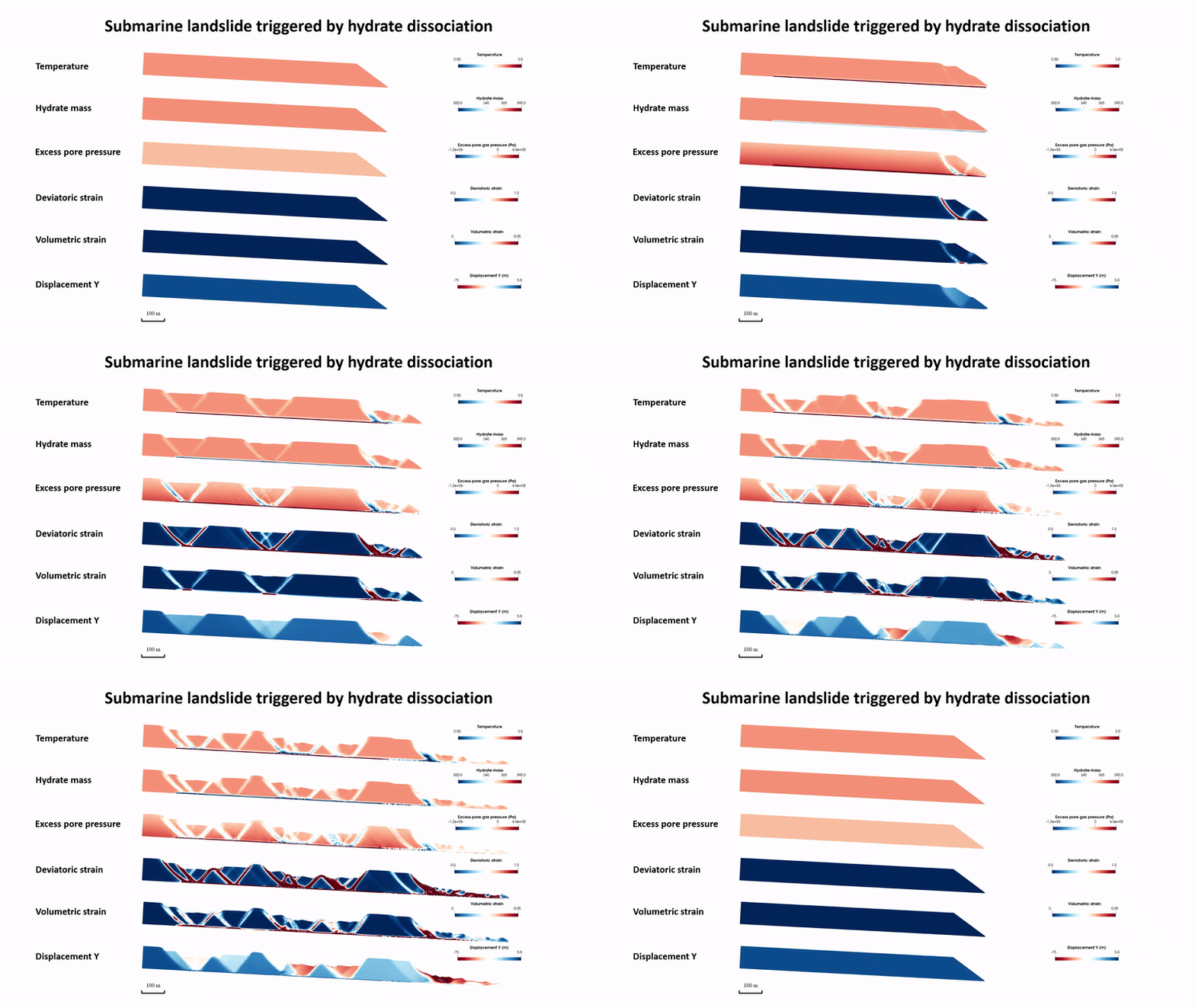
Methane hydrate-bearing sediments are a potential energy source but also a significant geohazard risk. Understanding how they fail?potentially triggering submarine landslides?is incredibly complex due to the interplay of mechanical stresses, fluid flow, heat transfer, and chemical reactions during hydrate dissociation. Our team developed a novel computational framework to tackle this challenge. Herein, we developed a Thermo-Hydro-Mechanical-Chemical (THMC) coupled model using the Material Point Method (MPM) to simulate everything from initial deformation to complete catastrophic failure. It features key innovations, including (1) Integrated dynamic phase transitions & large deformations, (2) mechanical degradation with hydrate saturation-dependent strength, and (3) A hybrid time integration scheme for computational efficiency.
Our simulations revealed that: (1) Shear dilation can create negative pore pressure, sucking heat and triggering dissociation right inside shear bands. (2) Shear heating from rapid deformation further promotes dissociation, creating a dangerous feedback loop that softens the sediment. (3) The progression of retrogressive slope failures is a complex dance between strength degradation, heat flow, and slope geometry (see animation). This work provides a powerful tool to assess geohazards and better understand the fundamental mechanics of these complex multiphase systems.
This is a collaborative work of our group with Prof Kenichi Soga of UC Berkeley who kindly hosted Jidu's research exchange early this year.
Read this JMPS paper.

Farewell and Welcome Members
A bittersweet and exciting time for our Lab! We recently gathered to bid a fond farewell to Dr. Tongming Qu, who has successfully completed his Research Assistant Professor (RAP) tenure at HKUST. We are incredibly proud as he moves on to his next chapter as a Full Professor at Wuhan University. Thank you, Tongming, for your tremendous contributions?we look forward to our continued fruitful collaborations and wish you every success!
Meanwhile we are thrilled to welcome brilliant new minds to our team. Please join us in welcoming: (1) New Postdoctoral Fellows: Dr. Jidu Yu (continuing with us!), Dr. Mengqi Wang (joining from Swansea University), and Dr. Shuaihao Zhang (joining from the University of Hong Kong). (2) New PhD Students: A warm welcome to Yibo Ma, Xiaoying Chen, Yuxuan Xia, Jiayu Lin, and Xiaodong Zhang. A special congratulations to Yibo Ma and Xiaonan Shang for being awarded the prestigious Hong Kong PhD Fellowship (HKPFS) this year!

Jidu Achieved Ph.D. Milestone
Thrilled to announce that Jidu Yu has successfully defended his PhD thesis with minor revisions! In his groundbreaking research titled "Multiscale Modeling of Coupled Thermo-Hydro-Mechanical Behaviour of Granular Media", Jidu developed advanced continuum-based MPM frameworks and innovative continuum-discrete MPM-DEM coupling approaches to model phase transitions and large deformations in frozen soils and methane hydrate-bearing sediments. Heartfelt thanks to the thesis committee for their invaluable insights: Prof. Johan Gaume (ETH), Prof. Xiaofang Zhou, Prof. Limin Zhang, Prof. Wenjing Ye, and Prof. Gang Wang.
Congratulations, Dr. Yu, on this extraordinary academic achievement and wish you a successful academic career from here !

Offered GIAN Course
Jidong has worked with Prof Ratna Kumar Annabattula of IIT Madras on the delivery of GIAN course on "Modelling and Simulations of Granular Materials" held in IIT Madras from 18-23 August 2025. GIAN refers to Global Initiative of Academic Networks sponsored by Ministry of Education of India. The 6-day course introduces basis and cutting-edge computational techniques on the modeling of granular materials such as powders, grains, and particles that are critical in industries from pharmaceuticals to additive manufacturing. It was attended by researchers, students and engineers. Jidong delivered his lectures online and appreciated Ratna for proposing this course and involving him.

News Coverage on our Research
We're delighted to share that Jeff Streeter recently interviewed Jidong about his new PNAS paper, resulting in a superb feature for Croucher News titled Predicting a Landslide. We're honored that this research has garnered significant media attention, with coverage including: HKUST News, Croucher News, Eurek Alert, Science Daily, Phys.org, Tech Post and Science, 紫荆号, 新浪网, 香港新闻网(香港中通社), 點新聞 广州日报(大洋网).

Editorial board for Computational Particle Mechanics
Jidong has been invited to join the editorial advisory board of Elsevier journal Computational Particle Mechanics (CPM) (formerly Springer Nature). CPM focuses on the modeling and simulation of systems involving particle mechanics and particle-based methods, aligning well with the research thrusts of our Lab. We appreciate the EICs Prof Eurenio Onate and Prof Tarek Zohdi for the kind invitation. Look forward to working with you and the eminent editorial board to advance research on computational particle mechanics.

ASCE R10 Distinguished Lecture
Jidong has been invited to give the ASCE Region 10 Distinguished Lecture online on 18 June 2025, entitled "Modeling geotechnical failures and geohazards". I am grateful for Dr Chao Li and ASCE R10 for the kind invitation. It was a great to see 140+ audience attending the online event and the ensuing stimulating discussions. Thank Prof Jian Chu of NTU for staying through the seminar and for your insightful questions. See detail of the lecture in ASCE Announcement.

New MPM paper in CMAME
Jidu's new paper has been officially published in CMAME where we present a new fractional step MPM formulation for modeling compressible fluid-driven porous media under full thermo-hydro-mechanical coupling. We address limitations of traditional methods by incorporating fluid compressibility and thermal expansivity via a node-based implicit scheme to improve stability and efficiency. This advance bridges critical gaps in simulating multiphysics-coupled system. The above animation shows its prediction of retrogressive failure of a saturated slope with sensitive clay. Read the MPM paper.

Plenary keynote at Coupled 2025
Jidong has given a plenary keynote lecture titled "Multiscale modeling of coupled thermo-hydro-mechanical problems in granular media" at Coupled Problems 2025 (Coupled2025) taking place on the beautiful island of Sardinia from May 25-28, 2025. Thank the organizers for kind invitation. Changyi has won a competitive travel grant award from the conference and has given an excellent talk on his recent work of unified peridynamic modeling of fluids and solids. Well done, Changyi!

New JFM paper
Changyi published a new paper in Journal of Fluid Mechanics where we present a peridynamics-based computational approach for modeling coupled fluid flow and heat transfer problems! It features a new thermo-hydrodynamic model using a semi-Lagrangian scheme and multi-horizon techniques to enhance accuracy and stability. Validation through various benchmarks demonstrates its effectiveness in capturing complex thermal flow patterns. This work lays the groundwork for a unified peridynamics framework for advanced multiphysics analysis of thermal fluid–solid interactions involving fractures in the future. Shown animation is the Rayleigh-Bnard convection. Read the JFM paper.

PNAS!
We’re excited to share our latest research: “Micromechanical modeling of triphasic granular media”, now published in Proceedings of the National Academy of Sciences (PNAS)! In this work, we developed PUA-DEM, a groundbreaking computational framework that unifies pore-scale hydromechanics with discrete element modeling (DEM). This allows us to: (a) Resolve air-water interfaces, capillary forces, and grain dynamics in unprecedented detail; (b) Simulate complex phenomena like viscous fingering, confined granular swelling, and wetting-induced collapse (see animations below); and (c) Bridge microscale interactions to predict macroscopic behavior in unsaturated soils and powders. Key insights offered by the study: (1) How capillary forces and saturation govern granular deformation? (2) Why confined swelling triggers stress localization and fabric anisotropy? (3) The role of pore-scale fluid redistribution in triggering landslides or stabilizing slopes. This is a work in collaboration with former PhD Amiya and Dr Thomas Sweijen of Utrecht University. Read this paper. News coverage of the study: Phys.org, EurekAlert, Science Daily, Tech and Science Post, HKCNA, Sina.com, Bauhinia Magazine, HKUST News.

GPU-MPM
New MPM study by Hao and Shiwei for simulating complex granular flows published in Computers and Geotechnics! The study introduces a sparse-memory-encoding framework that overcomes efficiency limitations in large-scale simulations caused by GPU computing's reliance on contiguous memory distribution. We present a novel atomic-free dual mapping algorithm and an efficient memory shift algorithm that optimizes memory usage for material properties. This framework seamlessly integrates various material models and accommodates diverse boundary conditions, enabling effective and efficient modeling of large-scale real-world problems like landslides. Here is a simulation of the GPU-MPM for the Baige Landslide, which occurred in Tibet, China, in 2018, resulting in a debris flow of 27.5 million cubic meters into the Jinsha River, cutting it off, and forming a gigantic barrier lake which breached later. This simulation used 4.1 million MPM points and 100,000 time steps and ran for 46 minutes on a desktop server with an RTX 4070 Ti. Read the paper.

Machine learning for granular mechanics
In his new CMAME paper, Shiwei introduces an innovative deep learning model, the Temporal Graph Neural Network-based Simulator (TGNNS), for granular materials. By constraining physical information flow, TGNNS enhances particle dynamics representation and demonstrate exceptional robustness and efficiency. It is rigorously trained and validated with data from a hierarchical multiscale modeling approach that combines the Material Point Method (MPM) and Discrete Element Method (DEM), and operates 100 times faster than traditional numerical simulations using state-of-the-art GPU-based DEMPM. Additionally, TGNNS excels with diverse datasets, even under complex boundary conditions. This new approach advances our understanding of multiscale behaviors in granular materials and paves the way for enhanced physics-based modeling in digital twins. Read the paper.
2024

Prof Charley Wu Visits HKUST and Lab
It was a great pleasure to host Prof Charley Wu from University of Surrey for his seminar in our Department at The Hong Kong University of Science and Technology. In his talk titled "Modelling cohesive powder behavior: a DEM approach", Charley shared his latest research and insights on how to model particulate cohesions in DEM originated from Van der Waals forces, electrostatic force, and liquid bridges, as well as deformable particles. He engaged in stimulating discussions with our colleagues and students. Thank you, Charley, for your time and visit, and your generous gift of your book on "Particle Technology and Engineering". We look forward to meeting you again soon on a future occasion.

Honored by Tsinghua University
Jidong has been honored to be appointed as a Distinguished Visiting Professor by his alma mater, Tsinghua University. He gave his inaugurated talk entitled "Progress and Challenges in Computational Geomechanics" at Tsinghua on 25 Nov 2025 and engaged stimulating discussions with faculty members and students!

Jidu visiting UC Berkeley
Jidu has arrived in University of California, Berkeley for a six-month research visit. Thank you Prof Kenichi Soga for hosting his visit. Hope Jidu's visit will be fruitful in fostering the collaboration between UCB and HKUST on MPM modeling and also be productive in pushing the research front on thermo-hydro-mechanical coupling of climate-change-sensitive granular soils!

Jidong delivered keynote at
Jidong delivered a keynote titled "High-Fidelity Simulations of Complex Particle-Fluid Interactions in Granular Media" at the 5th Aspheric & CFDEM Conference held in Vienna, Austria, from 25-27 Sept 2024. It was an incredible opportunity to connect with both academia and industry, showcasing the growing need for advanced particle modeling among leading industrial companies like BASF. A heartfelt thank you to Christoph Kloss and Christoph Goniva of DCS Computing GmbH for inviting me to this fantastic event. Vienna was beautiful, and the conference banquet was in the prestigious Kunsthistorisches Museum.

New project, big opportunities
Exciting opportunities to join us and work to shape the future with a next-generation digital twin coast for Hong Kong and the world! We are seeking capable research students and postdoc fellows to contribute to a groundbreaking project focusing on predicting and managing coastal hazards during extreme weather events (see HKUST News Release).
Coastal cities like Hong Kong face increasing vulnerability to typhoons, storm surges, and overtopping waves. This project aims to address the challenges by utilizing cutting-edge digital and computational methods, physical sensing, data science, and high-performance computing to model and predict complex coastal geosystems. Our goal is to provide precise predictions and support informed decision-making for hazard resiliency design and management during extreme storm surges.
Joining our team means delving into the mechanisms of wind-wave-soil-pore water-structure interactions across various scales. You will also have the opportunity for interdisciplinary supervision in data science and machine learning as well to develop advanced techniques for evaluating and improving the safety, resilience, and sustainability of coastal cities like Hong Kong against extreme storm surges.
To apply, please send your updated CV and a brief statement of interest to me.

Optimizing 3D Printing for L-PBF
Keyhole-induced porosity poses significant challenges for laser powder bed fusion (L-PBF) in additive manufacturing. Optimizing printing strategies routinely relies on trial and error. New paper published by Tao Yu in hashtag#AdditiveManufacturing journal introduces an optimization strategy that adjusts laser power based on insights into keyhole fluctuation mechanisms gained through high-fidelity numerical simulations. It identifies five stages of keyhole pore formation and suggests that reducing laser power during the initial "J"-like keyhole formation can enhance process stability. We propose adaptive indices to quantify keyhole fluctuations and predict the onset of this formation with demonstrated examples. Read the paper.

Newly minted Ph.D. and new Lab members
KU Quan has successfully passed his PhD defence and became a newly minted doctor for our Lab. Best luck for your future career, Quan! (30 August 2024)
We warmly welcome two new members, Dr Mengli LI from Tongji University and Dr Ruofeng Feng from Manchester University, joining our Lab as postdoctoral fellows! (Oct and Nov 2024).
Seminars at Peking University and Dalian University of Technology
It was a honour to present two talks recently. The first one was presented at Peking University on "Multiphysics, multiscale computational mechanics of granular media" on 24 July 2024 and thank Prof Caishan Liu for your kind invitation on the talk. The second one was arranged by Prof Degao Zou of Dalian University of Technology on "Recent advances and challenges on computational geomechanics" on 9 August 2024. Thank you Prof Zou for the invite.
Keynote at ISL2024 and talk at SANDLESS
Exciting times at the 14th International Symposium on Landslides (ISL 2024) in Chambery, France, 8-12 July 2024, where I presented my keynote on "High-fidelity modeling of debris flow and its impact on flexible barriers." Huge congrats to Véronique Merrien and François Nicot for orchestrating a fantastic conference that brought together top-notch researchers and practitioners on landslides and geohazards. Grateful for the opportunity to share my research and engage with such an enthusiastic audience.
I earlier also had the pleasure of participating in the "SANDLESS" workshop in Sydney from 1-4 July, where I presented on "Peridynamic modeling of multi-physics problems in rock mechanics." A big thank you to Itai Einav and Max Wiebicke for their dedication in organizing this exceptional workshop filled with stimulating discussions at the beautiful Q Station.
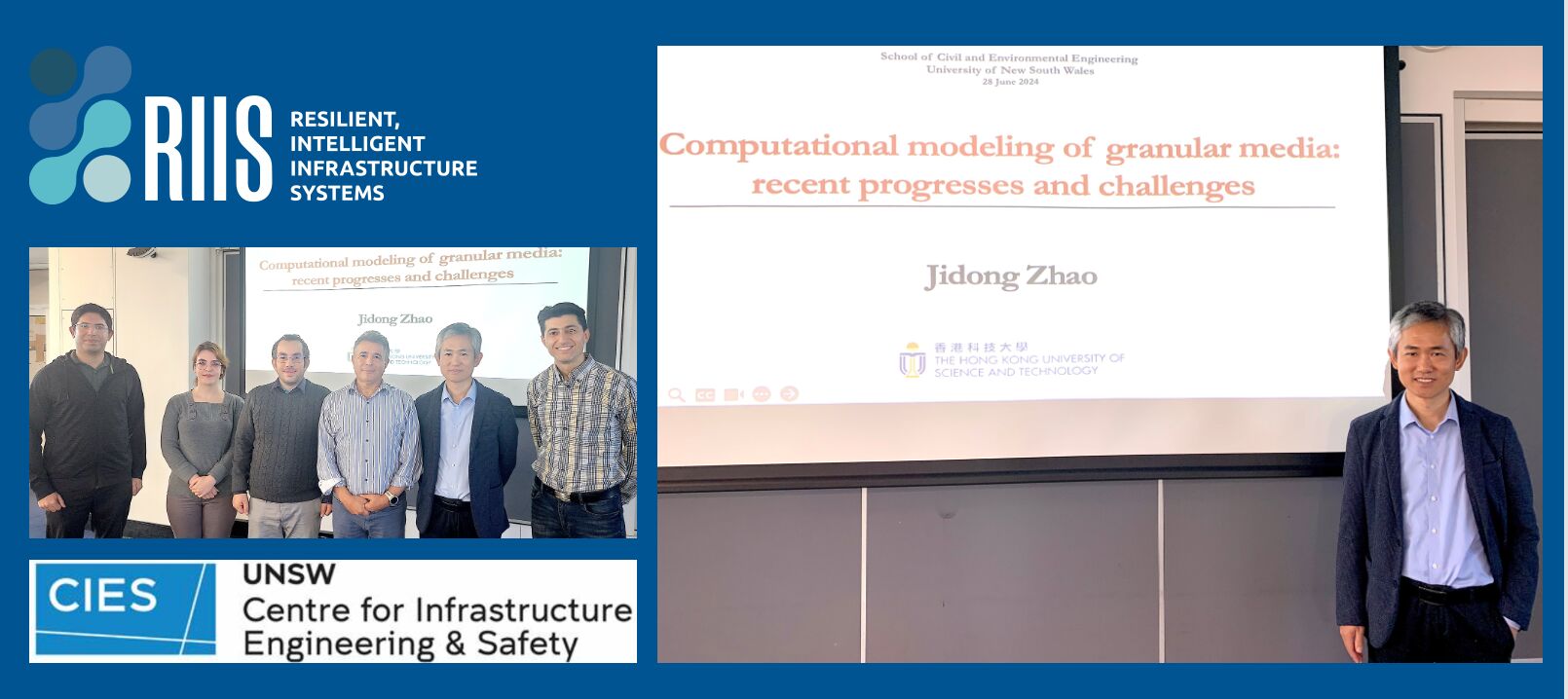
Seminar at UNSW
It was a honour and pleasure to present a seminar on "Computational modeling of granular media: recent progresses and challenges" at the Centre for Infrastructure Engineering and Safety of UNSW, Sydney, Australia, on 28 June 2024. Thank you Prof Nasser Khalili for kindly arranging this opportunity for me. It was great to meet and engage stimulating discussion with colleagues at the RIIS Hub.
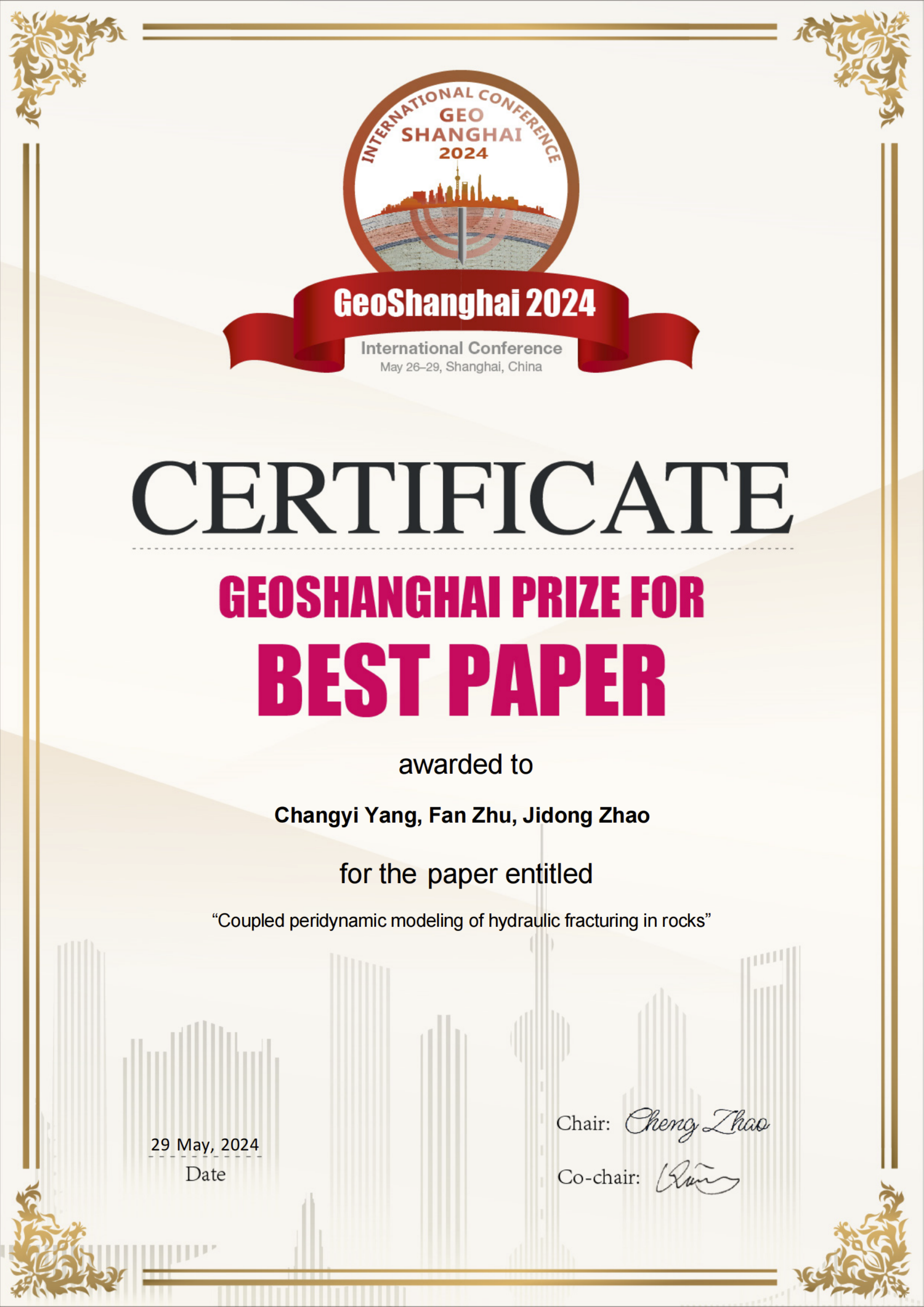
GeoShanghai Best Paper Award
Congratulations to Changyi for winning the GeoShanghai Best Paper award for his paper titled "Coupled peridynamic modeling of hydraulic fracturing ni rocks" presented at GeoShanghai 2024 held in Shanghai.
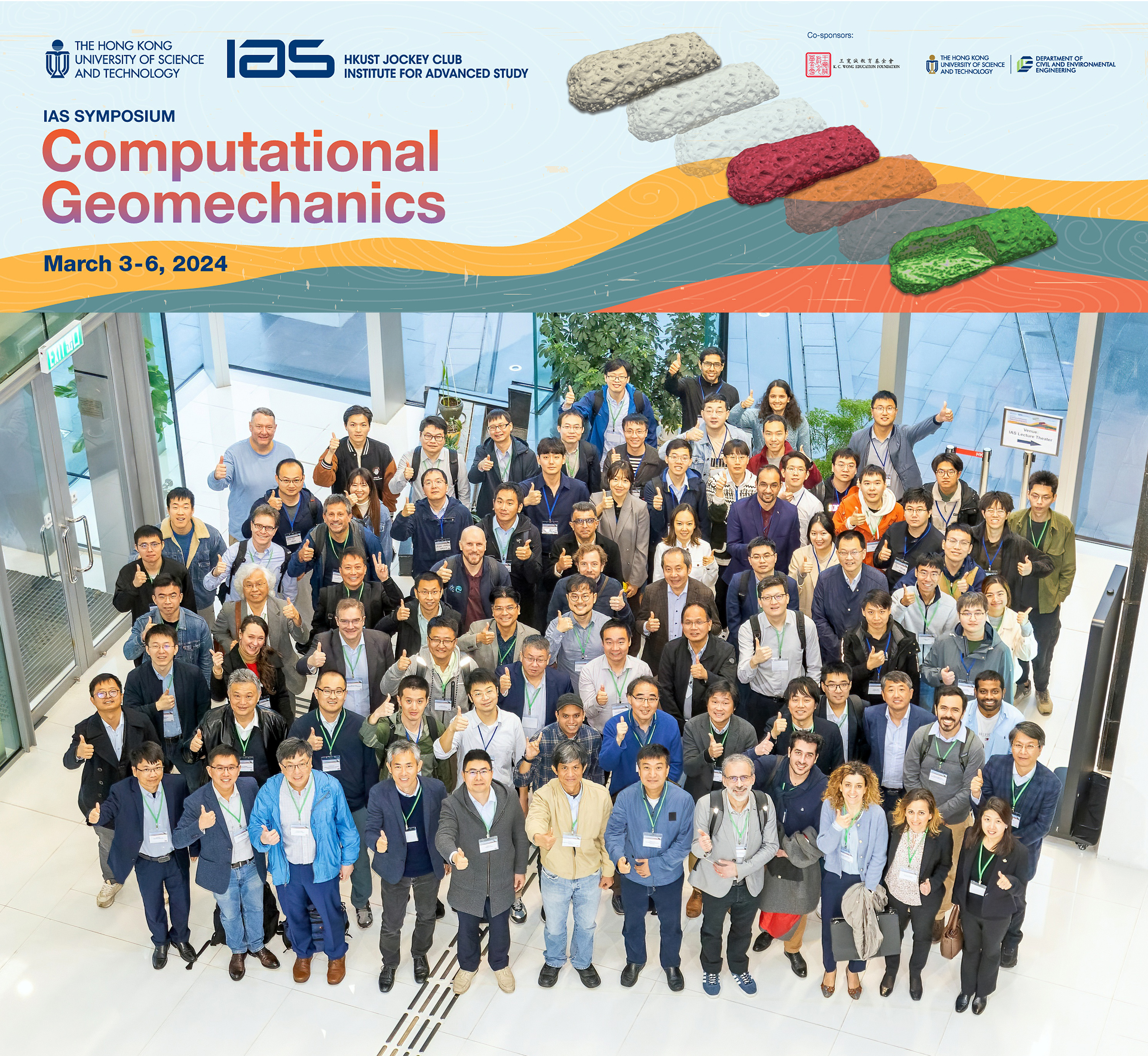
IAS Conference on Computational Geomechanics
We have successfully held IAS Symposium on #Computational #Geomechanics (CG2024) at HKUST from 3-6 March 2024. The event gathered 65 world leaders to discuss cut-edge research and challenges on computational geomechanics. The four-day event was intense, stimulating, and thoroughly enjoyable, attracting 160+ audience. The younger generation of students and researchers felt tremendously inspired by all talks, open discussions, and critical opinions. We thank all speakers for being such an inspiration. We would also like to acknowledge the meticulous work of Nancy of IAS and the supporting team in making the event a success. Special thanks to our Dean, Prof Hong K. Lo, for taking time out of his busy schedule to give the opening speech. We wish to express our gratitude to our sponsors, including the Institute for Advanced Study, the Department of Civil and Environmental Engineering, the Global Engagement and Communications Office of The Hong Kong University of Science and Technology, and the K.C. Wong Education Foundation. The conference was supported by TC103 and TC105 of International Society for Soil Mechanics and Geotechnical Engineering (ISSMGE). The program also featured an award ceremony session for presenting Scott Sloan Best Paper Awards by Computers and Geotechnics, Elsevier. See more information on the webiste: CG2024.

New Lab Member
We warmly welcome two new members, Dr Deyun Liu and Dr Hao Chen, joining the Lab. Deyun has been appointed as VPRDO Research Assistant Professor, and Hao works with us as a postdoc fellow. Welcome both.
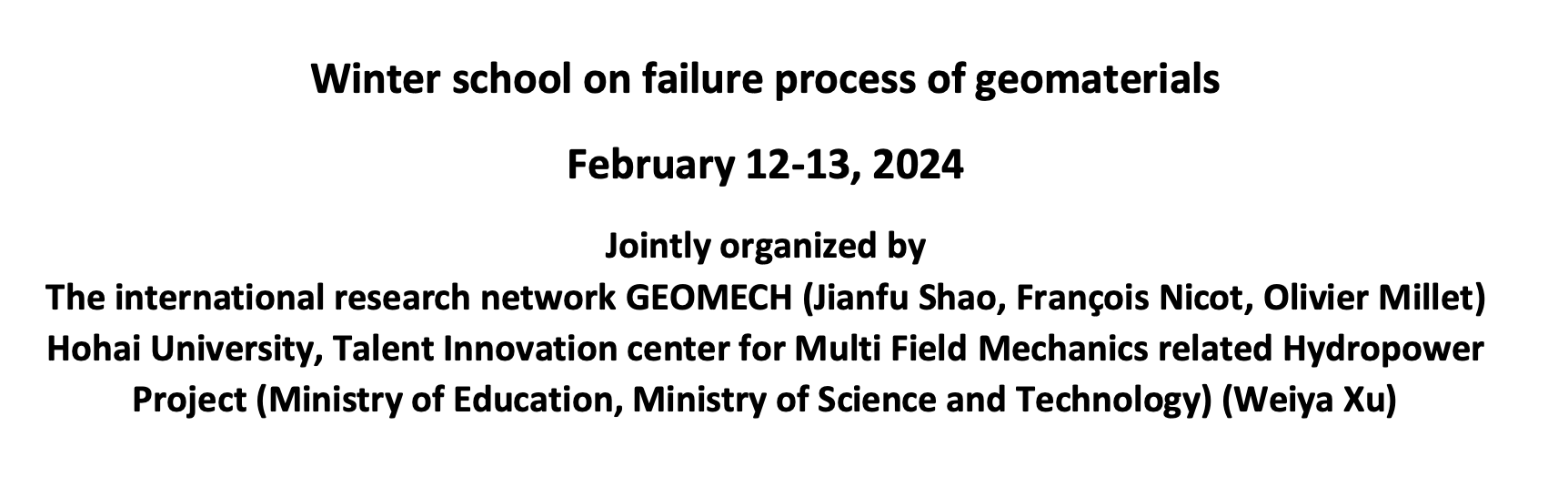
Invited online lecture at IRN Winter School
Jidong was invited to give an online lecture entitled "Computational Modeling of failures in granular materials subjected to thermo-hydro-mechanical loads" at the International Research Network GEOMECH (IRN) 2024 Winter School on Failure Process of Geomaterials, organised by Profs. Jianfu Shao, Francois Nicot, and Olivier Millet, from 12-13 Feb 2024. Ohter lecturers include Nicolas Moes, Jean Sulem, Djimedo Kondo, and John Rudnicki.
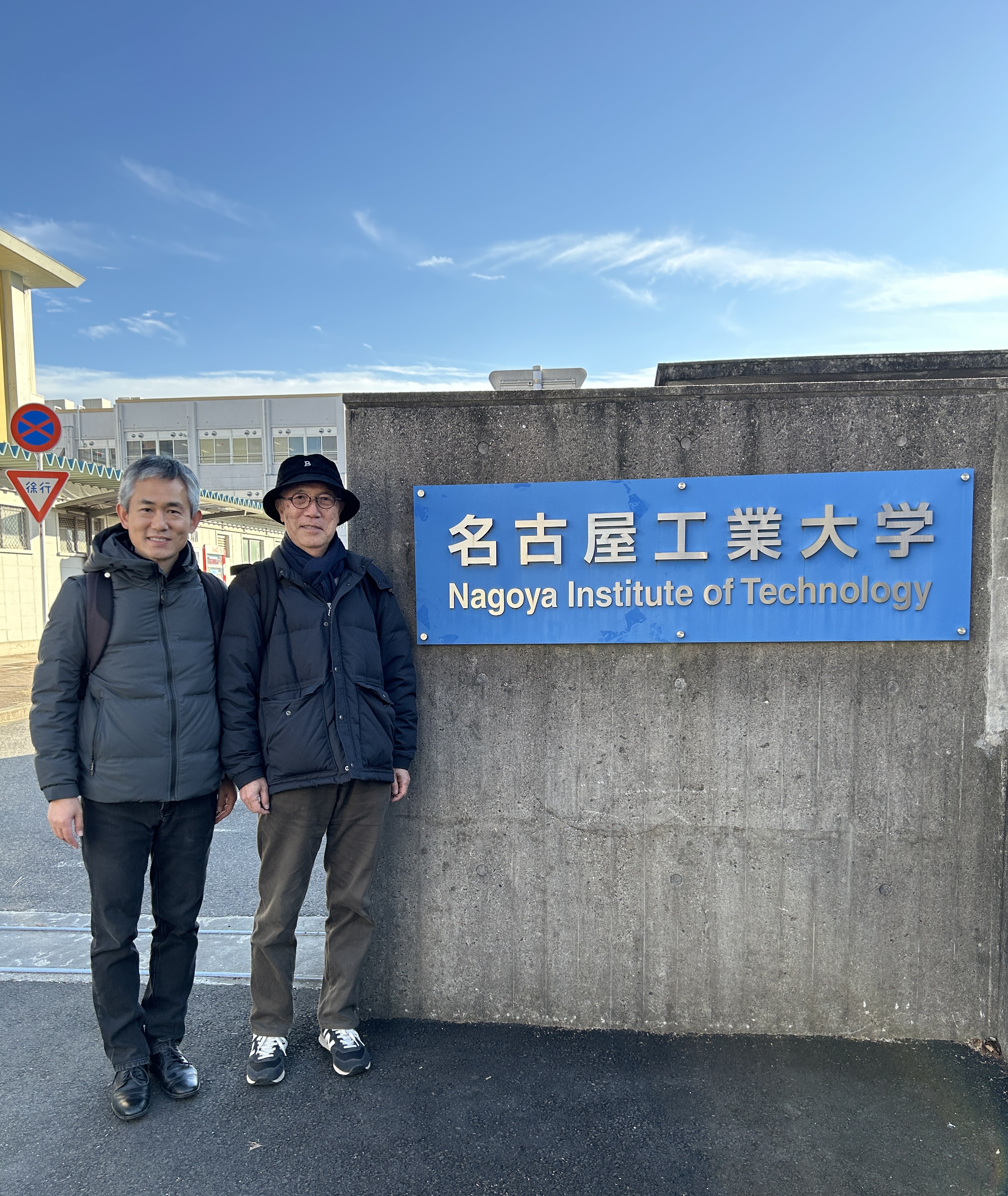
Visiting Nagoya Institute of Technology
Jidong paid a visit to Nagoya Institute of Technology on 2 Feb 2024, meeting geo-legend Prof Teruo Nakai and giving a lecture on "Multiphase, multiphysics modelling of debris flows and countermeasures". Thank Prof Yosuke Higo and Prof Hiroyuki Kyokawa for arranging this last one of five talks over Jidong's JSPS fellowship stay in Japan.
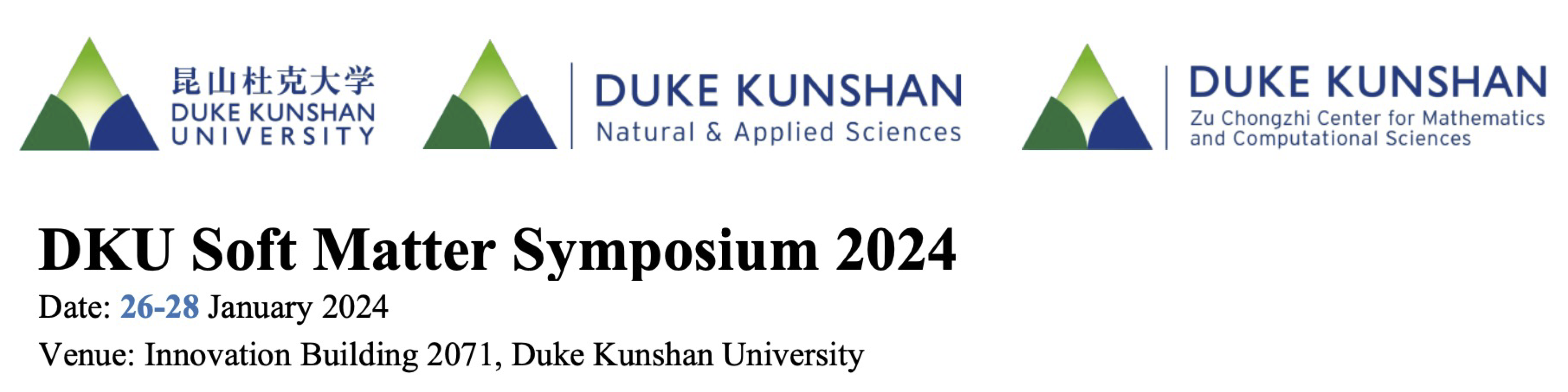
Talk at DKU Soft Matter Symposium
Jidong was invited to give a talk (onlin) entitled "Challenges and Implications of Grain Shape Modeling for Granular Media" at 2024 DKU Soft Matter Symposium held at Duke Kunshan University from 26-28 Jan 2024. It was great to talk and discuss with speakers working on crossdisciplinary areas of soft matter. Thank Prof Kai Huang for the kind invitation.
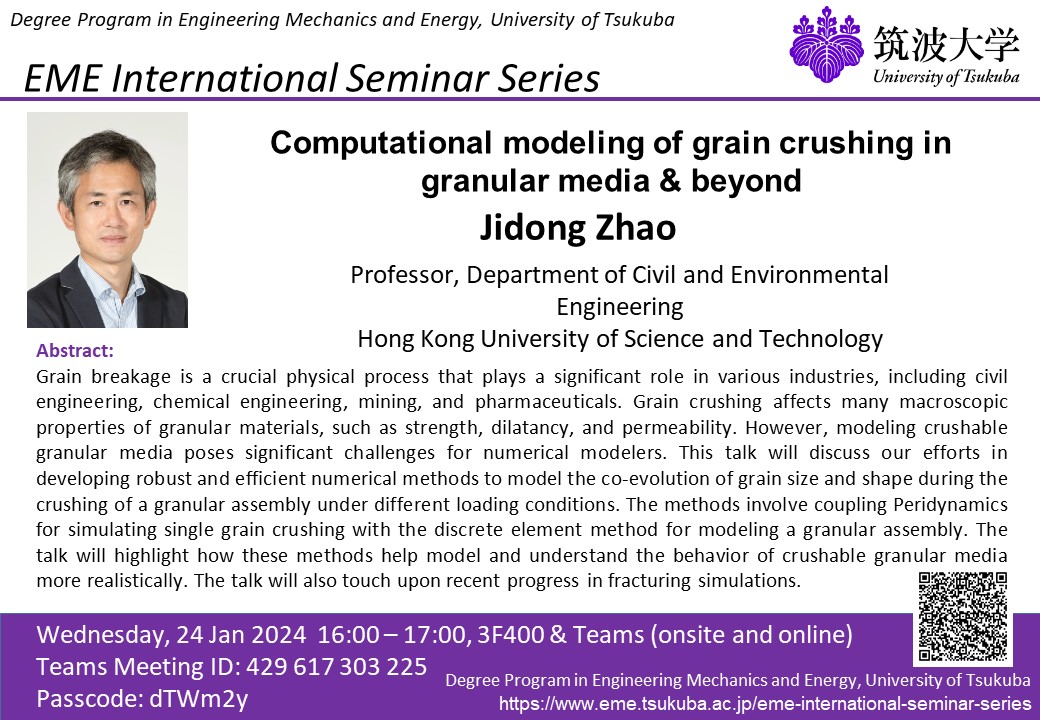
Visit to University of Tsukuba
Jidong visited University of Tsukuba on 24 Jan 2024 and gave an EME International Seminar entitled "Computational modeling of grain crushing in granular media and beyond". Thank Prof Takashi Matsukuma for inviting and hosting the talk.Jidong is also grateful to Professor Yosuke Higo for his generous time and efforts in arranging series talks for Jidong.
JGS TC103 Seminar
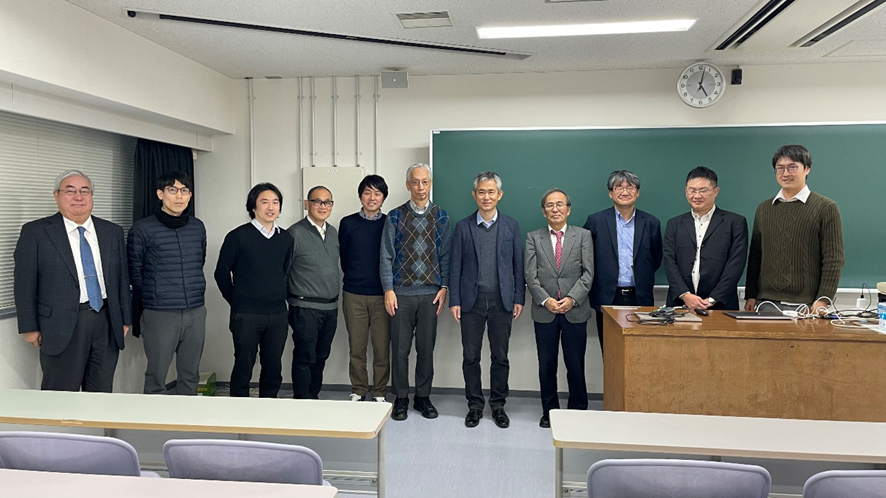
Jidong was invited by Japanese Geotechnical Society TC103 supporting committee to give a TC103 seminar entitled "Current and future challenges for computational geomechanics" in Kyoto on 22 Jan 2024. Thank Prof Murakami and JGS colleagues for providng such an opportunity. It was glad to meet Prof Fusao Oka in Kyoto too.
Invited Lecture at Kyoto University
Jidong was invited by Prof Yosuke Higo to give a lecture entitled "MPM for multiphysics and multiscale geotechnical problems" in his department at Kyoto University on 9 Jan 2024. It was great to have engaged stimulating disucssions with his colleagues and students.
Co-Editor-in-Chief for Computers and Geotechnics
Jidong is honoured to have been appointed to be Co-Editor-in-Chief for Computers and Geotechnics from 2024. We thank Prof Hywel R. Thomas for his exceptioanl services as Editor-in-Chief for the past years that has led the journal to new heights and become most popular geotechnical journal in our communicty. Look forward to working with the editor team and all our authors and reviewers on continuously developing the journal.
2023
Visiting Kyoto University
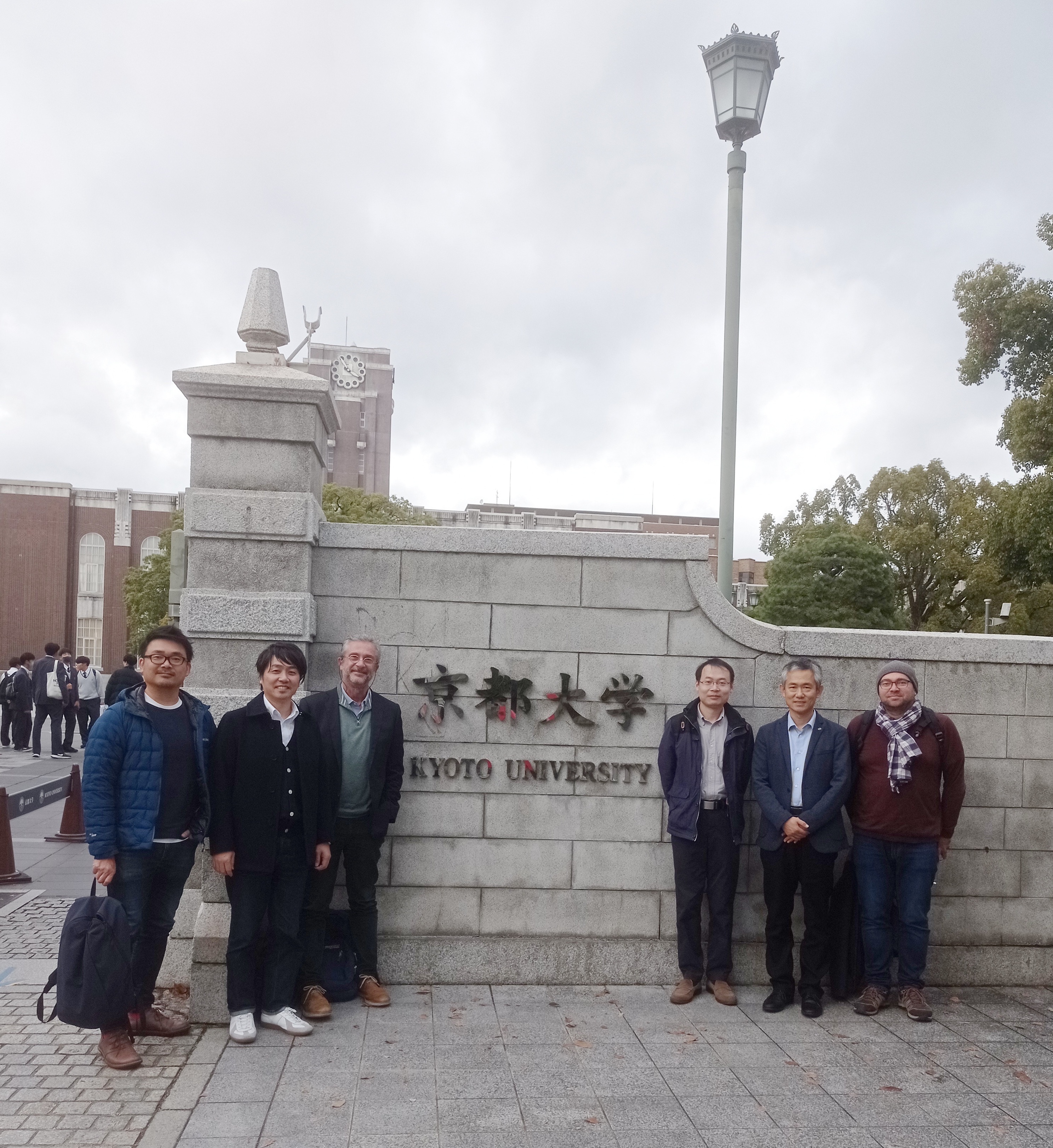
I am priviledged to have received a JSPS Invitational Fellowship to support me for a two-month researhc visit to Kyoto University from Dec 11. Thank Prof Yosuke Higo for hosting me and Dr Fan Zhu for all the supports. I am grateful for Japanese Geotechnical Society TC105 and TC103 for organising public seminars during my visit. Also great to catch up with Prof Cino Viggiani at Kyoto University.
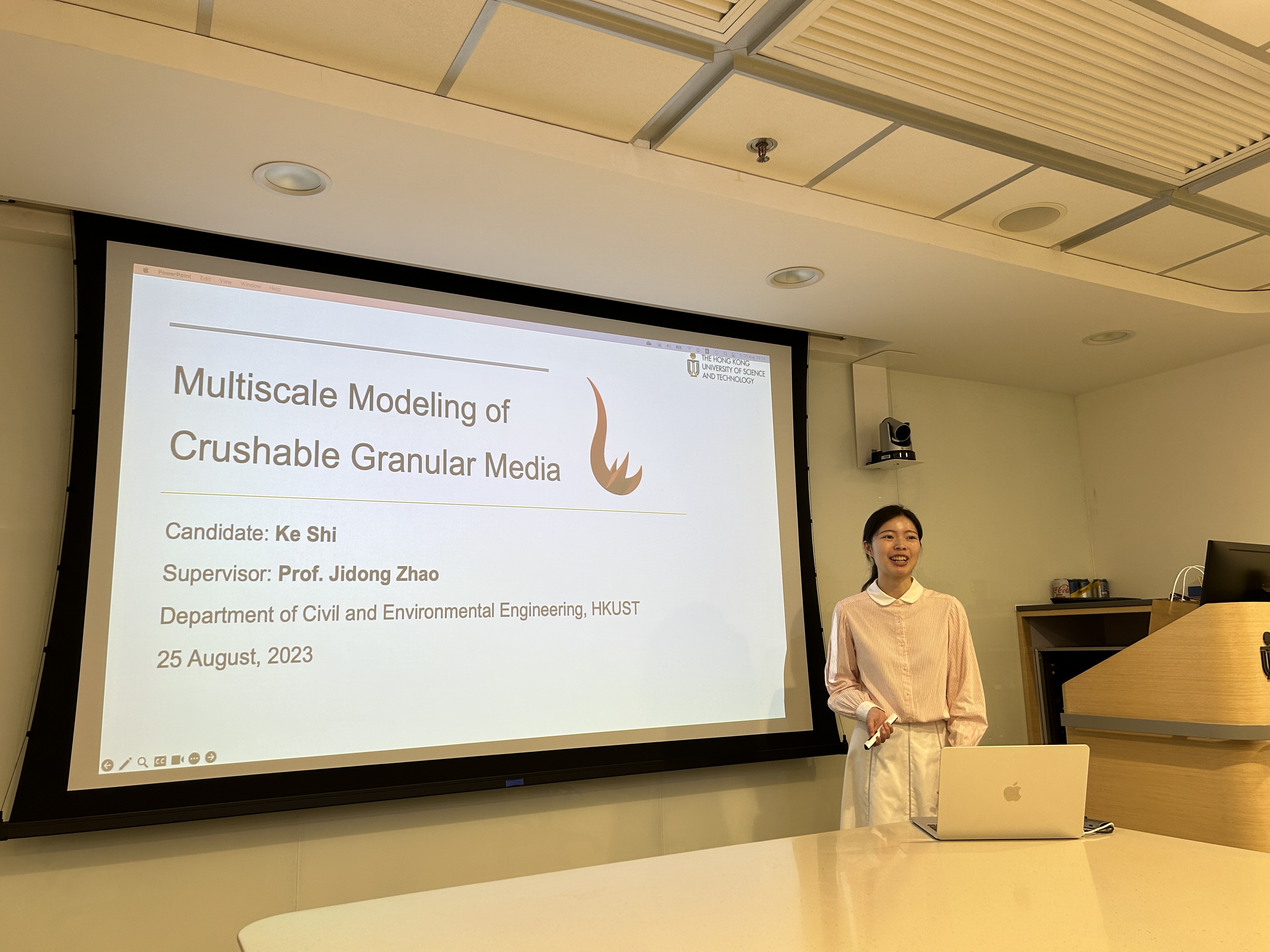
SHI Ke successfully passed PhD defence
SHI Ke has successfully passed her Ph.D. defence today on thesis entitled "Multiscale Modeling of crushable granular media". She developed advanced numerical methods to examine the shear behavior of granular sand under general loading conditions and put a focus on exploring the critical state characteristics of crushable sand. She has also devoted a study on the role of grain crushing on triggering earthquake at fault gauge. Thank you Ke for working with me. Wish you all the best for your future career.
New Lab Member
We warmly welcome three new members, Wentao WANG, Zheng CHENG, and Anjan Rajapakse, joining the Lab as research students. Look forward to an exciting and fruitful journey with all of you.
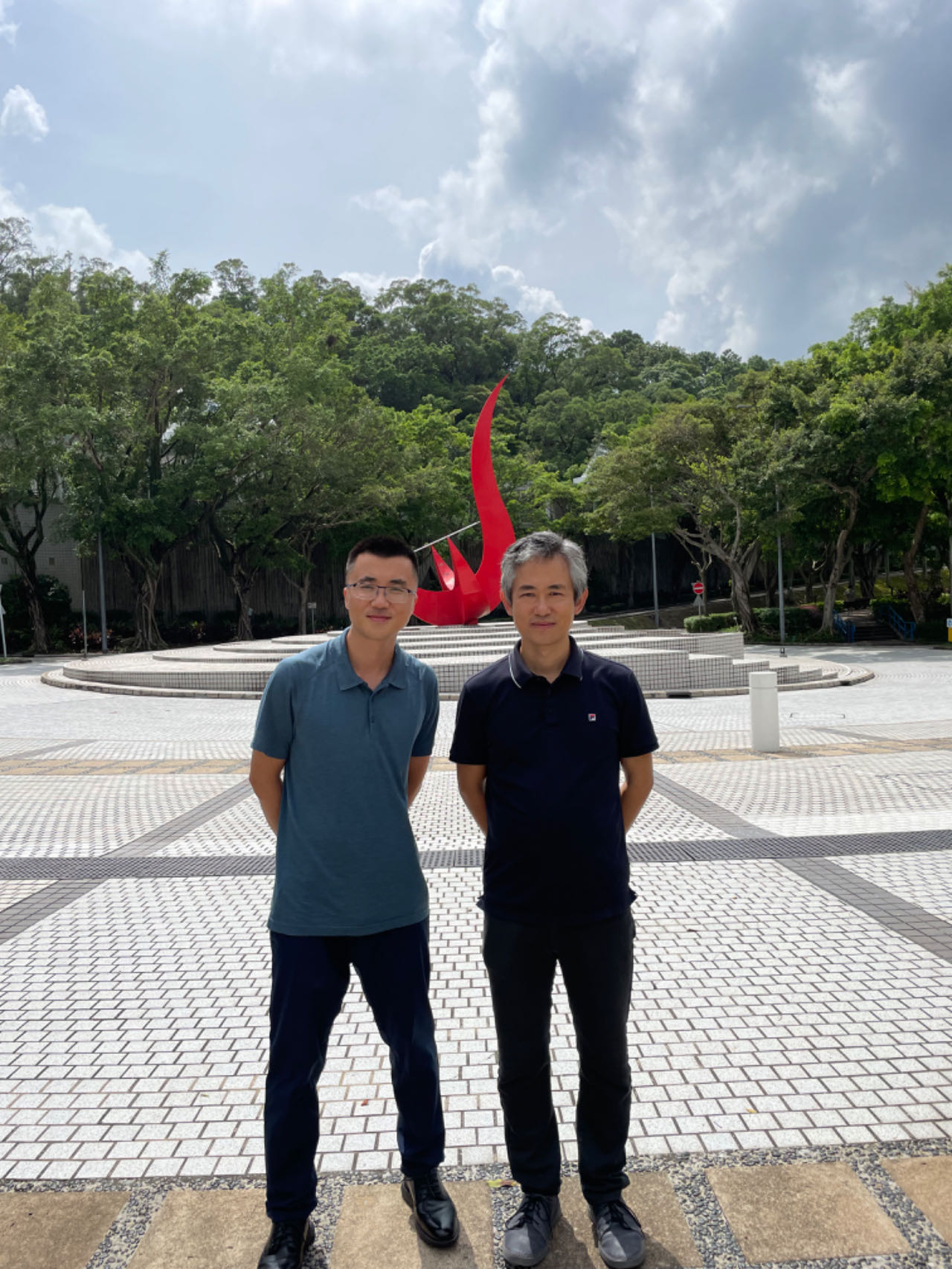
Dept seminar by Prof Qiushi Chen
It was a great pleasture to have invited Prof Qiushi Chen from Clemson University to give a seminar in the Department on DEM modeling of deformable granular particles. Prof Chen also engaged with our faculties and graduate students on stimulating discussions as part of the talk.
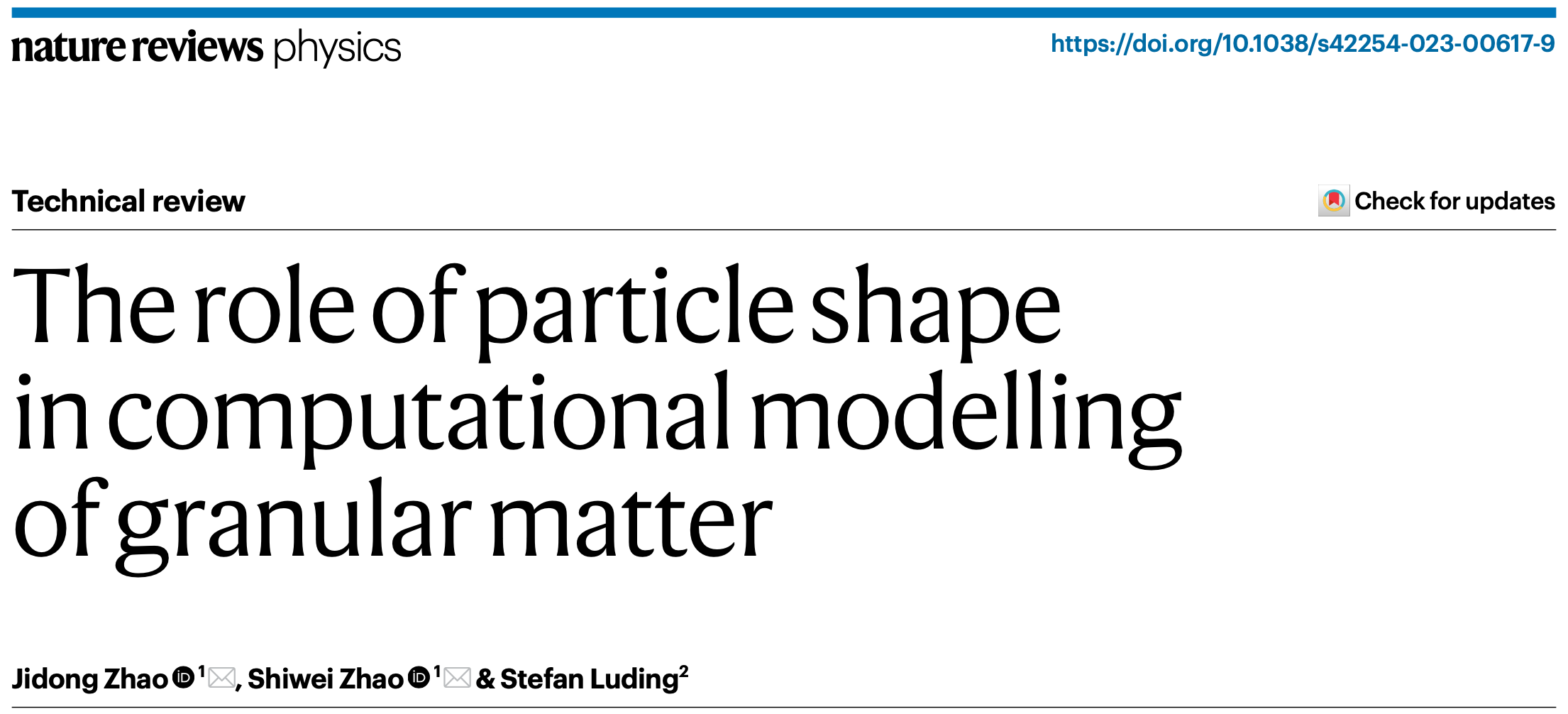
New paper in Nature Reviews Physics
Our invited Technical Review has been officially published in the prestigious Nature Reviews Physics journal where we critically reviewed the technical progresses in the past five years on how particle shapes of granular matter are computationally modelled for both naturally occuring materials and engineered geometries. We also disucssed how future challenges are related to pertinent scientific and engineering problems with granular matter where particle shape plays a key role. Read the NRP paper.
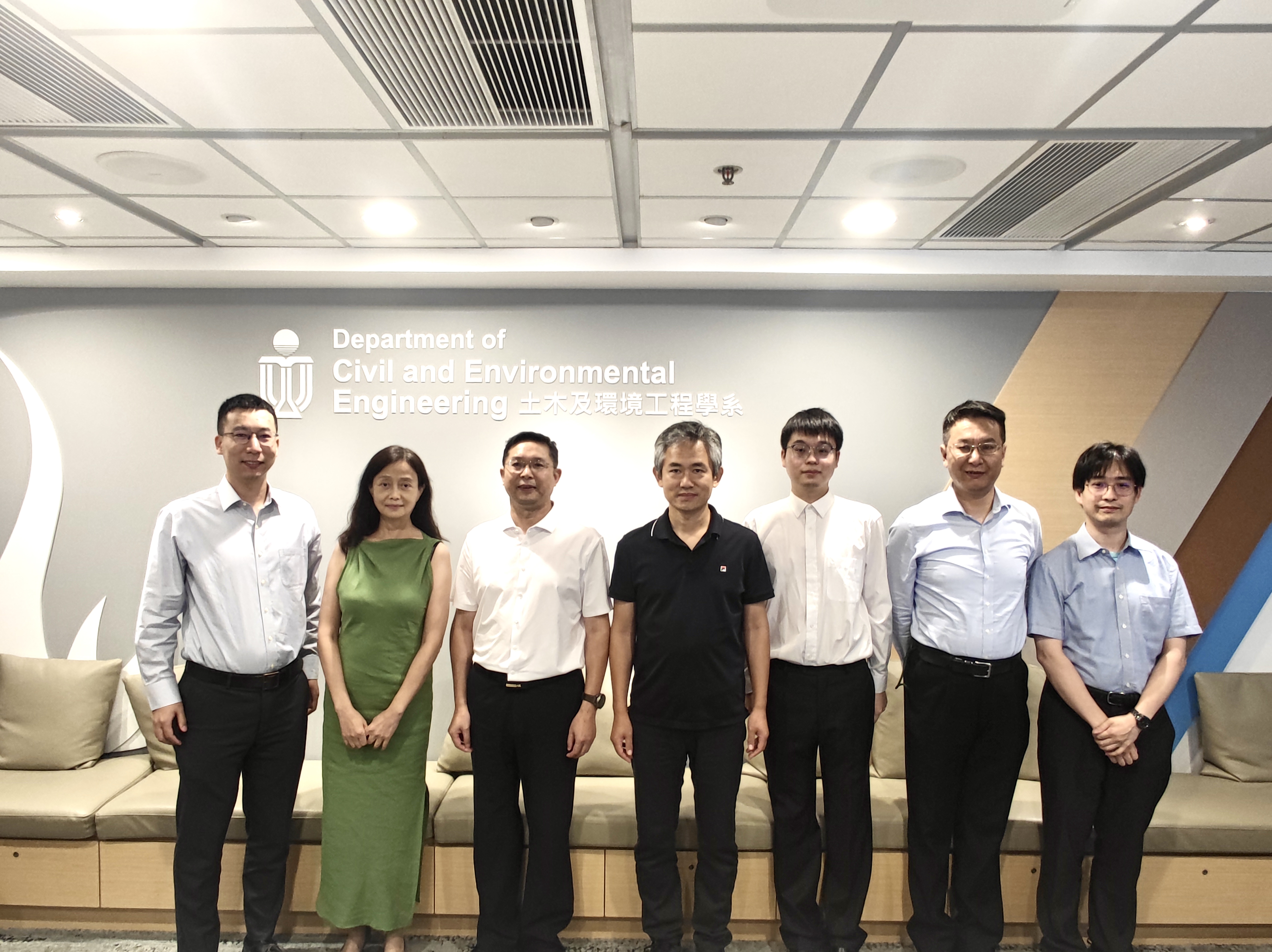
YU Tao successfully held defence
Proud supervisor moment - YU Tao has successfully held his Ph.D. defence today on thesis titled "Multiscale Modeling of Powder-based Additive Manufacturing". His thesis presents an advanced computational method in simulating complicated multiphase, multiphysics processes involved in laser powder-bed fusion (L-PBF) for additive manufacturing. The thesis includes external examiner Prof Moubin Liu of Peking University and HKUST colleagues as internal examiners - thank you all. Tao's work helps to create a new forefront for our computational granular mechanics research - thank you Tao for your great work. It has been a great pleasure working with you. Great to see you have found a dream job in your hometown which indeed diversifies the future for our graduates. Wish you all the best.
Multiple city travels and Taiyuan workshop
My summer break started officially from early July with travels to multiple mainland cities, first to Beijing (8-11 July), Wuhan (12-19 July) and then Taiyuan (20-23 July). Prof Wei Zhou and Prof Gang Ma kindly hosted my one-week stay at Wuhan University and my talk on 18 July 2023. Prof Huabei Liu and Prof Bo Zhou of Huanzhong University of Science and Technology also invited me to give a talk on my research on 17 July. It was great to meet up old friends in the community of computational granular mechanics in workshop organised by Prof Yuntian Feng in Taiyuan where I gave a talk summarising the state-of-the-art and challenges in multiscale, multiphase modeling of granular media.
Fully resolved CFD-DEM coupling scheme for arbitrarily shaped particles
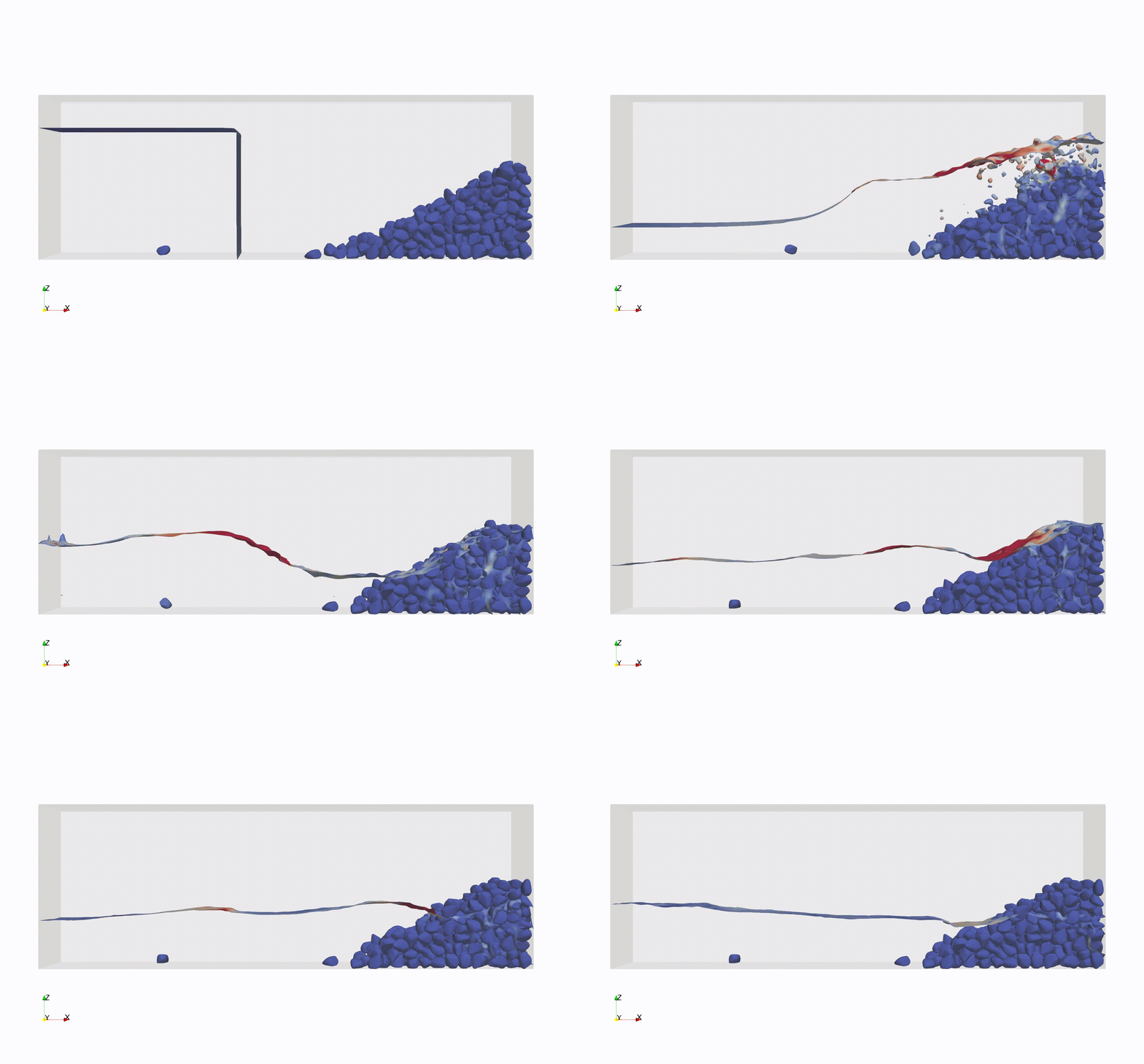
Zhengshou's new paper published in CMAME presents a new fully resolved CFD-DEM coupling scheme for accurate modeling of particle-fluid interactions involving arbitrarily shaped particles. We leverage the Signed Distance Field (SDF) theory as a broker for accommodating robust particle shape simulations and accurate characterization of the surrounding flow field. The flow can be multiphase involving both incompressible air and liquid phases. Shown animation is wave impacting on breakwater of non-spherical particles whereby the following details are captured: (1) the front-toe particles are carried by the wave to roll over to the top; (2) the air phase in the stack is driven out from the pores by the wave water; and (3) the infiltration of fluid down into the pores upon the retreat of the wave. Read the paper.
Invited talk at Imperial College
It was a great pleasure to give a talk on "The present and future of computational granular mechanics"at Department of Civil and Environmental Engineering of Imperial College London. Many thanks to Catherine O'Sullivan for hosting my talk and for your kind hospitality. Enjoyed the stimulating discussion with you and your students!
Vapor condensation and keyhole pore in L-PBF
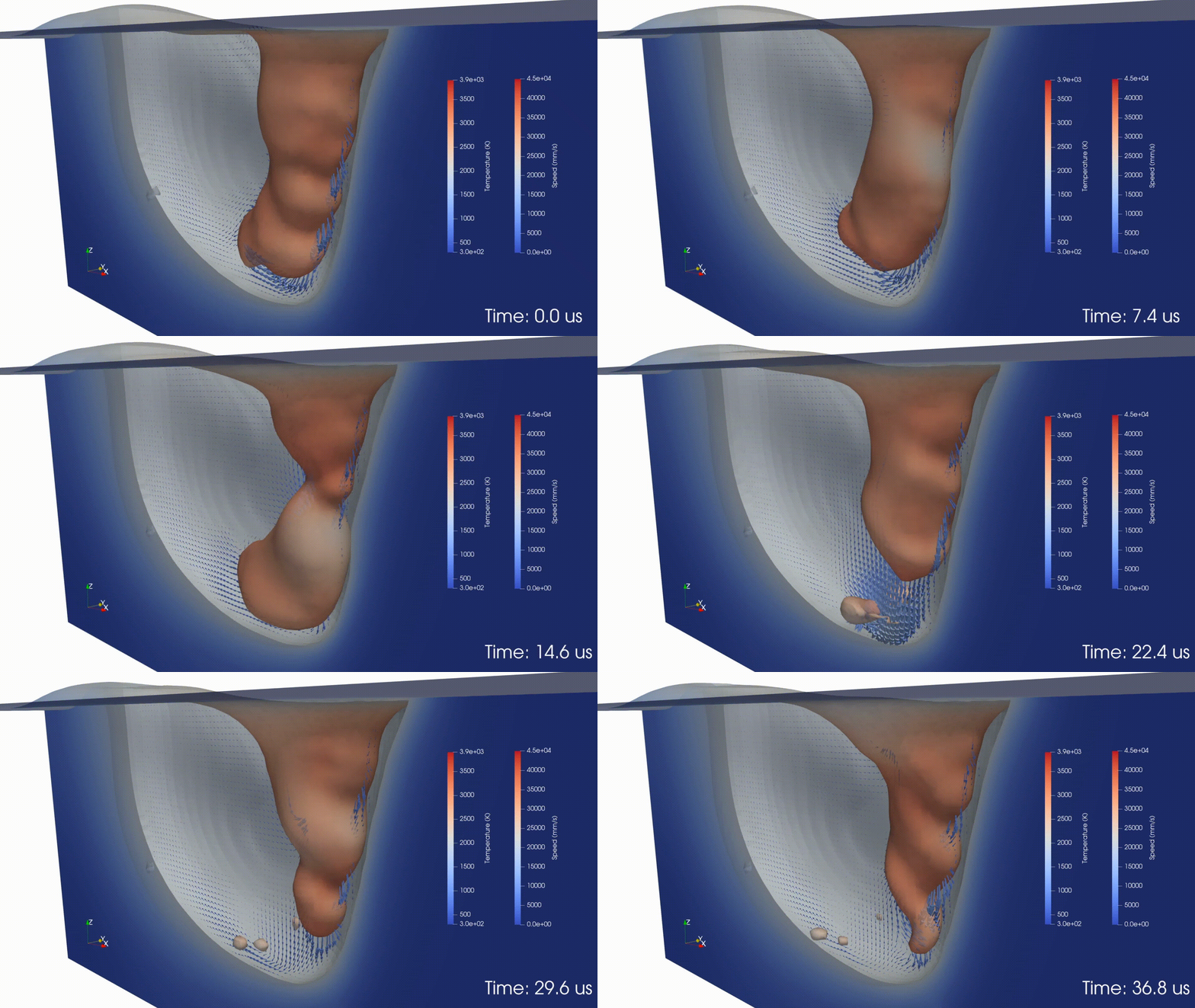
It is exciting to share our new study published in Additive Manufacturing where we numerically examined the complete cycle of keyhole pore evolution in L-PBF of Ti-6Al-4V alloy, including its generation, collapse, and splitting. We highlighted the possible contribution of metal vapor condensation in conjunction with liquid vortex, recoil pressure, surface tension, and keyhole morphology, to the development of keyhole pore. We further demonstrated vapor condensation may cause high-speed microjets for keyhole pore that lead to pore collapse and splitting. The study helps to improve our understanding of keyhole pore generation in metal selective laser melting (SLM) for additive manuscript. Shown animation is simulated keyhole pore generation followed by vapor condensation. Read the paper.
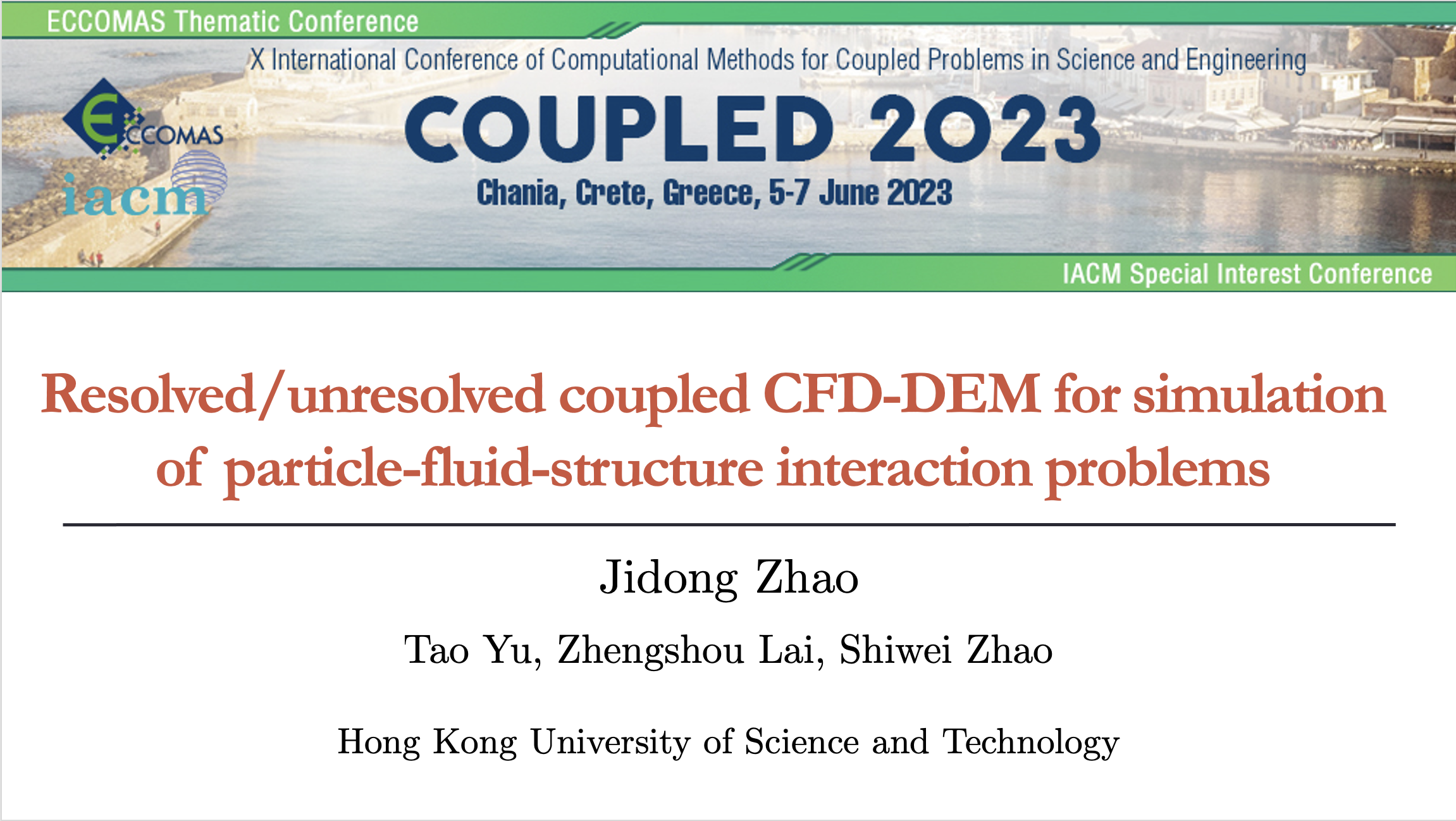
Theme keynote at Coupled 2023 conference
Honoured to give an invited theme keynote titled "Resolved/unresolved coupled CFD-DEM for simulation of particle-fluid-structure interaction problems" at Coupled 2023 conference in Chania, Crete, Greece, 5-7 June 2023. Thank you Prof Ha Bui of Monash University for organising the session and inviting me as the theme keynote speaker. Shiwei also attended the conference and gave a talk.
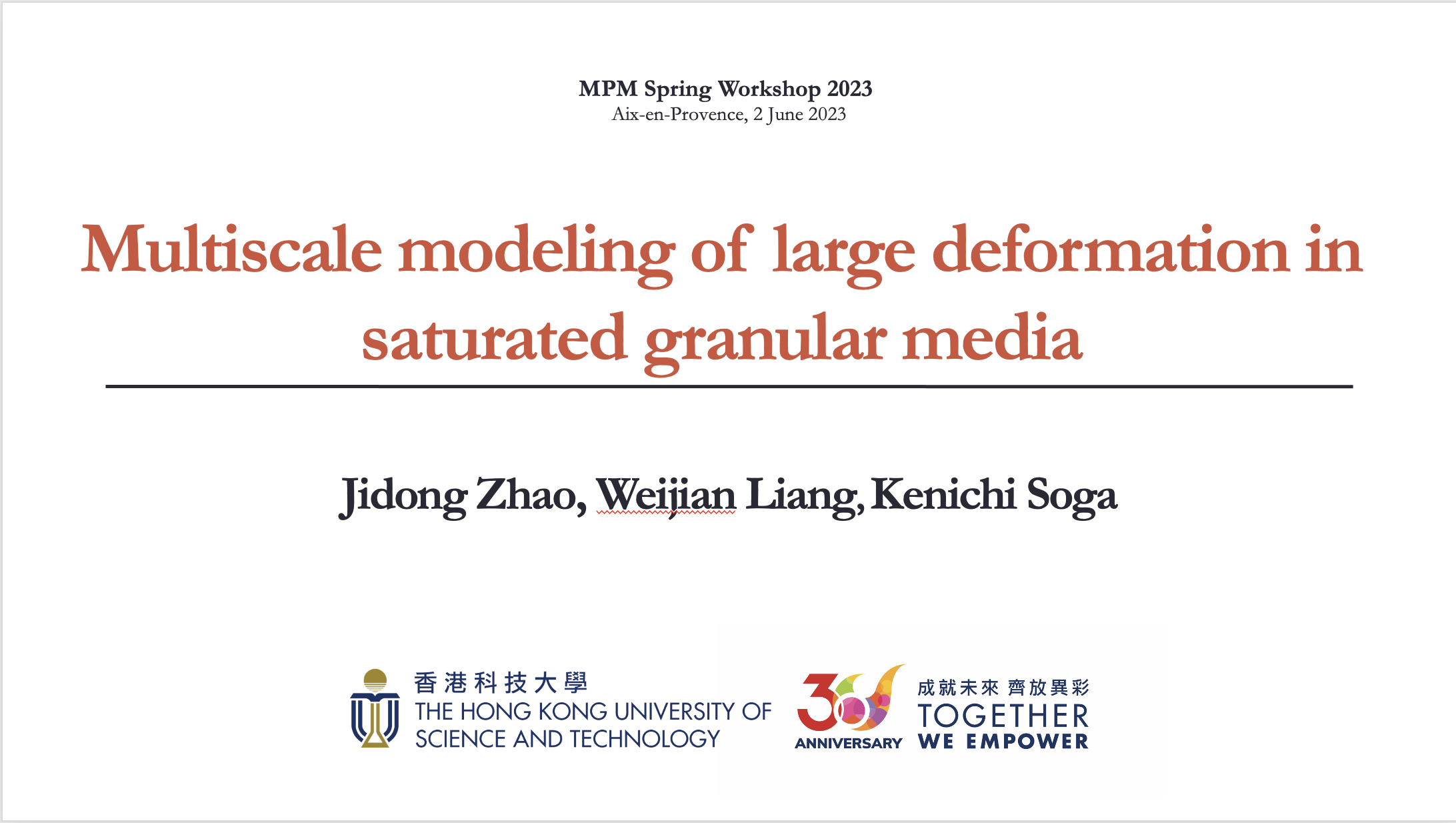
Invited talk at MPM Workshop in Aix
Travelled to Aix-en-Provence of France to attend a nice MPM workshop and gave a talk titled "Multiscale modeling of large deformation in saturated granular media" where we reconnected with many colleagues and met great researchers in person who I have known for long virtually. Thank you Jerome Duriez for organizing the event.

Conference travel to Assisi Italy
First international conference travel after almost 4 years since the pandemic - to beautiful Assisi of Italy attending the international symposium on Numerical Methods of Geomaterials (10-12 May 2023) and presenting a theme lecture titled "Computational modelling of multiphase fluids interacting with irregularly-shaped granular particles". The conference was dedicated to late professor Gyan Pande, the founding editor of our journal Computers and Geotechnics. Excited to have met many old friends and new ones in a peaceful and picturesque setting of Assisi. Shiwei and his student Hao CHEN have also attended the conference.
Keynote and invited talks in mainland
I was thrilled to have a 10-day trip to Beijing and Wuhan during the Easter break after lockdown in Hong Kong for three and half years. Honoured to give a keynote speech at the 14th National Conference on Numerical and Analytical Methods in Geomechanics held in Wuhan. Before that, I gave three invited talks at Tsinghua, CAS Institute of Mechanics, and Beijing Jiaotong University. Grateful for the kind invitations by Prof. Dianqing Li of Wuhan University, Prof Yifei Cui of Tsinghua, Prof Chuanqi Liu of CAS, and Prof Xu Li of BJTU. Prof Wei Zhou of Wuhan University also showed me the beautiful campus and his advanced lab. Great to reconnect with many old friends and know many new and young ones.
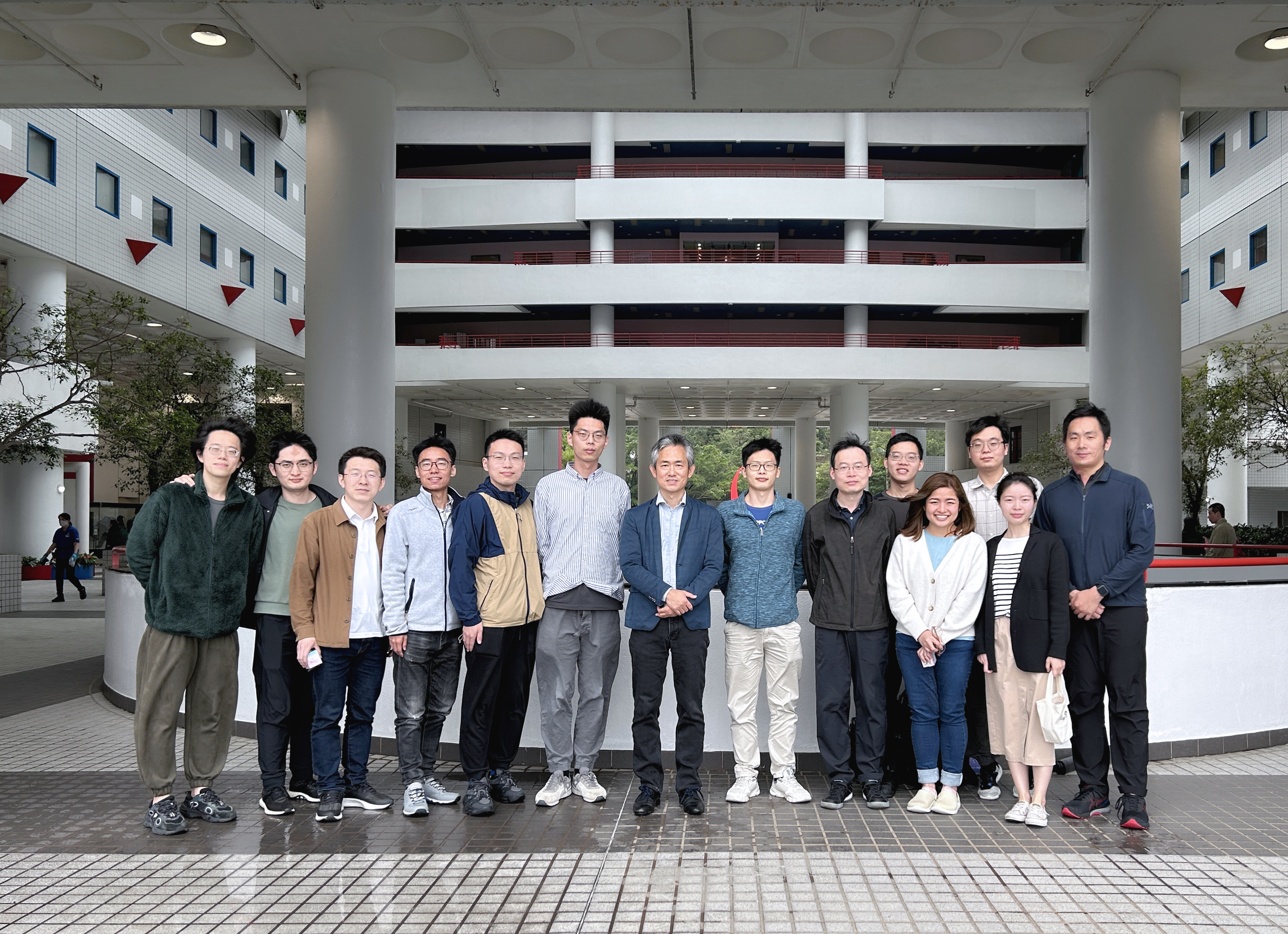
Lab alumni reunion
We warmly welcome former lab member Dr Fan ZHU (now Associate Professor at Kyoto University) back for a brief visit and lunch with the entire group. Weijian and Yong also came back joining the lunch and the group photo. Glad to know Fan is doing well.
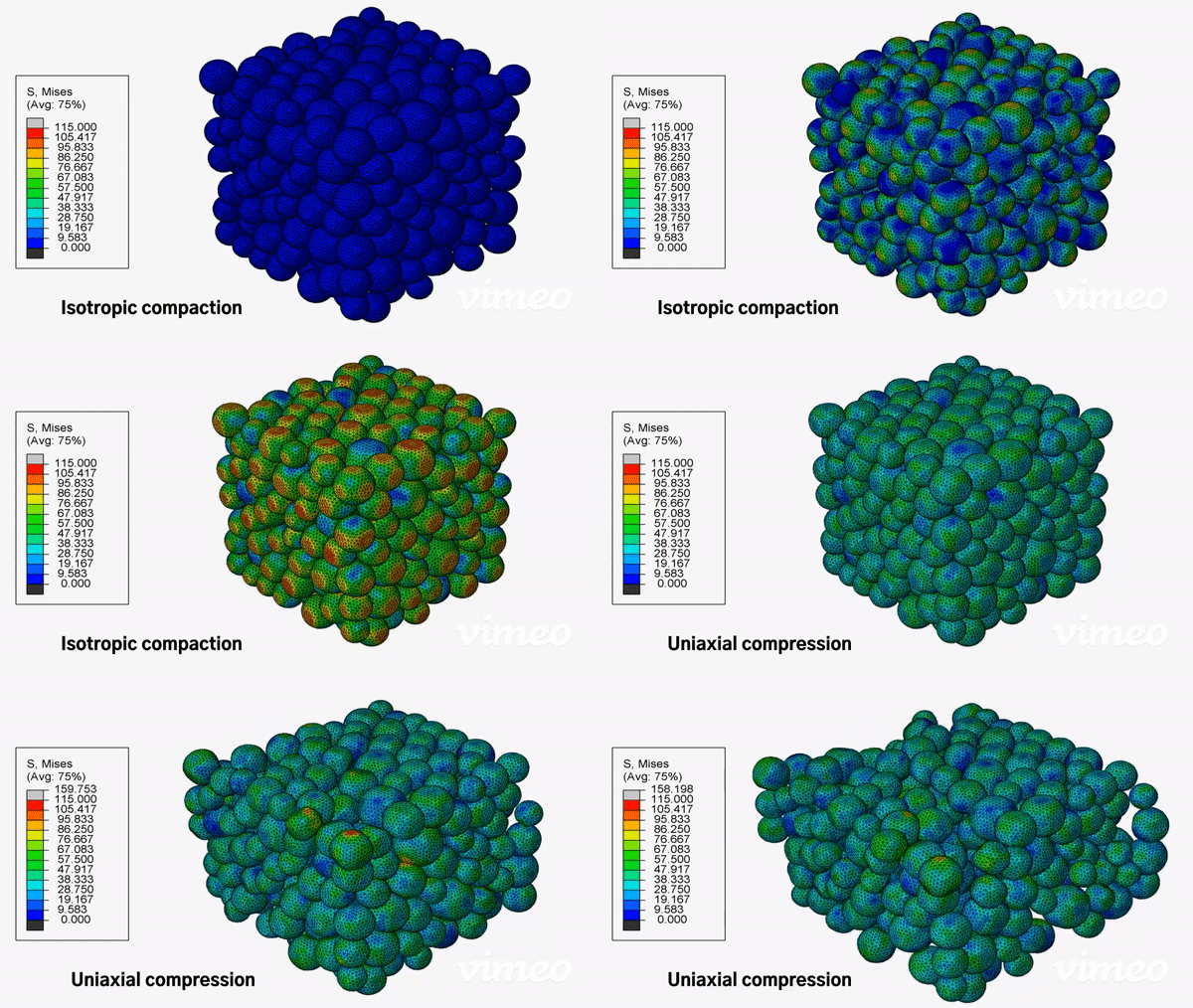
Deformable powders
Quan has published his first paper in PowderTechnology where he employed multi-particle FEM (#MPFEM) to simulate the mechanical behavior of highly deformable cohesive granular powders under compaction and decompaction, including elastic and plastic deformation, bonding, yielding, strength, and damage(debonding). The animation shows the process of powders under isotropic compaction, decompaction (unloading) before being compressed uniaxially, where how plastic deformation and bonds are initially developed and debonding occurs at later stage. The study is intended to shed lights into better understanding of powder compaction relevant to pharmaceutics, metallurgy and chemical engineering. Read the paper.
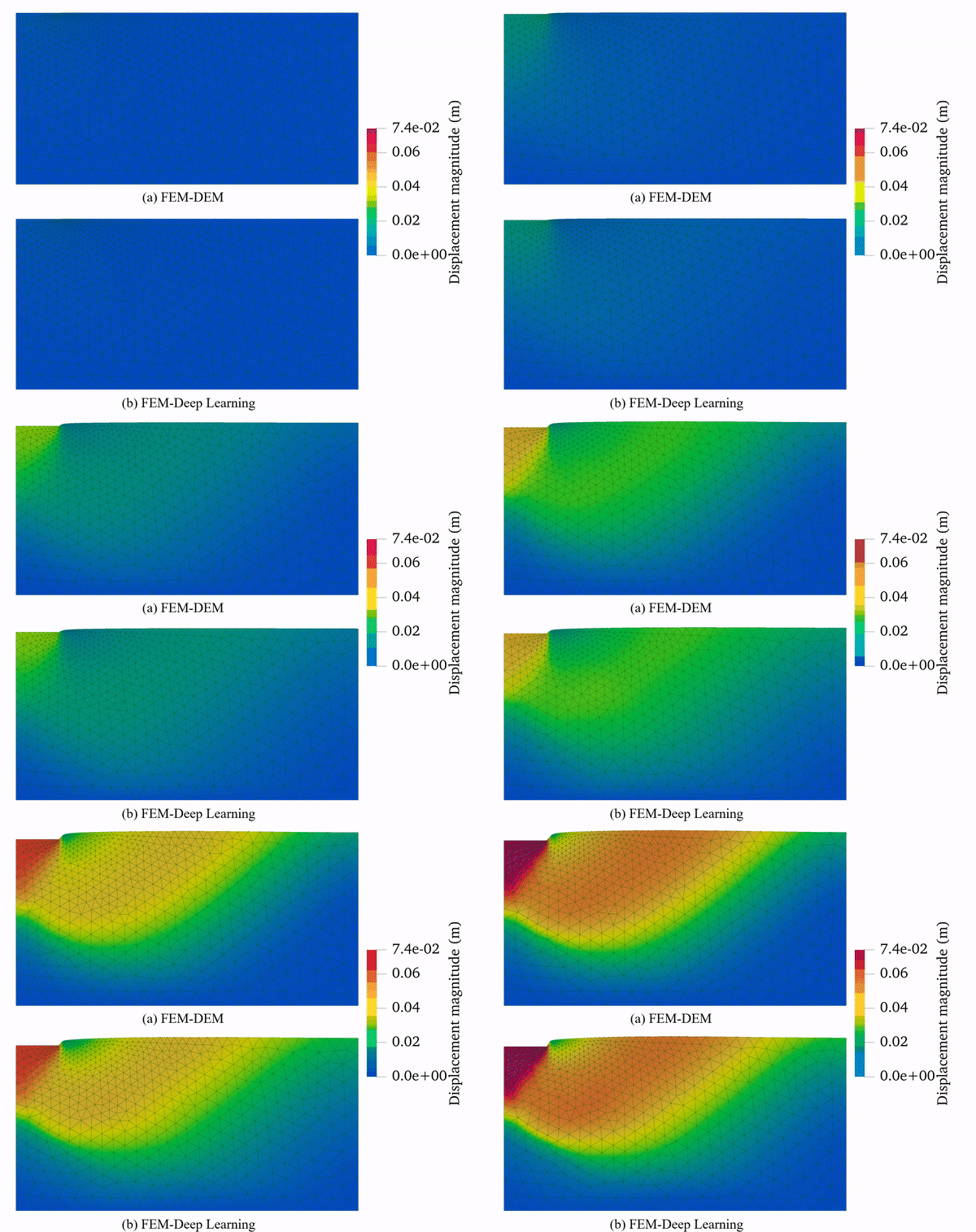
Deep active learning for constitutive modeling
Tongming published a new paper in International Journal of Plasticity where he developed a new committee-based deep active learning strategy to identify unreliable forecast and continuously improve data-driven constitutive modeling of granular media with less data. He demonstrated the strategy by multiple examples, including FEM prediction of footing foundation failure with deep active learning model in comparison with coupled FEMxDEM multiscale modeling of granular media showing comparable results but with much less computational effort (see animation below). Read the paper.
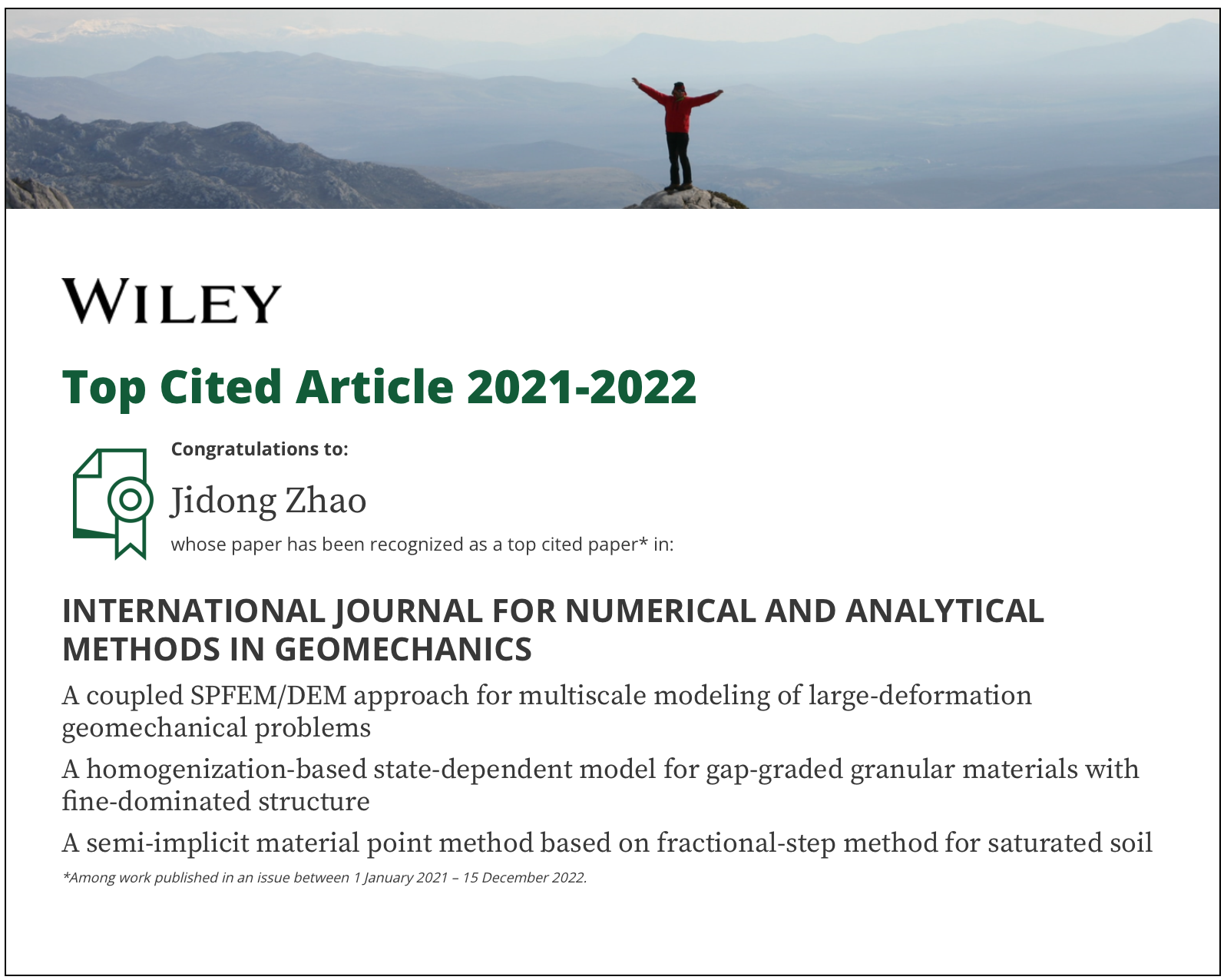
Top cited articles in NAG
Three of our papers published in NAG (Int. J. Numer. Analy. Meth. Geomech) in 2021 have been recognised as top cited articles among all published in 2021 and 2022. Congratulations to all co-authors and thank the communcity for appreciating our research.
New Lab Member
We warmly farewell an old member and welcome a new member. Zhengshou has finished his two-year term of Hong Kong Scholars Program with our lab and has secured an associate professor position at Sun Yat-Sen University. We wish Zhengshou all the best for his future career. Meanwhile, we welcome Dr. Xi Wang from Tongji University joining our lab as a postdoc fellow.
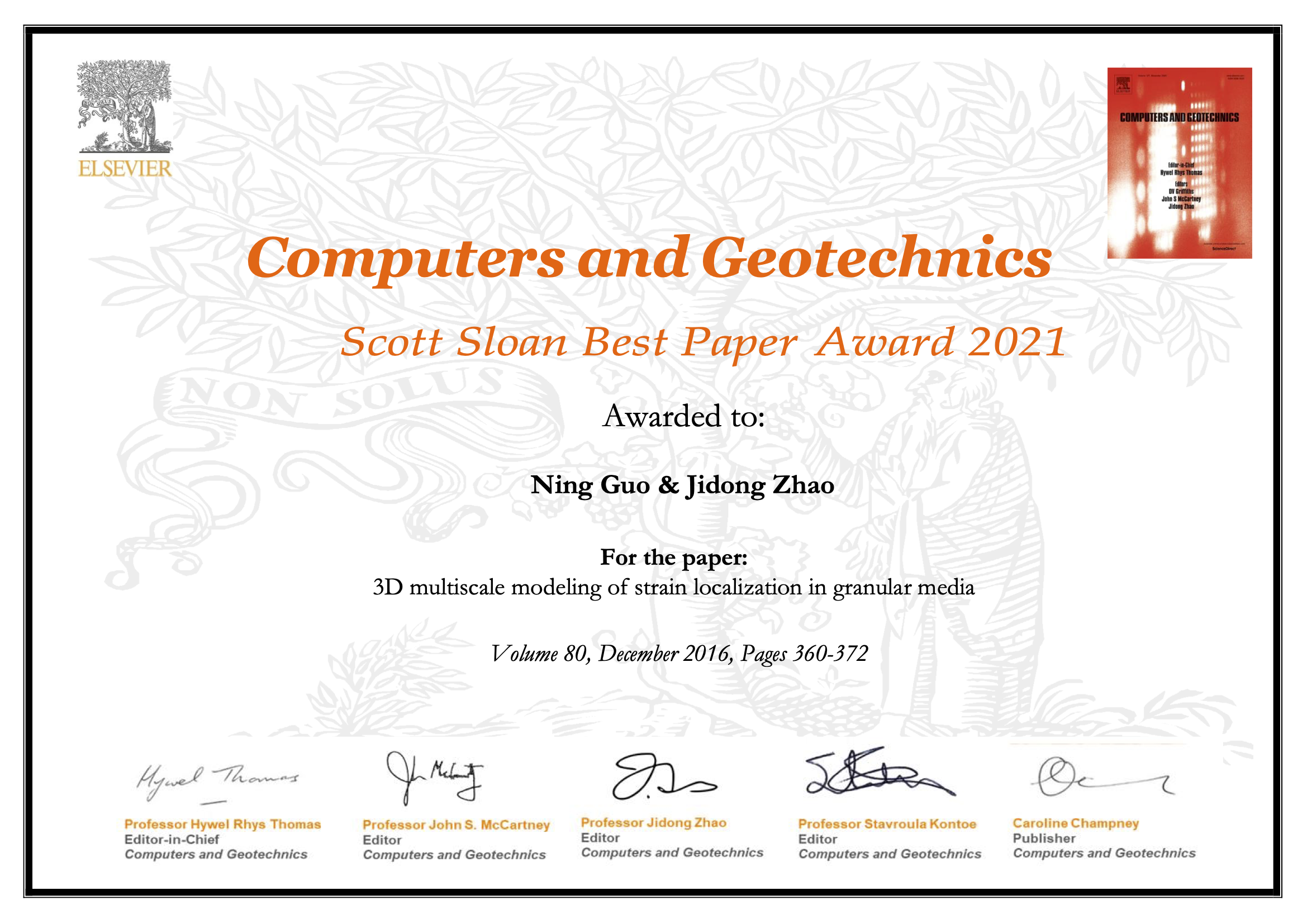
Scott Sloan Best Paper Award 2021
What a great start for 2023! We are honoured and thrilled to receive the prestigious "Scott Sloan Best Paper Award 2021" with former PhD student Dr Ning Guo (now Professor of Zhejiang University) for our paper published in Computers and Geotechnics in 2016. The Scott Sloan Best Paper Award, named in honour of the late Scott Sloan, recognises the top papers that have made a significant impact on the field of geotechnical engineering. This impact is based on both citations for the previous five years and the opinion of the Editors. Read our award-winning paper.

Multiscale multiphysics modeling
Weijian's new paper in collaboration with Prof Kenichi Soga of UC Berkeley published in top computational mechanics journal #CMAME. In this work we developed a multiscale, two-phase MPM based on u-v-p formulation and coupled the MPM with DEM to simulate both quasistatic and dynamic multiphysics problems of saturated granular materials in large deformation regime. Shown animation is the wave propagation (both displacement and excess pore pressure) in a saturated soil domain (Left to right: isotropic soil, anisotropic soil with a horizontal and 60 degree bedding plane by the DEM REV) triggered by a centre surface punch. Read the paper.
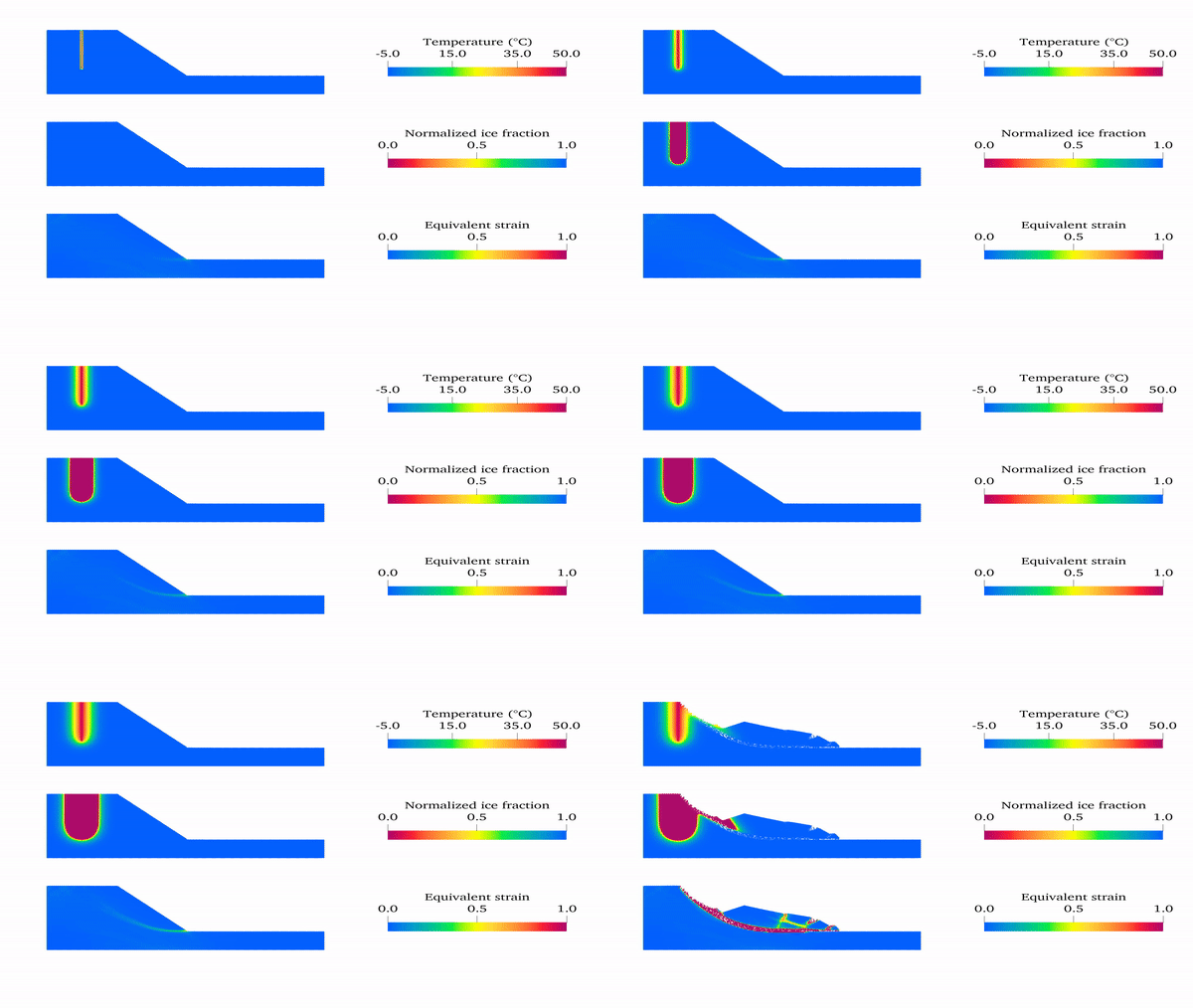
Multiscale modeling of freeze-thaw in soils
Shiwei's new invited paper is published in a special issue in Acta Mechanica Sinica on "mechanics of granular materials". In this paper, freeze-thaw related geotechnical problems are tackled based on grain-scale physics considering phase transition via a new MPMxDEM hierarchical multiscale modeling approach. Animation shows thawing induced slope collapse. Read the paper.
2022
Flexible barrier Research
Yong has continued his PhD work on studying debris flow and flexible barrier interactions and has made several fundamental advances. In our recent paper accepted by Géotechnique, we quantified the correlation of flow-barrier height ratio in conjunction with Froude number, Fr, with impact load, barrier deflection, and equivalent barrier stiffness based on coupled CFD-DEM simulations of debrisflow impact on a flexible barrier. We recommend this height ratio be used as a design index in addition the prevailing Froude number based models. The shown animation compares two cases of height ratios with same incoming flow velocity but rather different impact mechanisms. Read the paper published online.
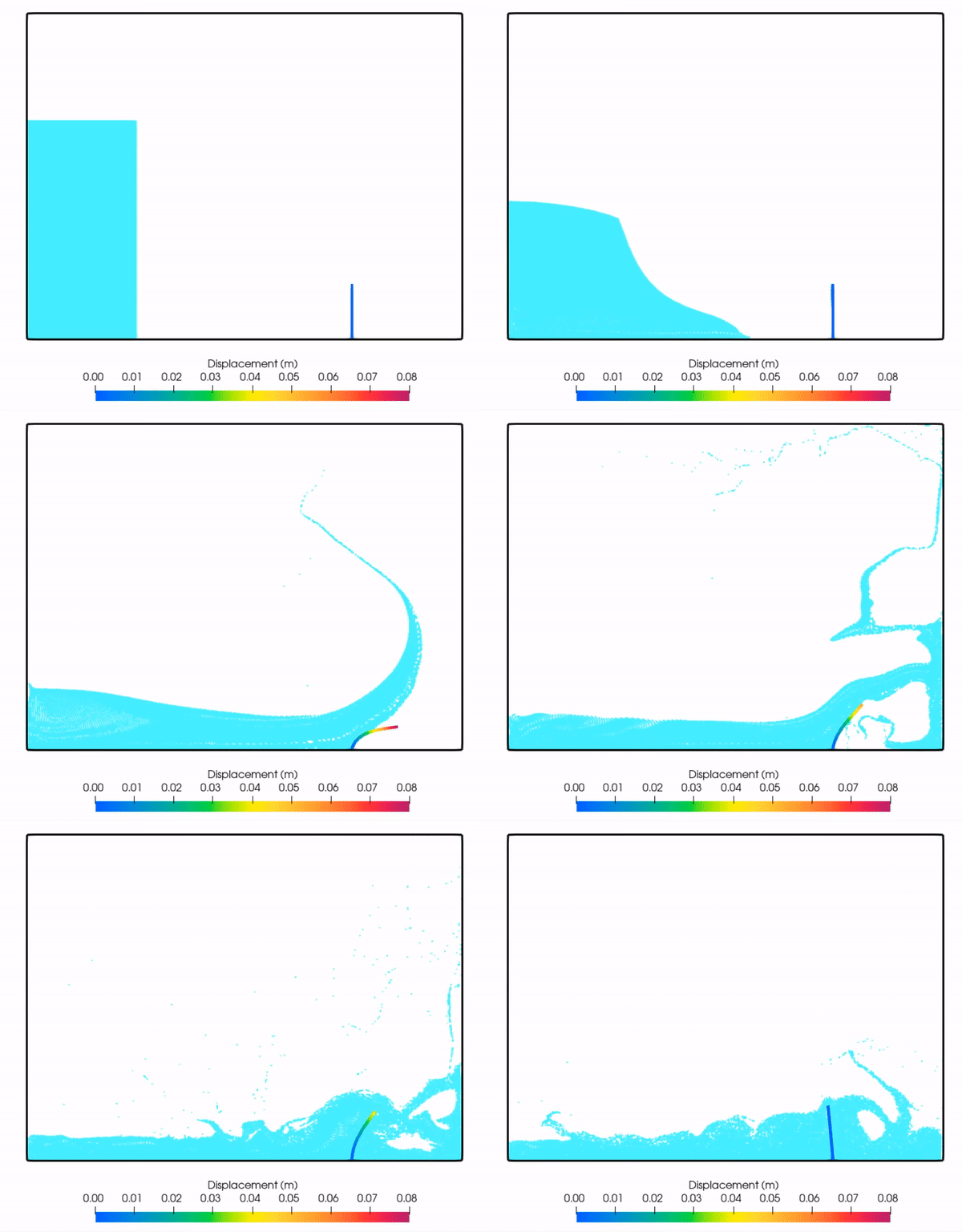
Contact-enabled MPM
Shiwei published new paper in CMAME to tackle contact problems in MPM - we instil the contact concepts typically used in DEM into material point method to model multi-material interactions involving both particle-particle and particle-structure contact problems where the particles can be treated as either solid or fluid. The new contact-enriched MPM is versatile of simulating of a wide range of interaction and contact problems involving of granular particles, fluids and structures (FSI). Shown animation is a dambreak impacting onto a flexible cantilever beam. Read this CMAME paper.
Jidong gave keynote at 17SEE
Jidong gave an invited keynote at 17th Symposium of Earthquake Engineering (17SEE) organised by IIT Roorkee from 14-17 Nov 2022. This talk covers his recent collaborated work with Weijian and Prof Kenichi Soga of UC Berkeley on multiscale modeling of the dynamic hydromechanical coupling behaviour in saturated granular media subjected to dynamic or earthquake load.
Grain crushing in general stress conditions
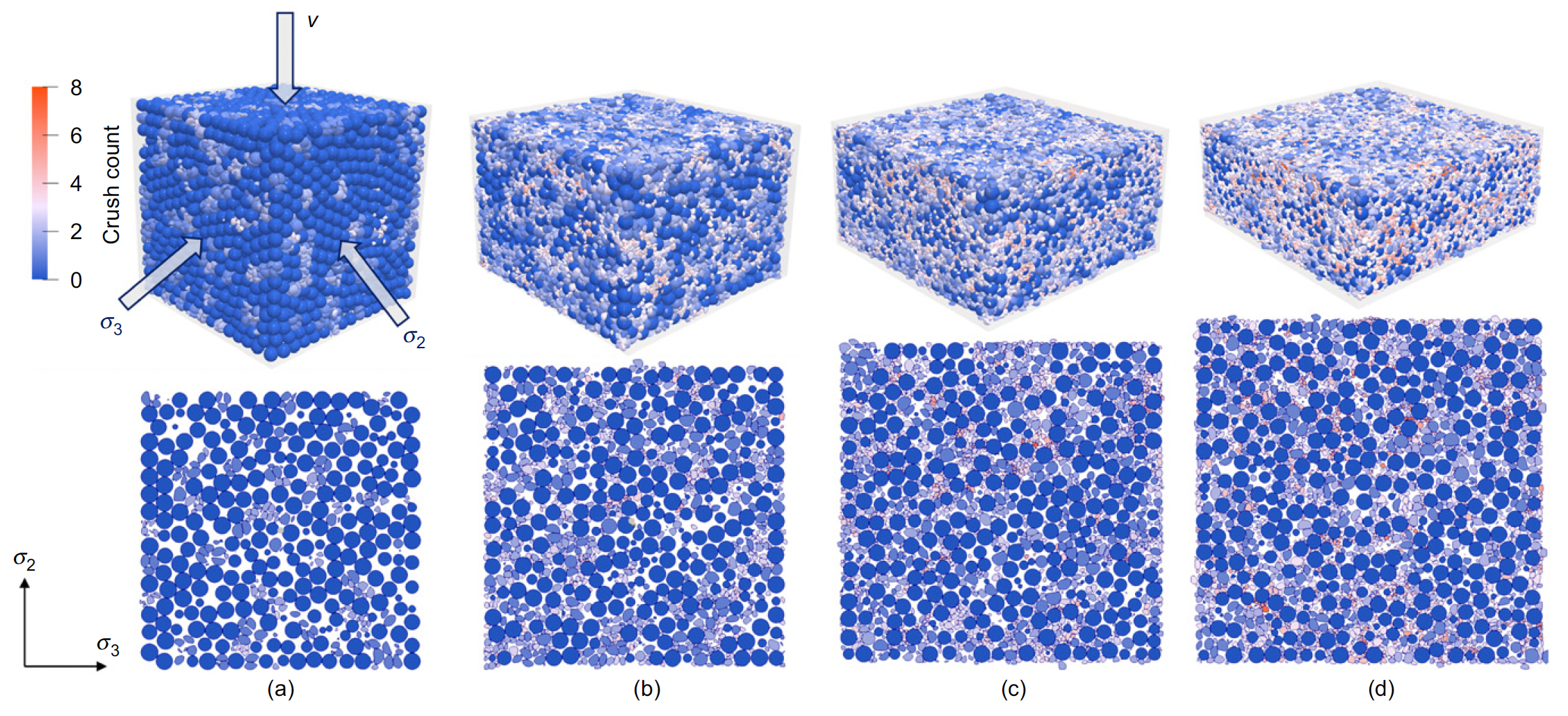
Ke published her first journal paper in Géotechnique where we used a coupled coupled non-smooth contact dynamics (NSCD) & Peridynamics (PD) to faithfully capture the evolutions of grain size and shape of grain crushing in crushable sand under general stress conditions. We explore how grain crushing under #constant intermediate principal stress ratio (constant-b) conditions affects all aspects of soil behavior, including strength, deformation, grain size and shape evolution, contact force network and anisotropy. We further discussed the possible competing mechanisms of void-filling by grain size reduction and enhanced friction interlocking due to grain shape changes. Read the paper.
Invited lecture at Beijing Jiaotong University
It was a pleasure for Jidong to deliver a 3-hour invited lecture on "Multiscale mechanics of granular media" to a large online audience online organised by Beijing Jiaotong University. The lecture was followed by enjoyable discussion with the audience on various topics of soil modeling. We appreciate the kind invitation and arrangement by Prof Xu LI of BJTU.
Yong's new paper in JGR Earth Surface
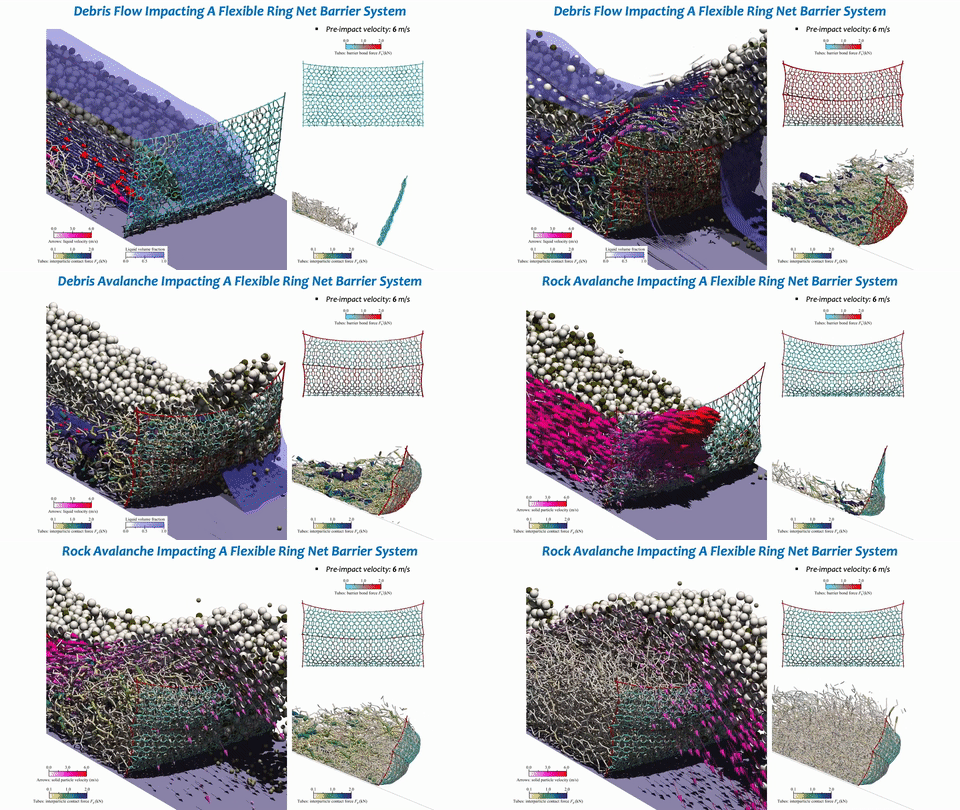
Former group member Yong has extended his PhD research on debris flow-flexible barrier interaction and identified a bilinear impact load - Froude number relation based on CFD-DEM simulations with a wide range of geophysical flow. The study shows that both flow types and impact dynamics control the bi-linear law, with the deflection point decided by a transition of deadzone retained in the barrier from a trapezoidal shape to a triangular one. The study offers a potential to change the empirical practice of flexible barrier-based geophysical flow mitigation by physics-based design. The animation takes half view of impact by fluid streamlines and particle contact force networks onto the flexible net. The study has been accepted for publication by Journal of Geophysical Research: Earth Surface. Read the preprint of the full paper.
ICCEFA'22 Keynote
Jidong has been invited to deliver the ICCEFA keynote lecture titled "Computational Multiscale Modeling of Granular Media for Integrated Civil Engineering Analysis and Design" at the 3rd International Conference on Civil Engineering Fundamentals and Applications (ICCEFA'22) held virtually online from 24-26 Oct 2022 (originally planned as an in-person conference in Seoul). Other keynote speakers include Prof Kincho H. Law of Stanford University.
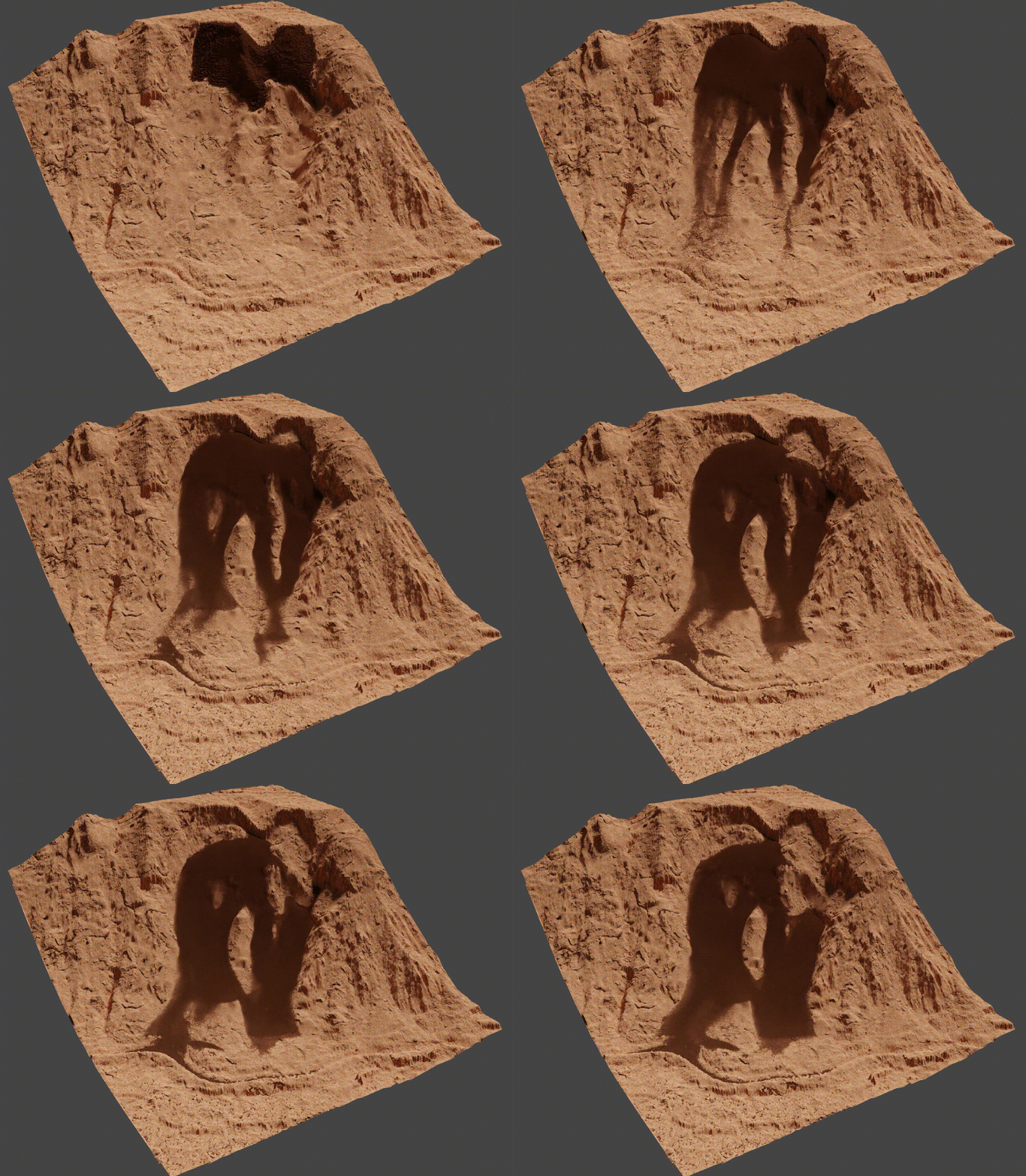
Ray tracing for particle methods
Neighborhood searching is computationally expensive for #particle-based numerical methods - #raytracing can help! Shiwei has developed a novel generalized ray tracing algorithm for high-efficiency neighbor searching suitable for DEM, MD, SPH and peridynamics (PD). The algorithm perfectly meshes with and leverages the RTX GPU architecture for general purpose high-performance computing and rendering of particle simulations. Animation below shows DEM simulation of a total of 1.6 million dry debris particles sliding down on a digital elevation model of a natural terrain slope consisting of 120,00 #triangular surface elements. It took 6.5 mins of running time on a Quadra RTX 3090 GPU card to simulate an actual time of 100 seconds of flow, with a time step of 0.001 s. The work is accepted by IJNME. Read the preprint.
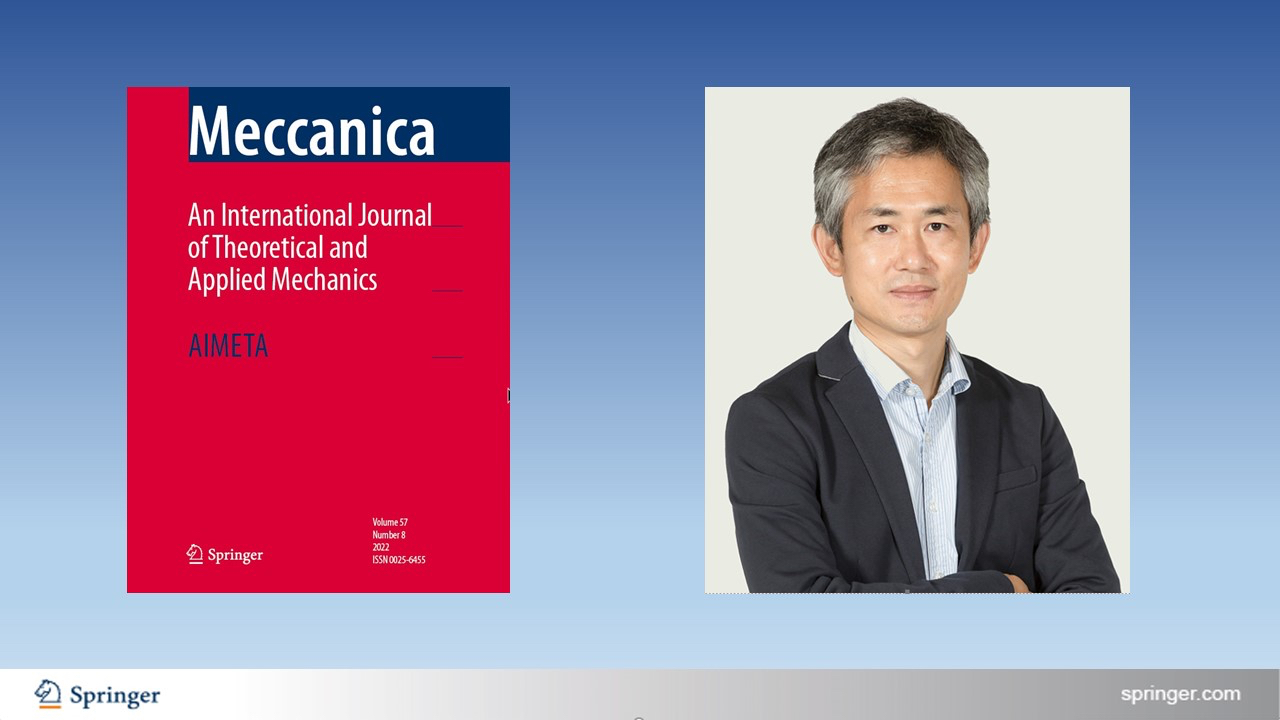
Advisory board of Meccanica
Jidong has been invited by the editor in chief of Meccanica, Prof Anna Pandolfi of Politecnica di Milano, to join the advisory board of her journal. Meccanica, An International Journal of Theoretical and Applied Mechanics published by Springer Nature, is the official journal of the Italian Association of Theoretical and Applied Mechanics established in 1966. It is a great honour to join the prestigious advisory board consisting of top mechanicians and editors of major mechanics journals from around the world.

Huanran won John Carter Award
Huanran has won the 2022 John Carter Award bestowed by International Association for Computer Methods and Advances in Geomechanics (IACMAG) (see also PDF) at 16th IACMAG Conference held in Torino, Italy (30 Aug -2 Sept 2022). The award is given by IACMAG every three years in recognition of a recent PhD graduate worldwide with a PhD degree less than 5 years who has demonstrated outstanding research potential in Geomechanics through her/his work published in refereed journals. Huanran obtained his PhD from the Lab in 2018 and has worked for another 1.5 years in the Lab as a postdoc fellow before joining Chongqing University as a faculty member. He has previously won the 2018 Ringo Yu Prize for Best PhD Thesis in Geotechnical Studies awarded by the HKIE Geotechnical Division.

Two thesis defences and a new member
Two lab members, Terry and Amiya, have successfully passed their thesis defences. Congrats to both. The Lab also warmly welcome our new member, Changyi, joining for his PhD with the support of a Hong Kong PhD Fellowship.
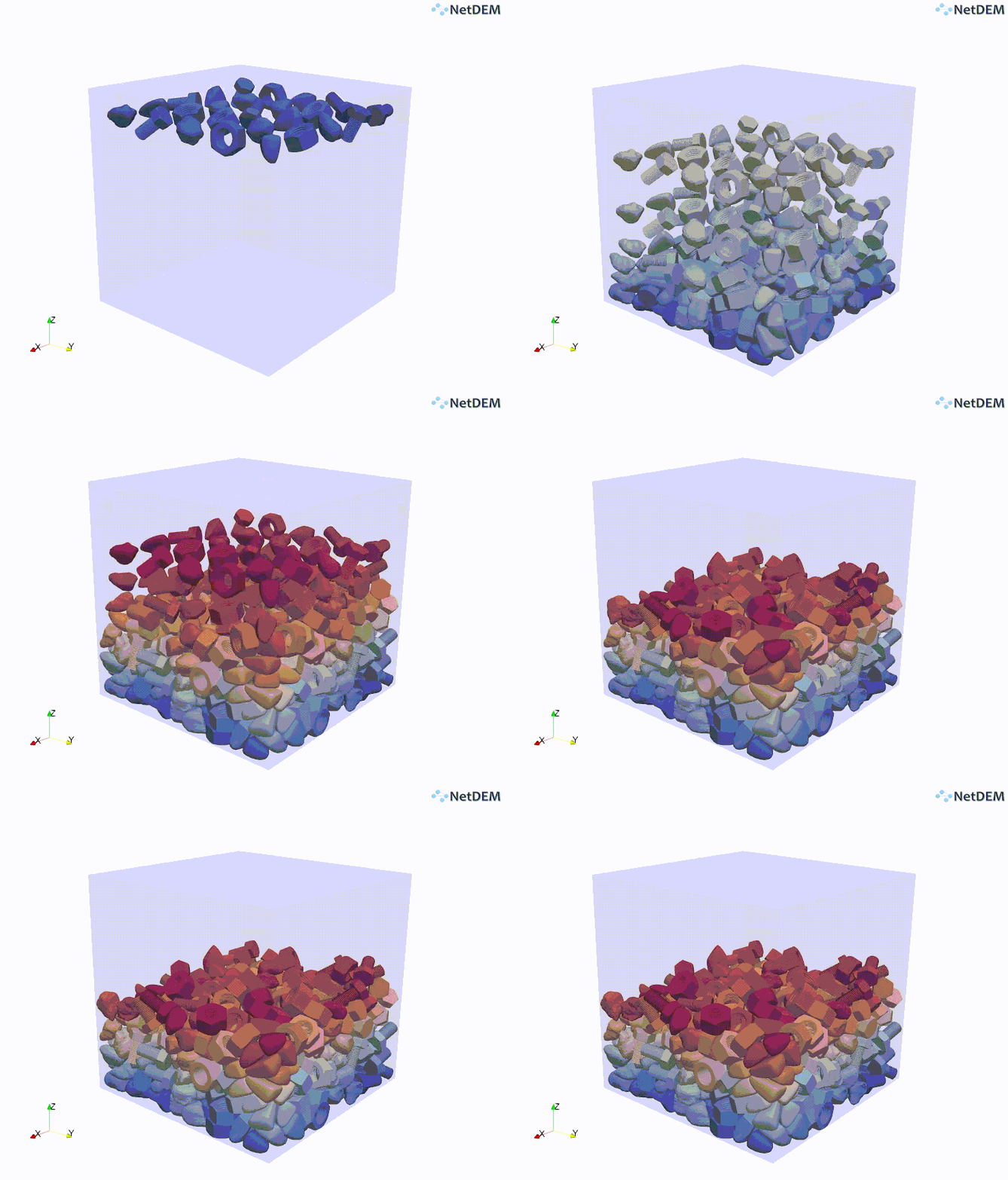
New paper on DEM with arbitrary shape
New DEM paper by Zhengshou and Shiwei accepted by Computational Mechanics of Springer Nature (see also PDF). A new, general Signed Distance Field (SDF) approach is proposed in the study to model contact problems involving arbitrarily shaped granular particles in DEM. It recovers popular methods, such as poly-super-ellipsoid, poly-super-quadrics, spherical harmonics, polyhedron, and level set, as special cases. A new SDF based energy-conserving contact theory in conjunction with weighted spherical centroidal Voronoi tessellation enables effective contact detection in the DEM. Shown animation is a mixing of bolts, nuts and sand grains.
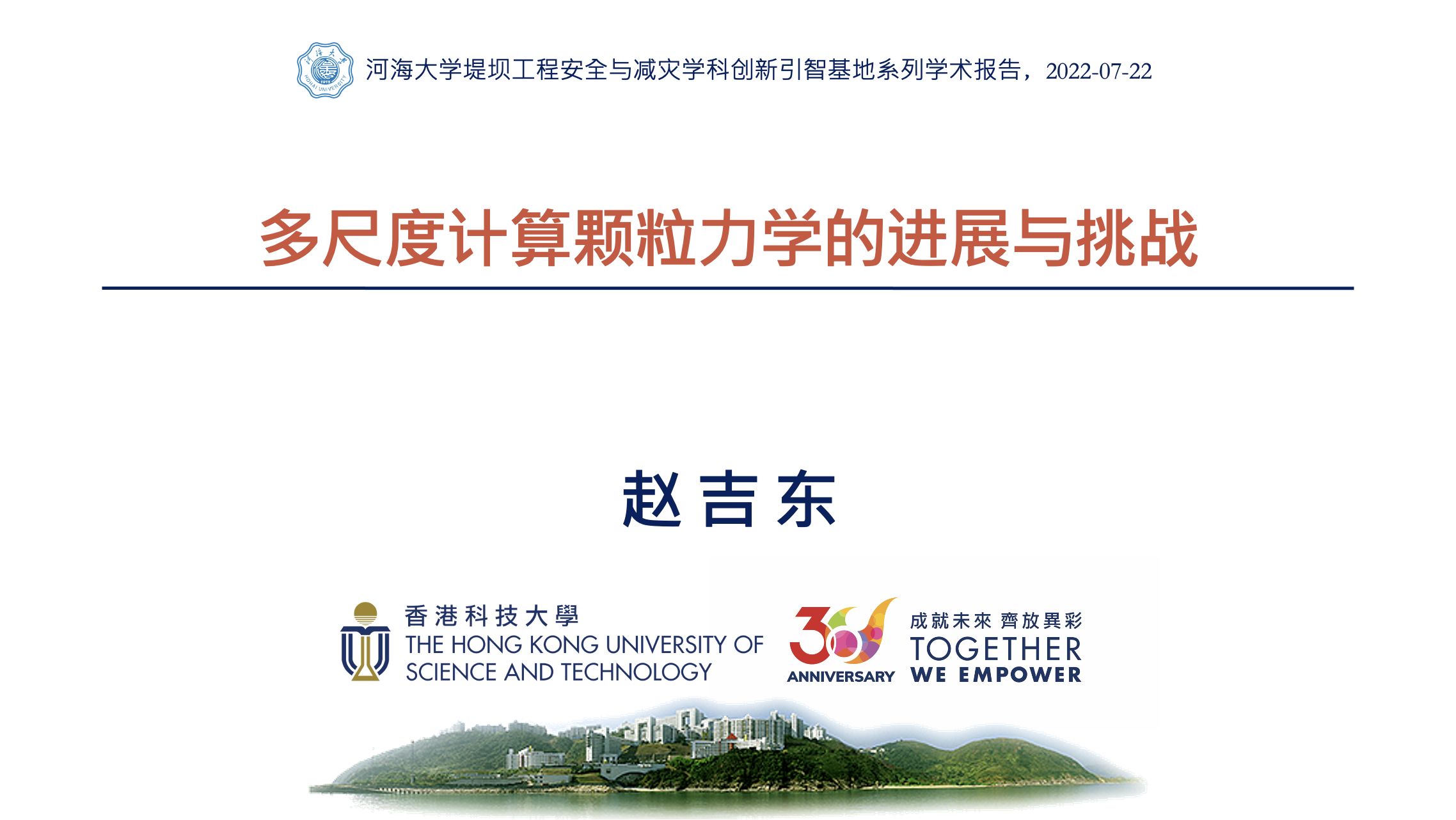
Invited lecture at Hohai University
Jidong was invited by Hohai University to deliver an invited lecture entitled "Computational Multiscale Granular Mechanics: Progresses and challenges " as one of the series lectures on "Dike and Dam Safety and Hazard Mitigation" ("堤坝工程安全与减灾学科创新引智基地系列学术报告"). The talk summarizes our major developments on multiscale modeling of granular media and latest progresses. It also covers major challenges that may potentially open up new research areas of granular mechanics. Thank Prof Yufeng Gao and Prof Xiusong Shi for the invitation.

Invited lecture at PBD-IV 2020
Jidong delivered an invited Theme Lecture entitled "Multiscale insights into dynamic behavior of saturated granular sand at large deformation" at the 4th International Conference on Performance-based Design in Earthquake Geotechnical Engineering held in Beijing (hybrid mode) from July 15-17, 2022. In this talk, we discussed our recent effort in extending our multiscale modeling approach to address a class of dynamic problems involving saturated granular media.
New predictive power on metal SLM
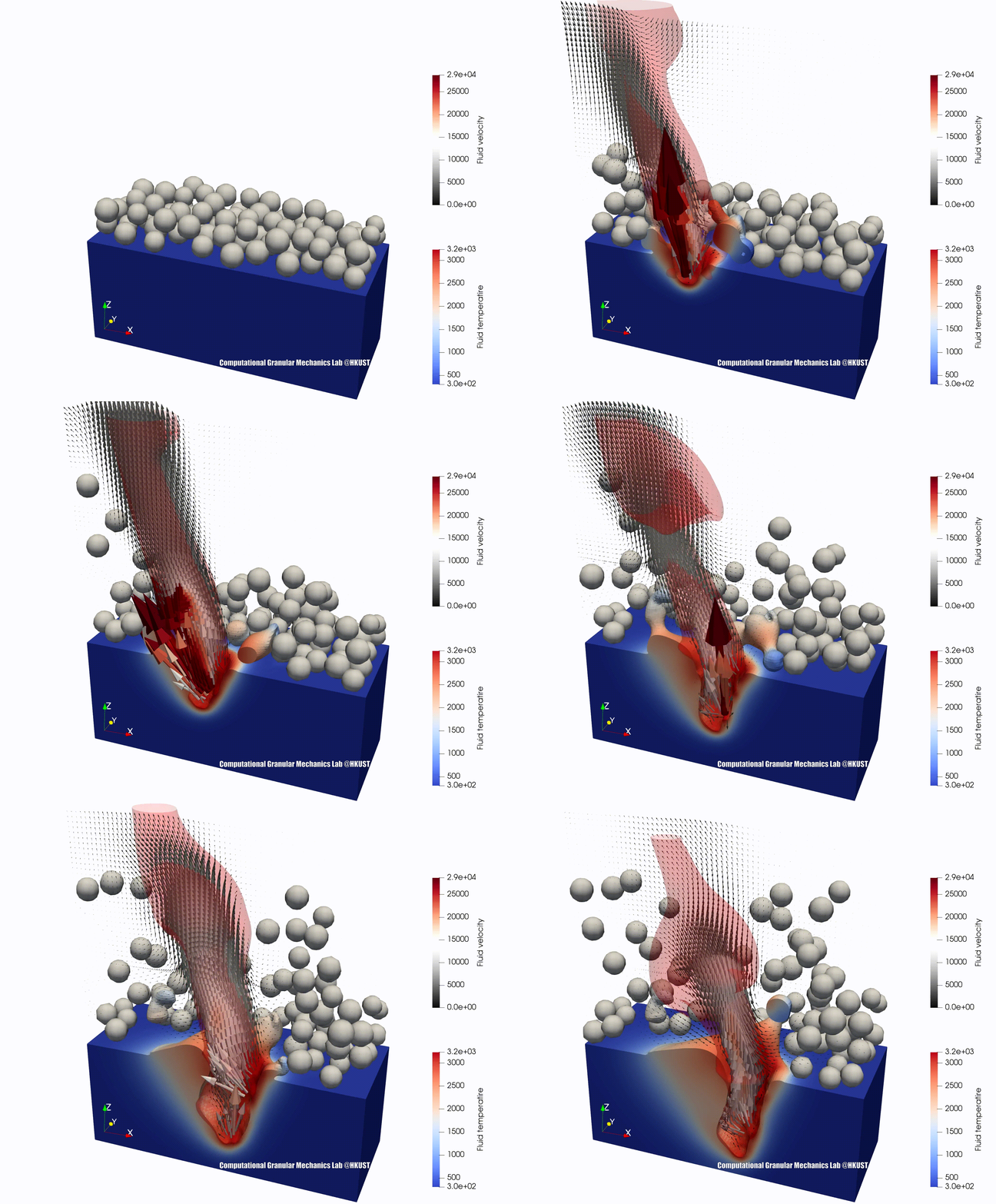
Excited to share a major progress on simulation of metal-powder based selective laser melting - Tao's second paper accepted by top computational journal CMAME (see also PDF). In this new study, we developed a fully resolved coupled CFD-DEM frameowork to rigorously consider key aspects of SLM, including multi-way phase changes (such as melting, vaporization and solidification) and underlying physics including the Fresnel reflection and refraction, laser penetration and absorption, recoil pressure, vapor pressure, Marangoni's flow and Darcy's effect, to offer a first-of-its-kind, high-fidelity simulation tool for metal SLM. In the paper we demonstrated the key mechanisms we could capture, including keyhole formation, melt pool dynamics, and powder motions (spatting and splashing) where high-speed metal vapors generated by the laser illumination play an important role.

Weijian Joins PolyU as RAP
Weijian has officially joined Hong Kong Polytechnic University as a Research Assistant Professor starting this month. He will be working with Prof Zhenyu Yin while maintaining a close collaboration with our group. Congratulations Weijian. Wish you all the best for your future career!
Debris flow mitigation
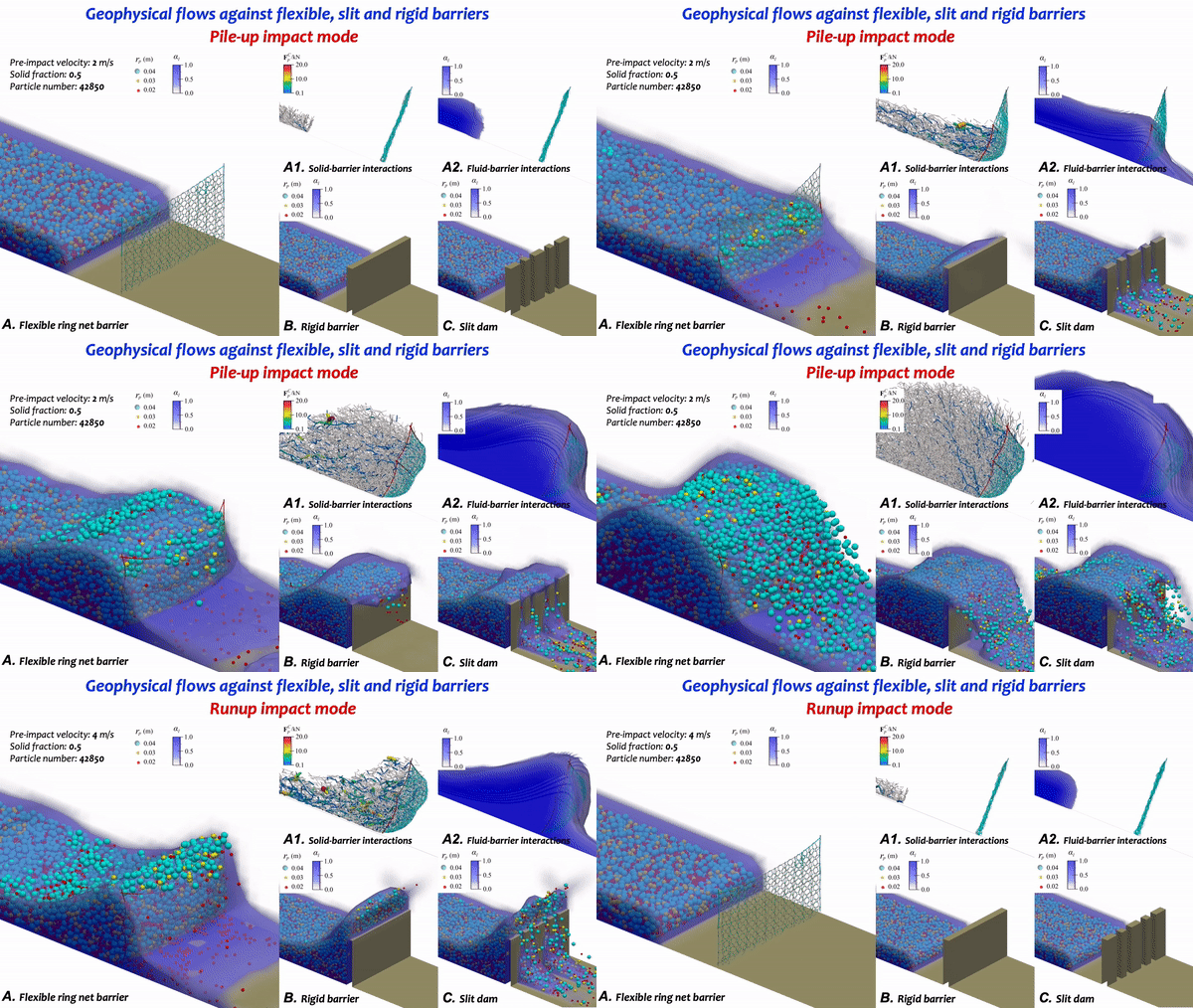
Yong (now working in HKU) has published a recent study on tackling geophysical flows using different mitigation measures, including flexible, slit and rigid barriers, in JGR Earth Surface (see also PDF). Shown animation identifies the conditions for pileup and runup mechanisms occurring in the three barrier cases.
Tackling climate change
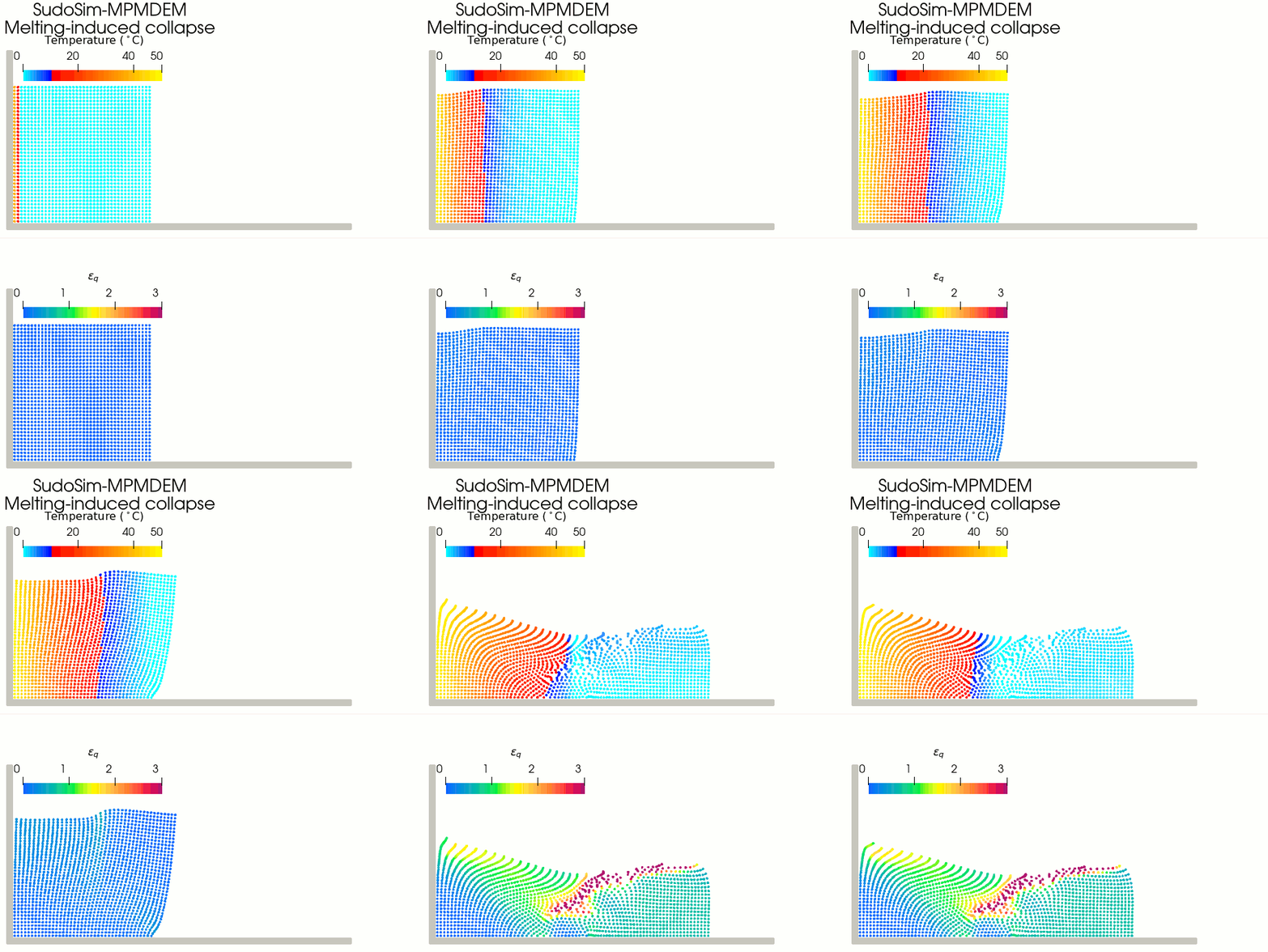
Shiwei has extended multiscale MPM x DEM to tackle thermo-mechanical coupling problems in granular media, in the wake of climate change and global warming. From grain scale physics we consider thermal induced stress, mechanical friction generated heat, and thermal induced melting to simulate relevant boundary value problems. The paper is officially published in Computers and Geotechnics (see also PDF). Shown animation is the temperature rise (from the left) induced ice melting causing collapse of frozen soil column.
Talk at Intelligent Geotechnics Conference
Jidong gave an invited keynote speech entitled "Multiscale modeling of thermo- mechanical coupling problems in granular media" at the International Symposium of Intelligent Geotechnics held online from June 10-11, 2022, organised by Prof Jeff Wang of CityU, Prof Zhenyu Yin of PolyU and Dr Fiona Kwok of HKU. Thank you for inviting me for the talk.
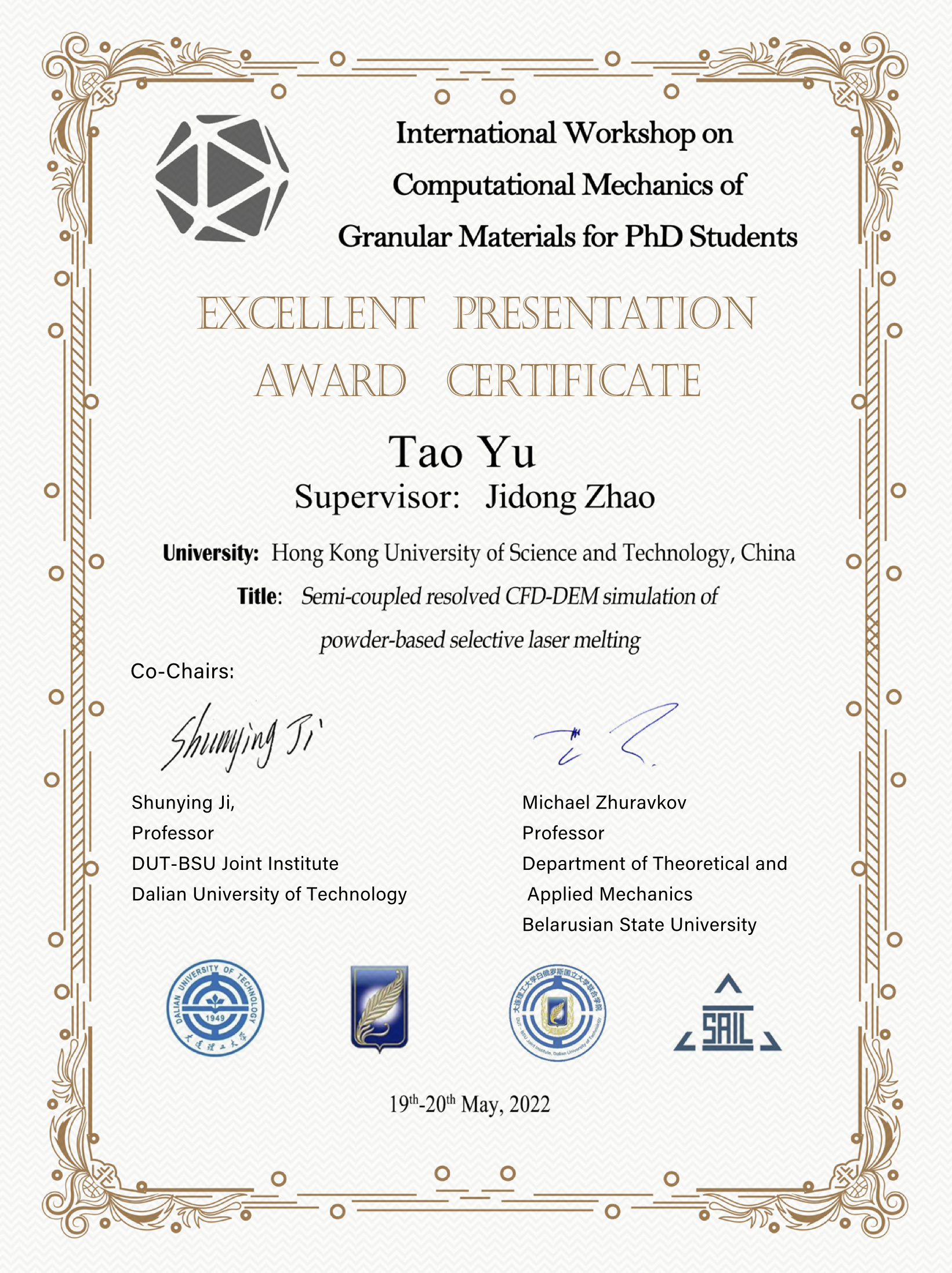
Excellent Presentation Award for YU Tao
PhD student YU Tao has won an Excellent Presentation Award with cash prize in the International Workshop on Computational Mechanics of Granular Materials for PhD Students, organised by Dalian University of Technology and Belarusian State University online from 19-20 May 2022. Congrats Tao!
New Lab members
We warmly welcome the joining of a new postdoc fellow, Dr. Tongming Qu, for our lab. Tongming received both his bachelor's and master's degrees from Central South University (China) and earned his PhD from Swansea University (UK) in Dec 2021. He works on developing novel DEM algorithms for geotechnical applications and physics-based data-driven constitutive modelling of granular materials.
2022 HKSTAM Distinguished lecture
Jidong has given a Distinguished Lecture on "Multiscale, multiphysics modeling of granular materials" in the 25th Annual Conference of HKSTAM 2022 in conjunction with 17th Jiangsu-Hong Kong Forum on Mechanics and Its Application, held online on 23 April 2022. He is grateful for Prof Gang Wang and HKSTAM for the kind invitation.
Invited lecture at Tianjin University
It was a great pleasure to give an invited online lecture on "Multiscale modeling of debris flow and their mitigation" for a 200+ audience organized by Tianjin University (地震工程综合模拟创新基地-智汇讲坛- 云讲座). Grateful for Prof Jie Xu, Prof Mingjing Jiang and Tianjin University for arranging such an opportunity to introduce our debris flow research.

New HKPFS Award
An upcoming student, Changyi Yang, has been awarded a prestigeous Hong Kong Ph.D. Fellowship (HKPF) to join the Lab as a Ph.D. student in Fall 2022. Changyi is currently finalizing his master's study at Tongji University of China. With Changyi's joining, our lab has proudly hosted a total of 6 HKPFS awardees. The Hong Kong PhD Fellowship Scheme (HKPFS) aims at attracting the best and brightest students in the world to pursue their PhD studies in Hong Kong's universities.

Fan to join Kyoto University
We are happy and proud to share a good news that Dr Fan ZHU has accepted an offer of Associate Professor (with tenure) from Kyoto University and will assume his position in the coming May. Many congratulations Fan! We wish you all the best for your future career in Japan.
Early this year, former PhD student Dr Xingyue Li joined Tongji University as a Distinguished Research Fellow (特聘研究员,equivalent to a full professor rank), after two-year postdoc at EPFL. Congrats to Xingyue too!
Despite the difficulty with pandemic, it is a great start for our group to see group members launch their academic careers in top universities around the world!
State Of the Art Lecuture at GeoCongress 2022
Jidong is honoured and pleased to have presented the State Of the Art (SOA) Lecture on "Micro Mechanics and Advances in DEM" at GeoCongress 2022, along with the other 15 distinguished SOA and SOP (State Of the Practice) lecturers in geotechnical engineering (see). The last time GeoInstitute organised SOA and SOP lectures was 10 years again in GeoCongress 2012 which featured almost geotechnical legends (see 2012 SOA and SOP lectures collection). Due to travel restriction by ongoing COVID surge, Jidong delivered his lecture using pre-recorded video.
Scalable MPMxDEM modeling
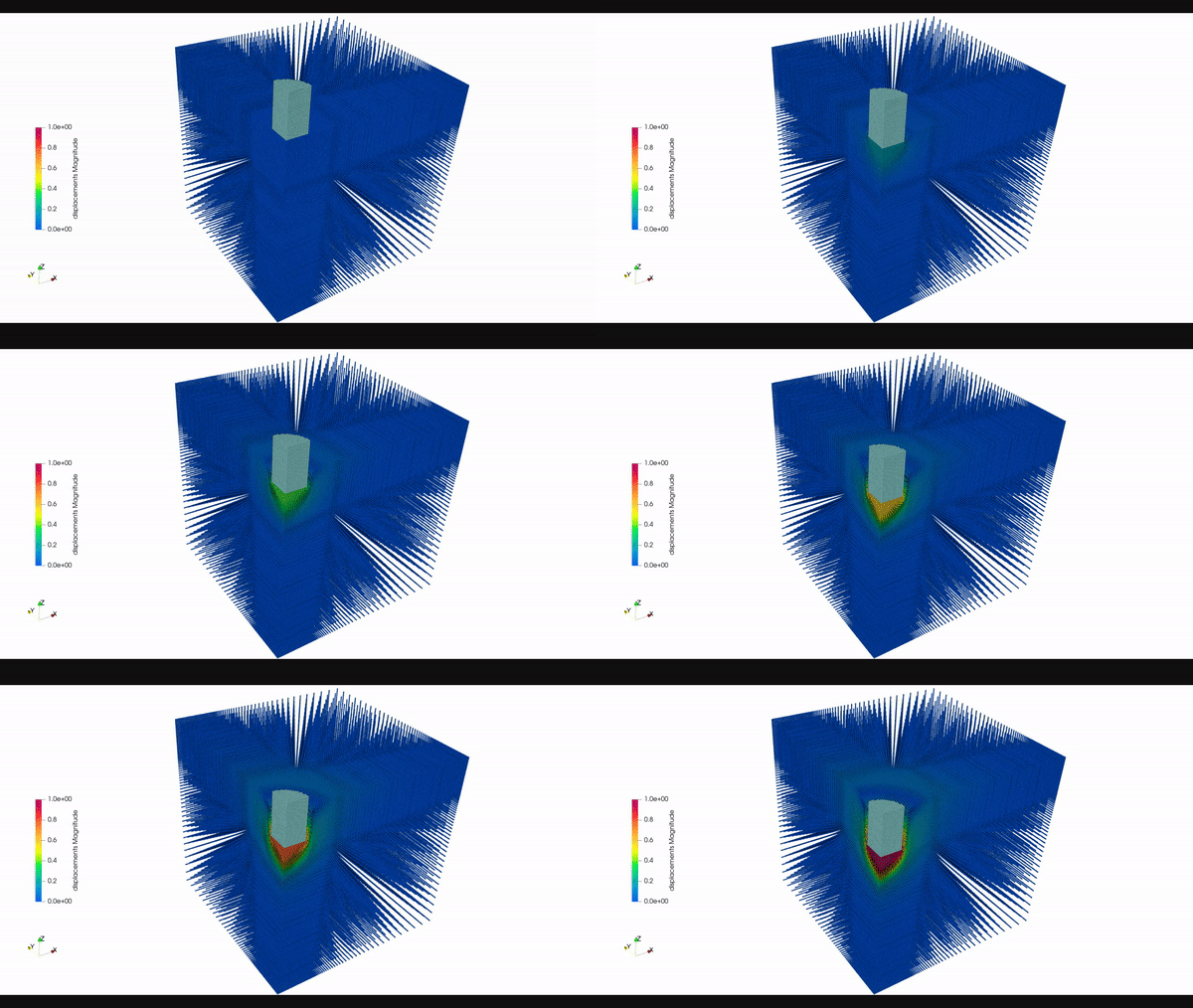
Weijian has developed a new scalable parallel computing scheme based on flat MPI for coupled MPM x DEM multiscale modeling of granular media. It is validated by a intruder problem amounting to a total of 287,496 RVEs and equivalent 229,966,800 DEM particles using 40 nodes on national supercomputer Tianhe 2, showing up to 40X speedup. The paper has been accepted for publication in International Journal for Numerical Methods in Engineering (read preprint)
2021
Two end-year talks
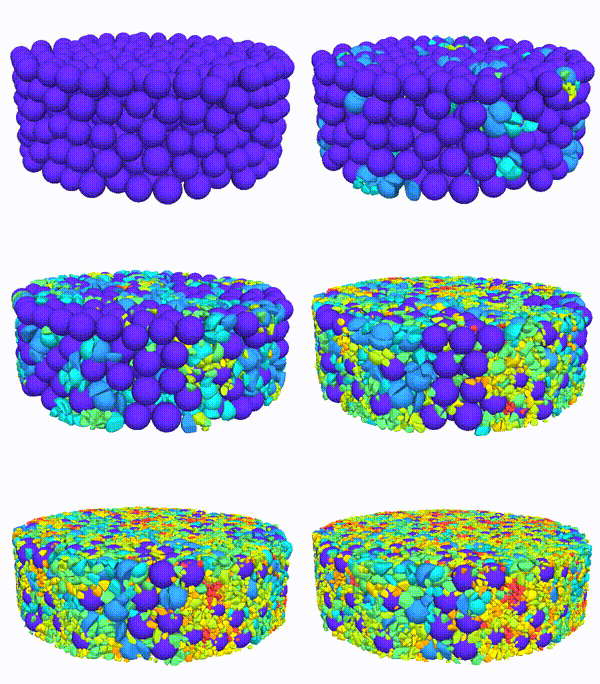
Jidong was invited to give two end-year talks. One is entitled "Numerical modeling of intertwined evolution of grain size and shape in crushable granular media" at the International Workshop on Computational Mechanics of Granular Materials, co-organised by Belarusian State University and Dalian University of Technology on 23 Dec 2021 (thank Prof Shunying Ji for the invitation). The other is on "Multiscale modeling of transition of deformation bands in high-porosity sandstone" at the 2021 Annual Workshop on "Marine Geology and Carbon Sequestration" organised by Key Laboratory of Zhejiang Province on Marine Geology and Resources on 25 Dec 2021. Many thanks to Prof Lizhong Wang for inviting me for the talk.
End year group hiking
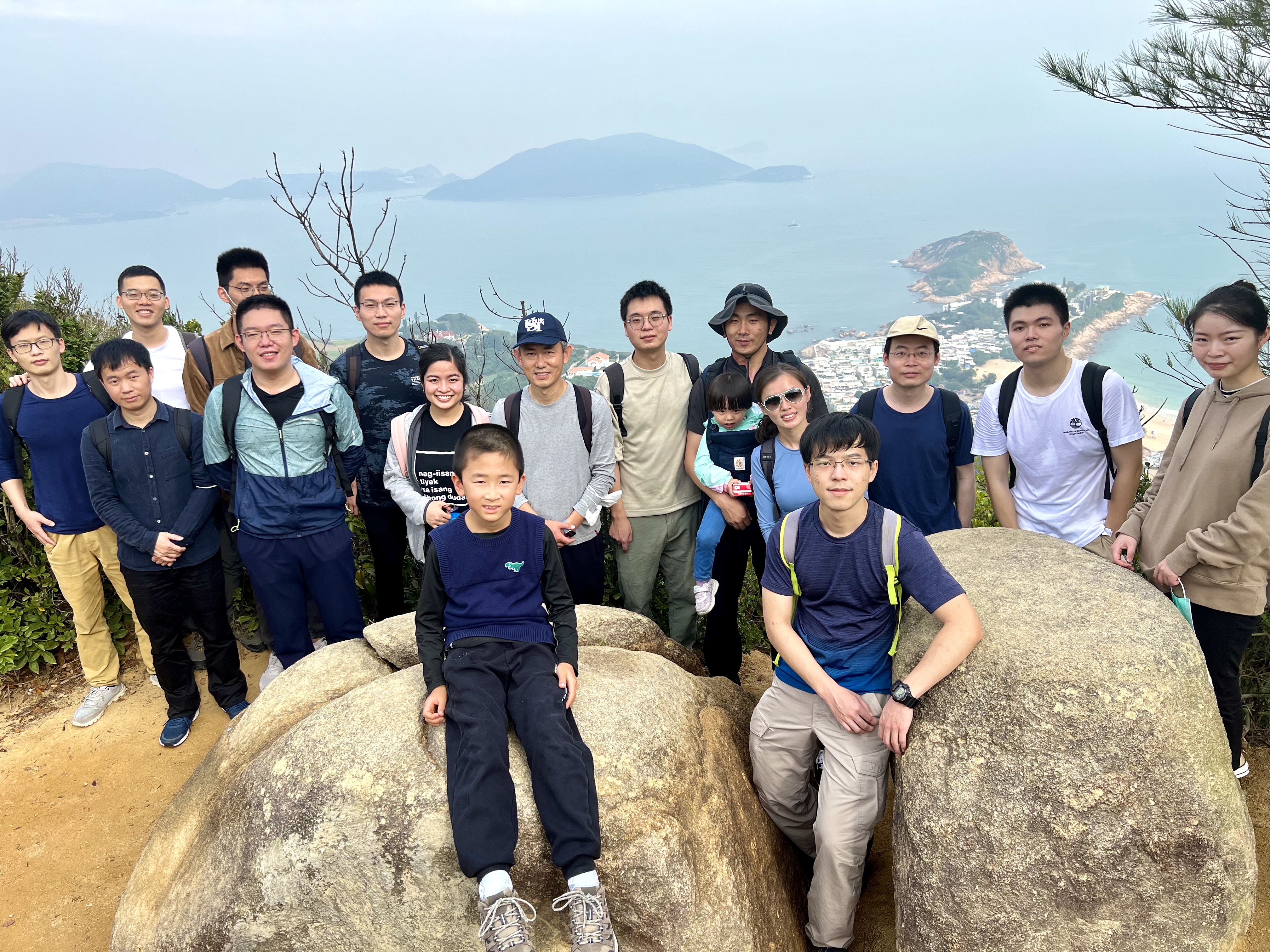
On Christmas eve we held a half-day group hiking over the scenery Dragon's back trail on Hong Kong Island to celebrate the end of semester and the coming holidays. It has been a long while since we have had our last group activities. Former group member Dr. Yong Kong and his family and two project students also joined the hiking. Everyone enjoyed the hiking and the dinner gathering afterwards. We will definitely arrange more similar activities in the future. Sitting on the front is a future robotics engineer (his n-th career dream, n>=4 and counting).

Shiwei returned as Research Assistant Professor
We are pleased to welcome Dr. Shiwei Zhao to rejoin our lab with an appointment of HKUST VPRDO Research Assistant Professorship. Shiwei has worked with us for two years from 2018-2020 before joining South China University of Technology as a tenure track faculty in late 2020, and has kept a close collaboration with our lab on various innovative developments of granular mechanics modeling. Shiwei has grown to be an emerging young star in multiscale modeling of multiphysics (such as thermo-hydro-mechanical coupling) problems in granular media. His open-source code SudoDEM has been well received by the research community. Excited to be able to collaborate with him again.

Keynote at CPT 2021 and invited lecture at Smart Infrastructure Workshop
Jidong gave an invited keynote lecture online entitled "Continuum-discrete coupling for multiscale modeling of granular media" at the 3rd International Symposium on Computational Particle Technology (CPT 2021), held in hybrid mode in Suzhou (China) and Melbourne (Australia) , 17-21 Nov 2021.
Jidong has also given an invited online talk entitled "Peridynamic simulation of continuous grain crushing in granular media" at International Workshop of Smart Infrastructure Development towards Smart City, organised by Prof Shuilong Shen and Prof Zhenyu Yin in online mode, hosted by Shantou University, Shantou, China, 20 Nov 2021.
Jidong delivered online keynote at WISE 2021
Jidong has given an invited online keynote lecture entitled "Paradigm shift in computational modeling of granular media for geomechanics" at 2021 Westlake International Symposium in Engineering (WISE 2021), held by Westlake University, Hangzhou, China, 26-27 Oct 2021. Thank Prof Ling Li and Prof Sergo Torres for the invitation.
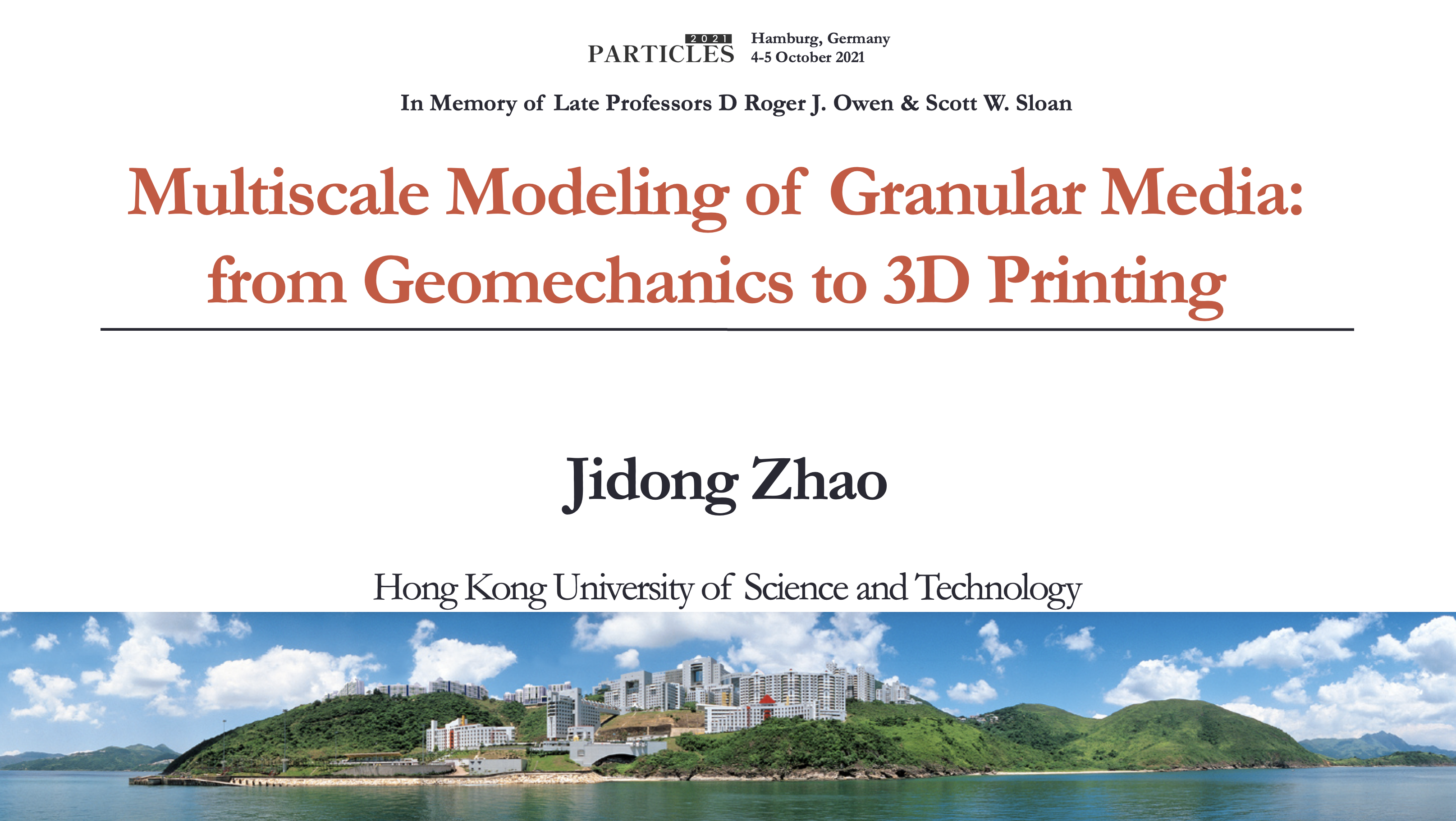
Jidong gave plenary keynote at PARTICLES 2021
Jidong has given an invited online keynote lecture at the VII International Conference on Particle-Based Methods (PARTICLES 2021), held in Hamburg, Germany, 4-5 Oct 2021. The conference was held in hybrid mode. Thank Prof Eugenio Oñate, Prof. Peter Wriggers and the organizing committee for inviting me.
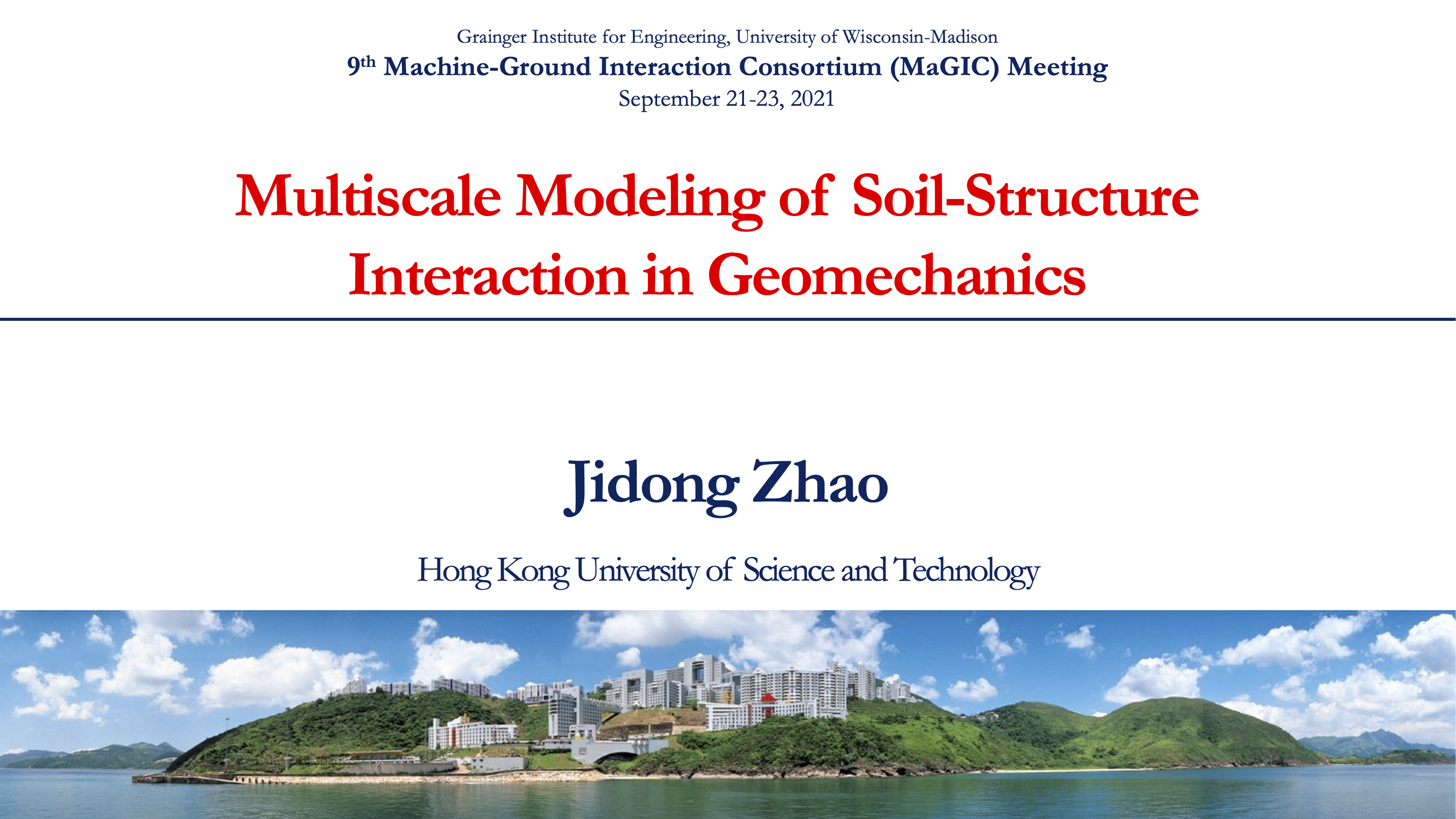
Invited talk at MaGIC 2021
Jidong gave an invited talk on "Multiscale modeling of soil-structure interaction in geomechanics" at the 9th Machine-Ground Interaction Consortium Meeting (MaGIC 2021), Grainger Institute for Engineering, University of Wisconsin-Madison, 21-23 Sept 2021. Thank Prof Dan Negrut for the kind invitation.
Jidong gave a keynote at 2nd INLGEO
Jidong gave an invited keynote lecture entitled "Multiscale modeling of large deformation in geomechanics" at the Second International Workshop on Numerical Simulation Methods for Large Deformation Problems in Geotechnical Engineering (2nd INLGEO, 18-19 Sept 2021, Shanghai, China). Thank Prof Hongwei Huang and Dr. Mingliang Zhou from Tongji University for the organising and invitation.
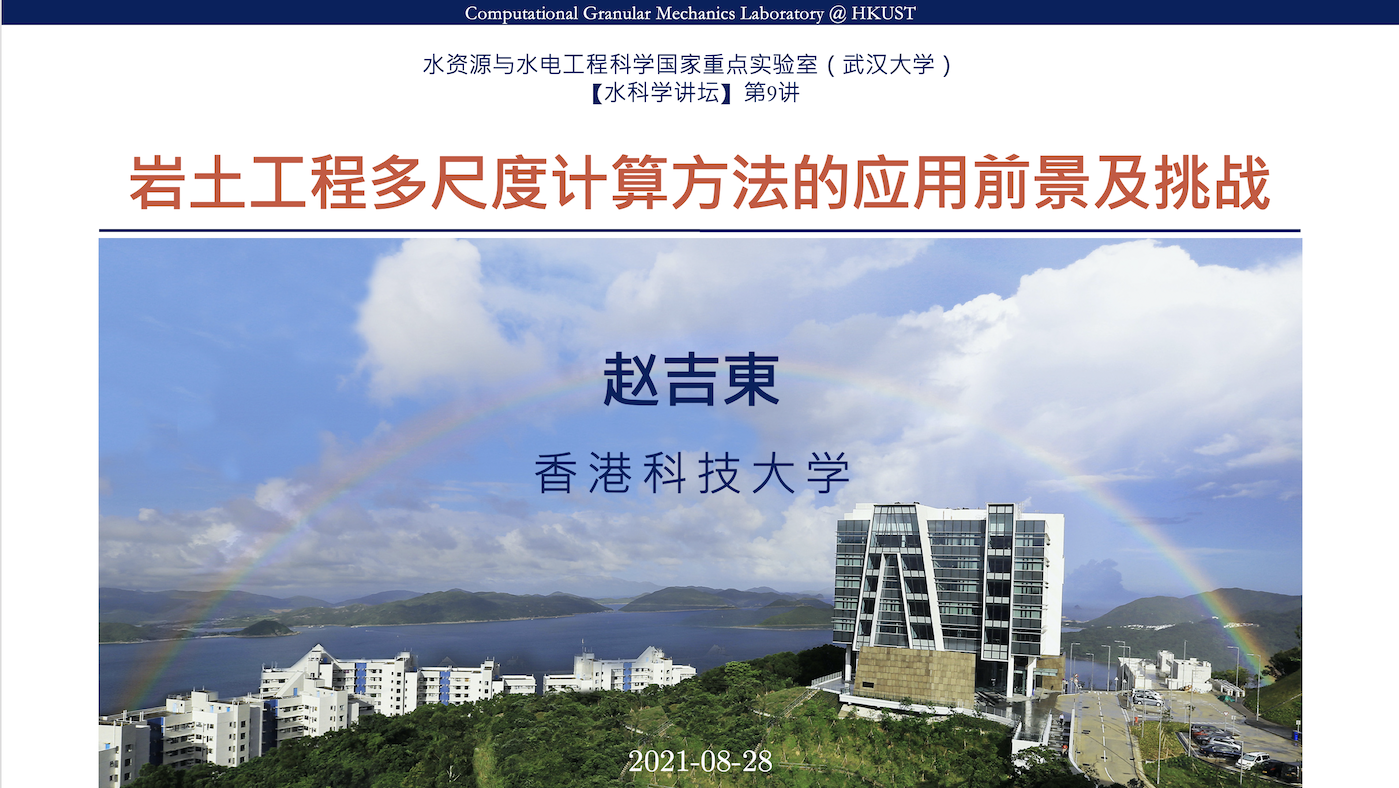
Jidong gave an online lecture at State Key Lab
Jidong was invited by the State Key Laboratory of Water Resources and Hydropower Engineering Science (Wuhan University) to give an online 'Water Science Lecture' on multiscale modeling in geomechanics. The lecture was hosted by the Lab Director Prof Dianqing Li and attracted 500+ attendees.
Two new members joining lab
Our Lab is joined by two new Ph.D. students, Jidu Yu from Hohai University of China and Renee Vizmanos from University of the Philippines, Diliman. Welcome both of you for joining the Lab amid this trying time of pandemic. We wish you a successful and fulfilling journey at HKUST!
USNCCM Conference Presentations
Fan and Jidong have attended the virtual 16th U.S. National Congress on Computational Mechanics (July 25-29, 2021). Each gave a talk on our recent work on Peridynamics in the invited minisymposium on Peridynamic Theory and Multiscale Methods for Complex Material Behavior of the conference organised by Pablo Seleson and coworkers.

France/Hong Kong Joint Research Workshop
The CGM Lab has successfully held the second half-day online workshop with Dr. Jérôme Duriez of INRAE, France, and his group. Five research presentations and stimulative discussions have been made during the workshop, as part of a France/Hong Kong Joint Research Scheme project . We expect closer collaborations among members of the two group.

Keynote Lecture at P&G 2021
Jidong gave an invited keynote lecture entitled "Multiscale modeling of granular media for geomechanics and beyond" at the 2021 Powders and Grains (Argentina, Virtual) Conference. Powders & Grains is a prestigious international scientific conference held every four years. It gathers top researchers working on the physics and micromechanics of granular media and features a single plenary session wtih a great mixture of multidisciplines from civil and chemical engineering, pharmaceutical and powder industries, and granular physics.
A net of seven tales
Yong has published his paper quantifying the transition of impact mechanisms by simulating different geophysical flows impact onto a flexible barrier. The transition from pileup to run up mechanisms is found closely related to flow features and barrier responses. The paper has been published in Engineering Geology (see also PDF).
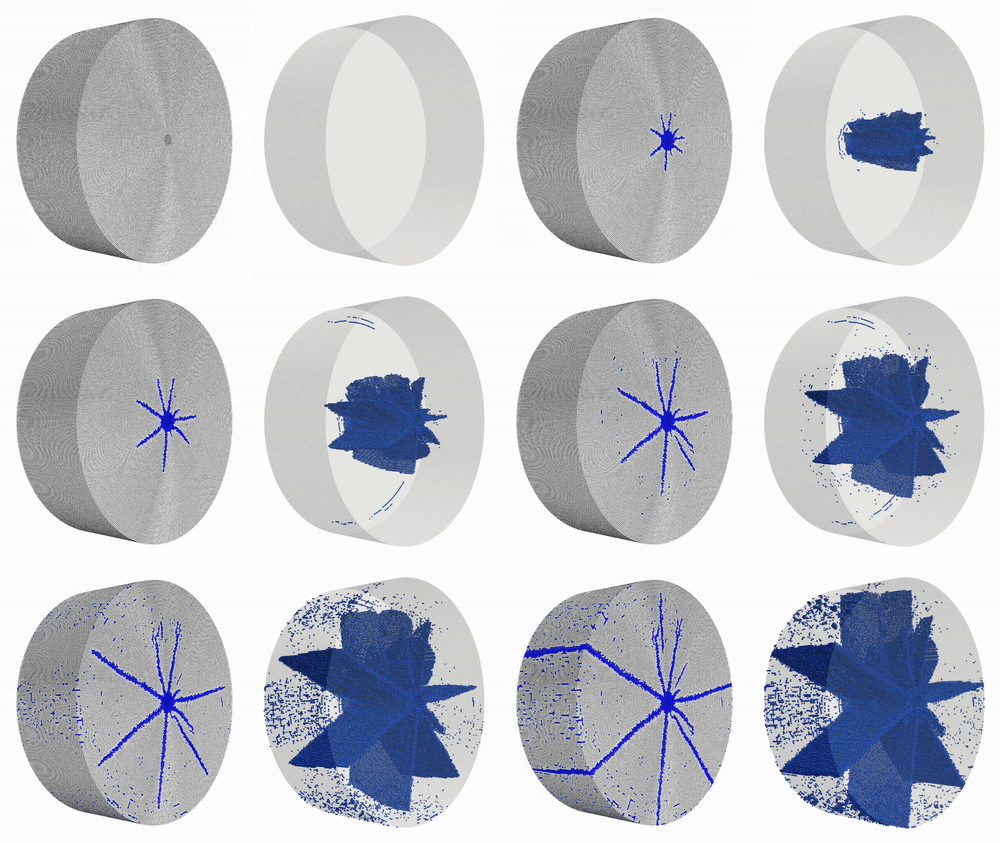
Peridynamics on rock blasting
Fan has published his new paper on rock blasting in Journal of the Mechanics and Physics of Solids (see also PDF). He developed a new non-ordinary state-based peridynamics approach to consider pressure dependency, strain rate effect, and viscoplasticity in rock fracture under blasting, in conjunction with updated Lagrangian peridynamics with Jones-Wilkins-Lee equation of state to simulate detonation of explosives and gas expansion.
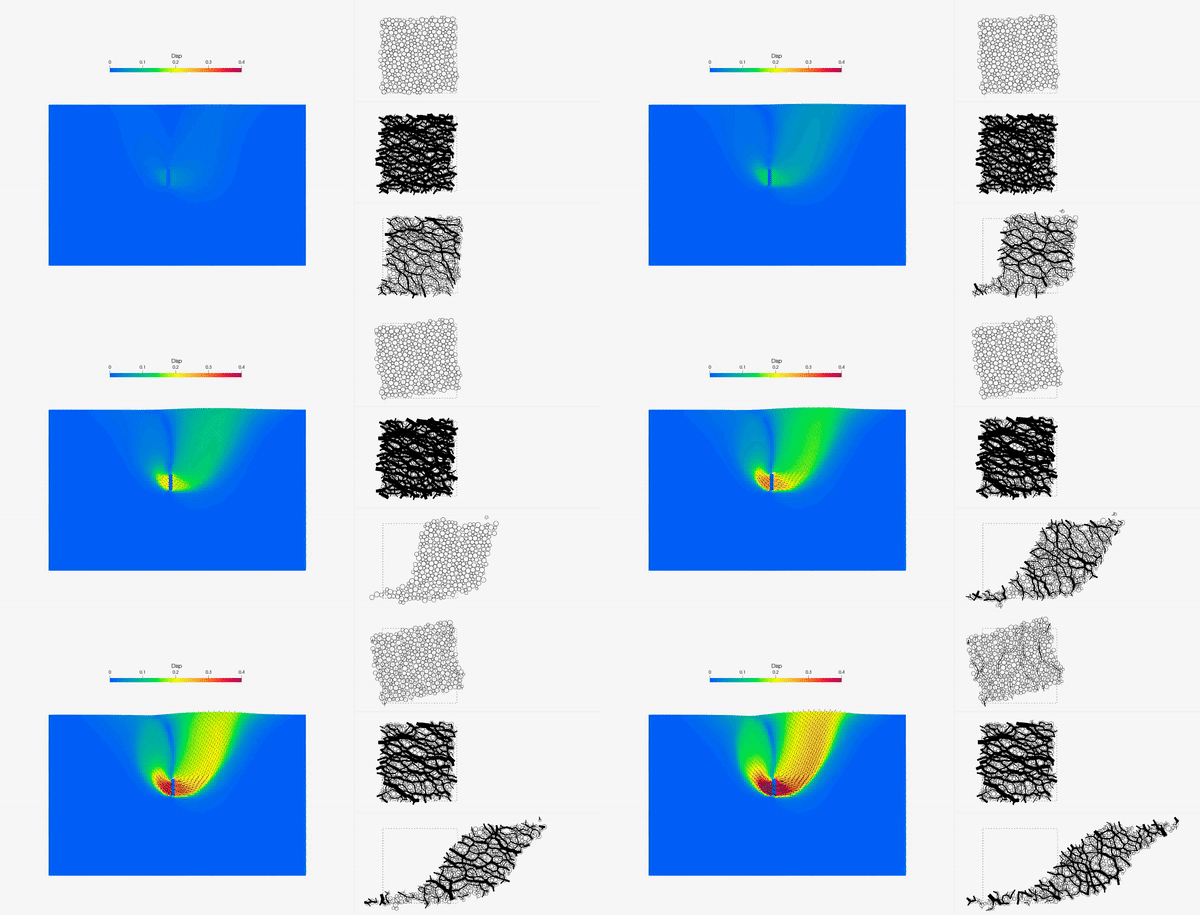
Offshore anchor pullout
Weijian's new paper on offshore anchor pullout has been published in JGGE (see also PDF), where a thorough multiscale analysis was performed to predict the pullout bearing capacity of both horizontally and vertically placed anchor buried in loose and dense sand at different depth. Shown in the animation are contact force network evolutions for three RVEs (from top to bottom) located behind and immediately in front of the anchor plate and at the edge of the front shear banding, respectively.
The work was a collaboration with Prof. Kenichi Soga of UC Berkeley.
New Lab Members and HKPF
We proudly announce that two new members will be joining our Lab in the coming Fall semester as Ph.D. students, Jidu Yu from Hohai University, China and Renee Vizmanos from University of the Philippines Diliman, Philipine. In particular, Renee has been award the prestigious Hong Kong Ph.D. Fellowship (HKPF) to support her Ph.D. in our Lab. Congratulations to both of them and look forward to their joining.
If you are interested in joining our Lab, please feel free to contact us. The coming round (2021/2022) Hong Kong Ph.D. Fellowship (HKPF) scheme will open from 1 Sept 2021. You are advised to contact us as early as possible for expression of interest.
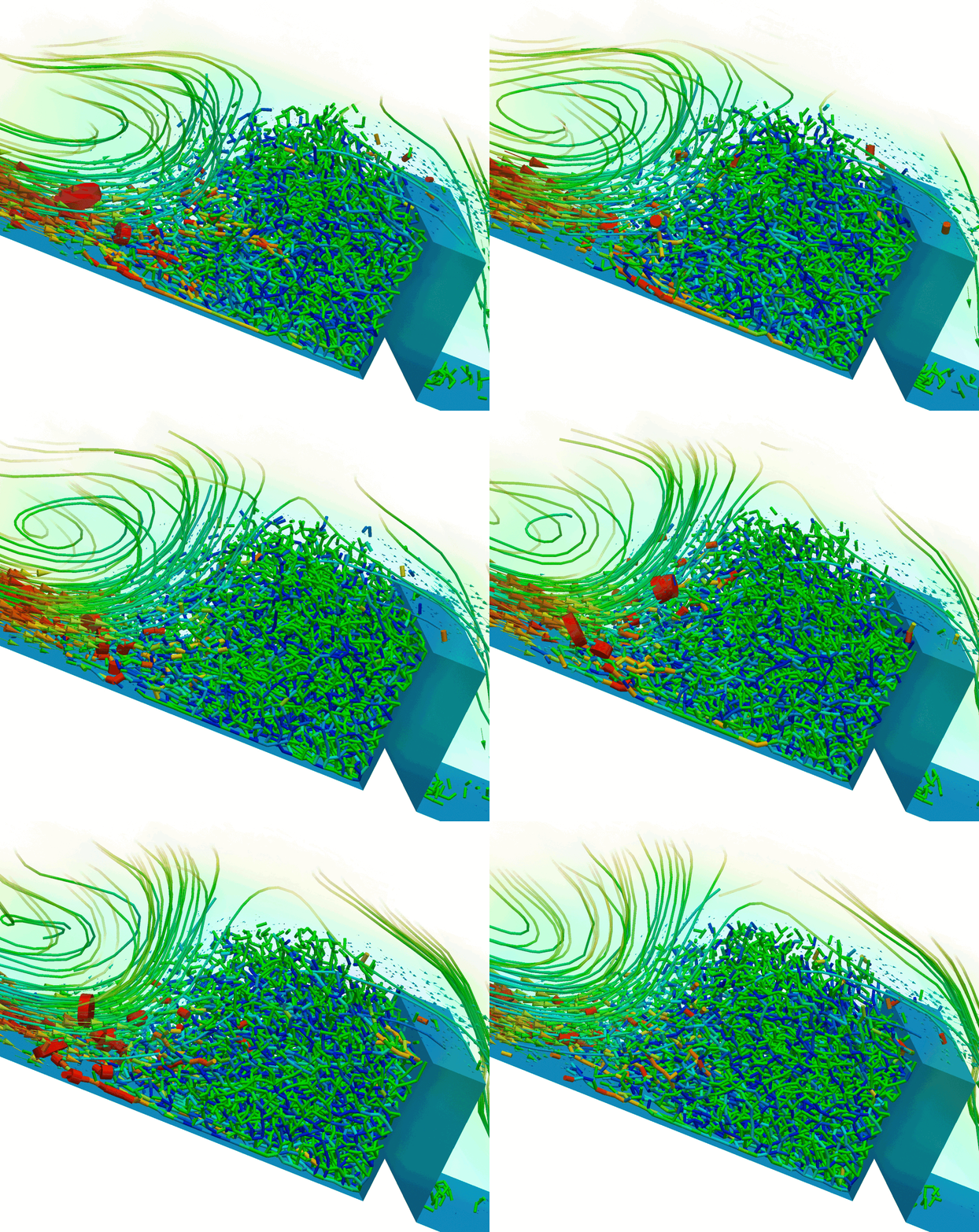
Hydrodynamic Dead Zone
Yong has published his recent work on quantification and characterization of hydrodynamic dead zone formed when a sedimment gravity flow impacts a rigid barrier in Powder Technology (see also PDF). Yong developed a new granular temperature taking into account of polydispersity and both translational and rotational flucturations of displacements of granular system as a measure for this purpose. He has also proposed a simplified source-sink model on its interpretation.
New Lab Member
Our Lab warmly welcome Dr Zhengshou Lai from Sun Yat-sen University joining as a postdoc research fellow, co-sponsored by the “Hong Kong Scholars Program”. Zhengshou obtained his Ph.D. (2018) from Clemson University. He will work on crushable particulate material modeling.
Meanwhile, Shiwei has finished his two-year, productive postdoc under the 'Hong Kong Scholars Program' in Oct 2020 and has accepted an appointment as associate professor at South China University of Technology. Thank you, Shiwei! We wish you all the best for your future career!
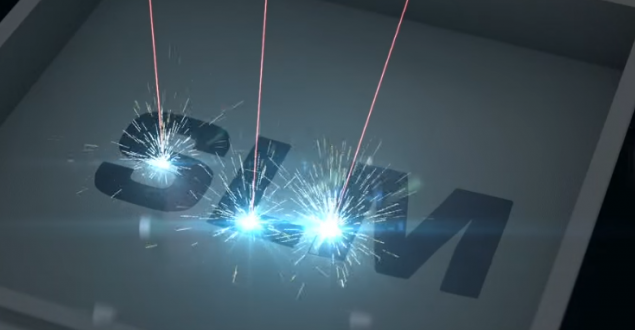
Lab go for 3D Printing
It is exciting to report our lab's first publication in powder-based selective laser melting for additive manufacturing has been published in Computer methods in Applied Mechanics and Engineering (see also PDF). It was a brilliant work by our first-year PhD student, Tao YU, a HKPF awardee. Tao developed a rigorous coupling scheme of fully resolved CFD with DEM to tackle the complicated thermal induced phase transition of granular powders into metal liquid and thereafter solidified product as well as the accompanied fluid-particle interactions that may control the finishing quality. The following animation shows a multi-track printing process. We are excited to further improve this advanced computational tool for real additive manufacturing applications.
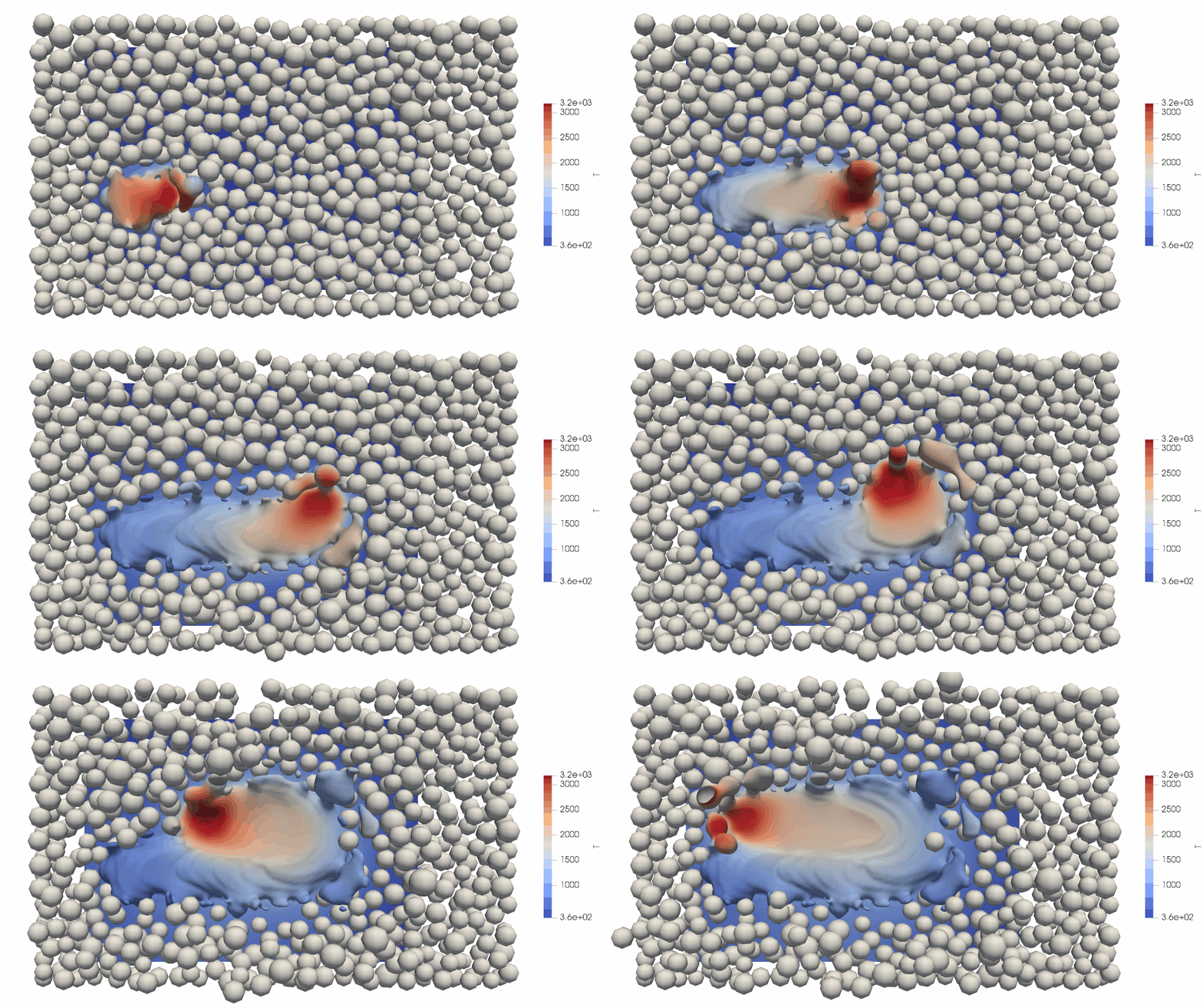

Keynote at IRN GeoMech Symposium 2021
Jidong has been invited to give a keynote speech at the Interntional Research Network (IRN) GeoMech Online Symposium on "Micromechanics of granular materials: relationships between microstructure and macroscopic behaviour, from experiments to modeling", organised by Niels Kruyt, Francois Nicot, Olivier Millet and Chaofa Zhao, 18-19 January 2021. It was a great online conference.
2020
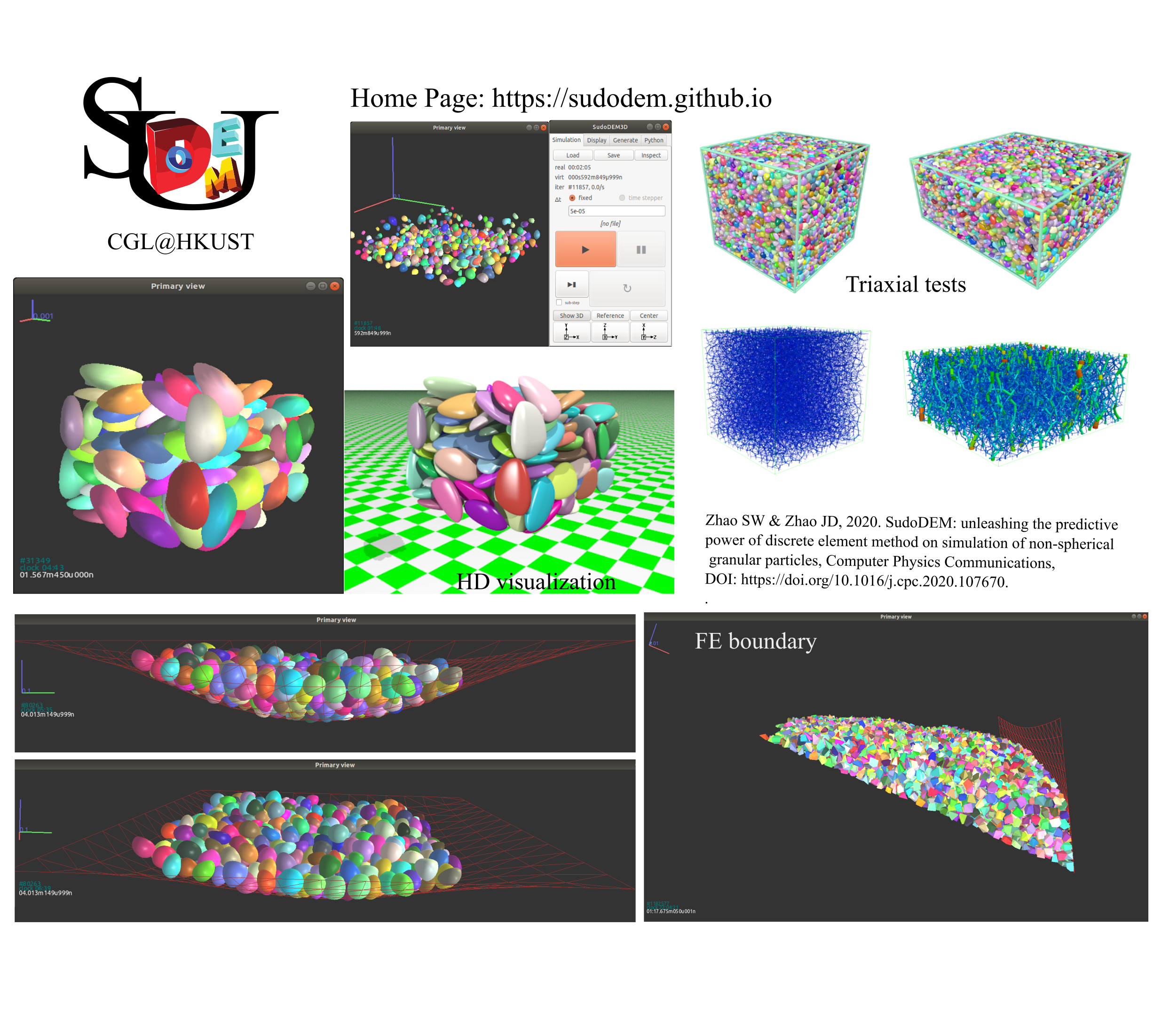
SudoDEM is officially launched
Dr Shiwei Zhao has had new DEM code fully functional for non spherical grains modeling, SudoDEM, open-sourced for free download and use for the community: https://sudodem.github.io. Full features of SudoDEM are summarised in a new paper published in Computer Physics Communications.
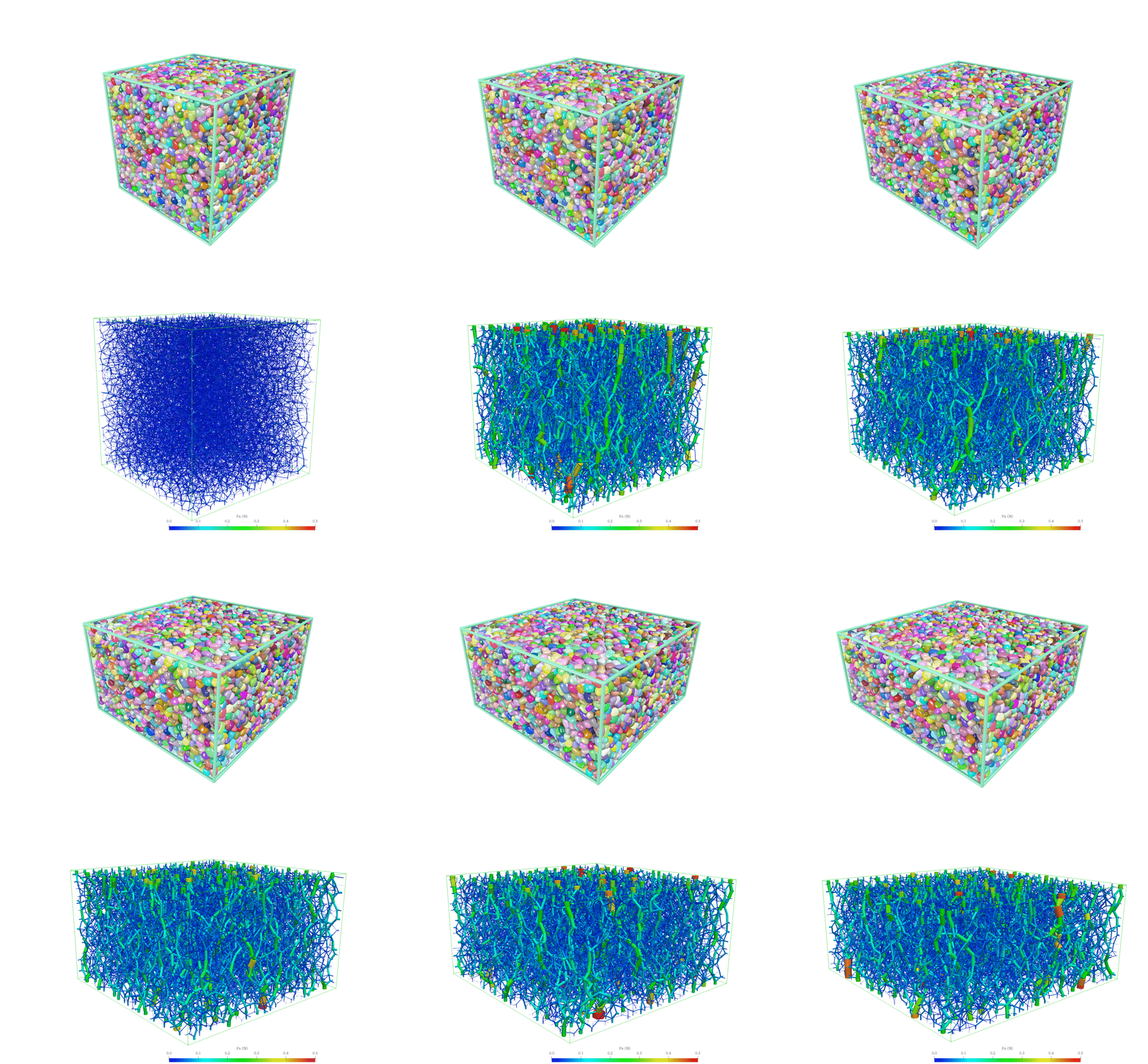 Triaxial compression of assembly with poly-superellipsoids and evolution of contact force network by SudoDEM
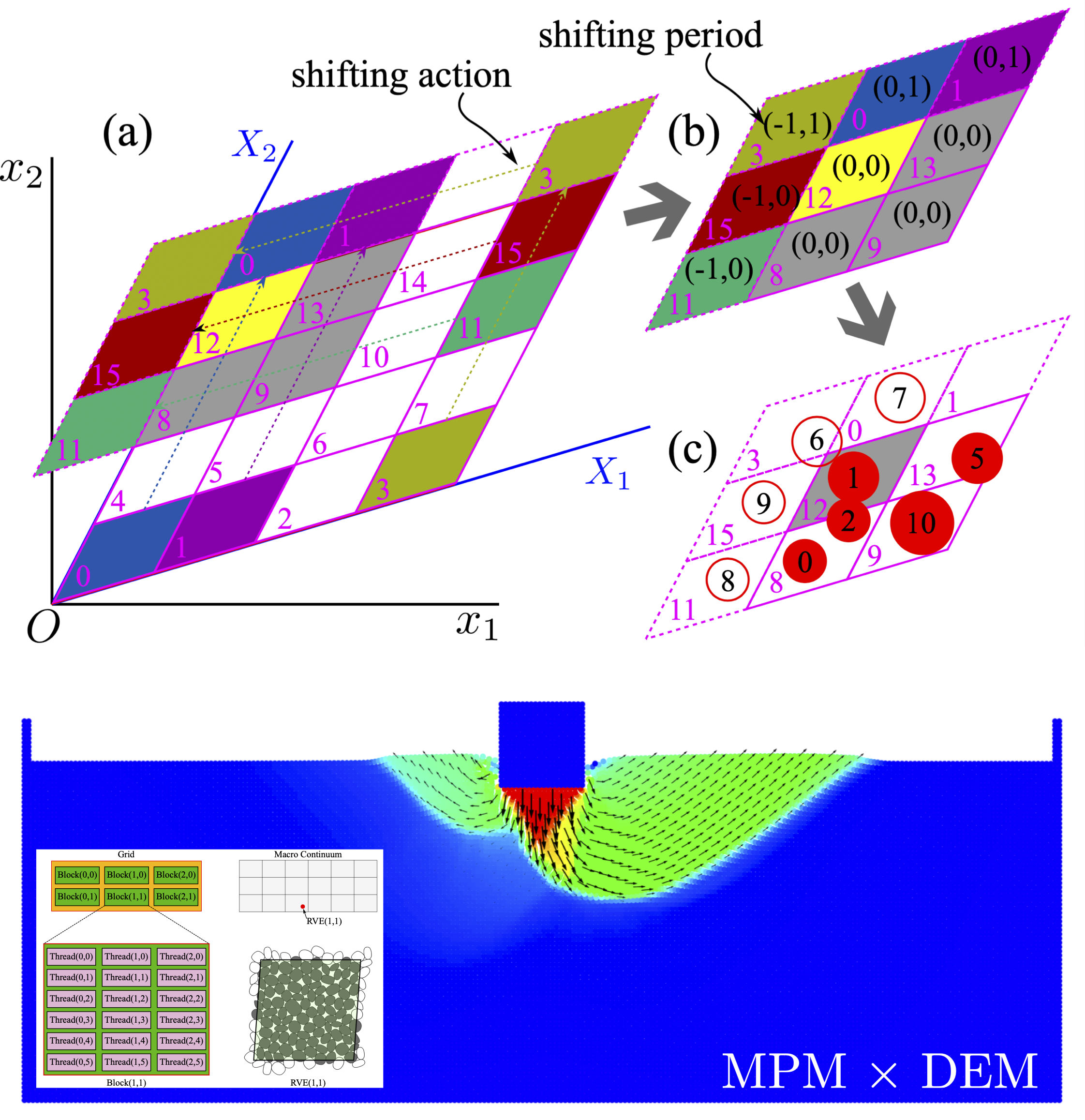
Speedy match for multiscale modeling
Speedy match! Shiwei has proposed a scalable thread-clockwise RVE based parallel computing scheme - GoDEM - to match hierarchical multiscale modeling with GPUs. GoDEM (with MPM x DEM) finished modeling a footing below with 7.68 million particles in total for RVEs in 33 mins, or 91 times faster than parallel CPU computation (CPU: 2xIntel Xeon E5-2670; GPU: 1xNvidia Geforce RTX 2080 Ti). Paper published in NME.
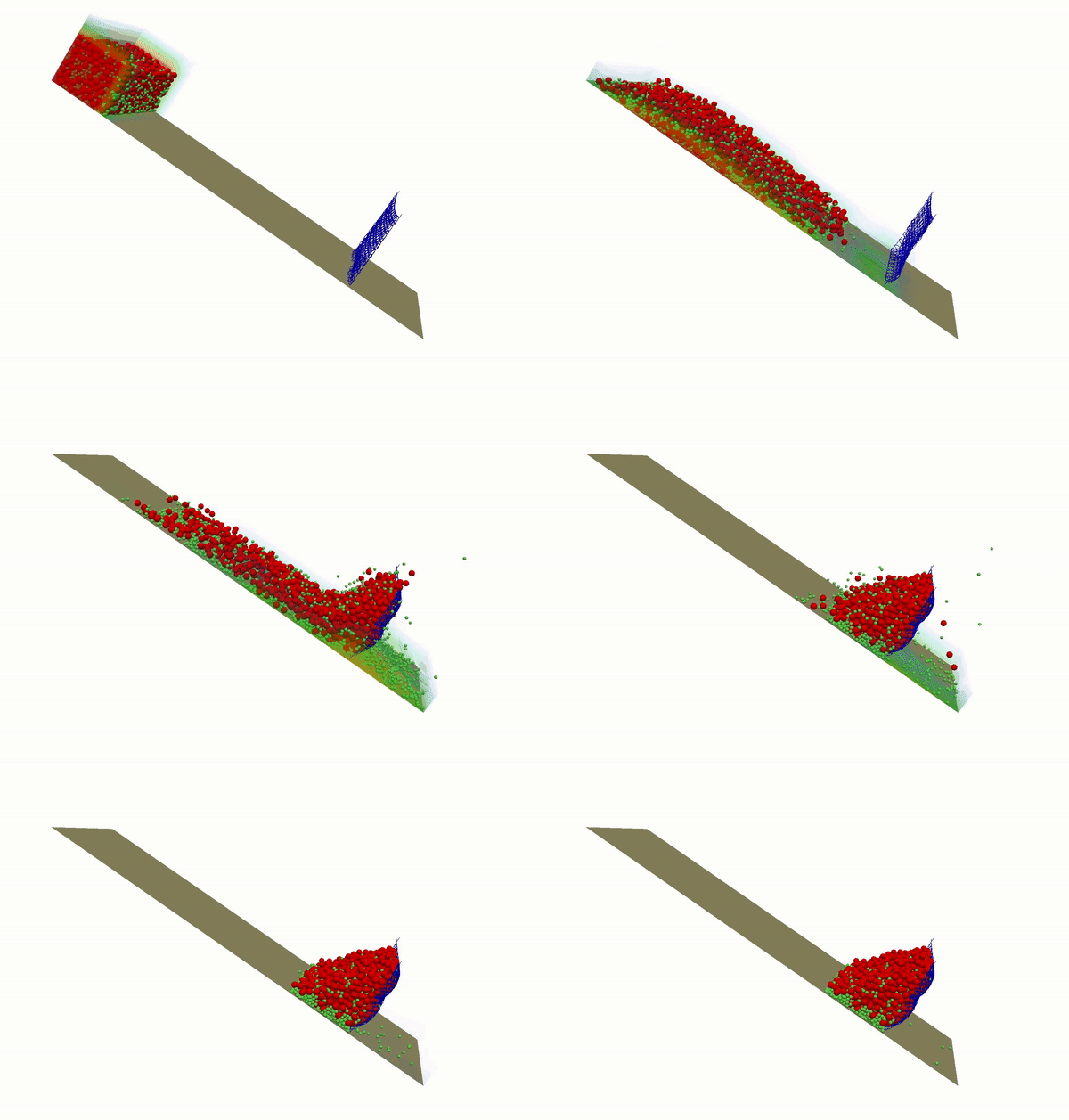
Netting debris flow
Xingyue has published a paper on intercepting debris flow by flexible ring barrier based on coupled CFD-DEM where multi-way, multi-physics interactions among the debris solids, the debris fluid and the different deformable components of the flexible ring barrier are captured, including ring-ring and ring-cable frictional contact and sliding.
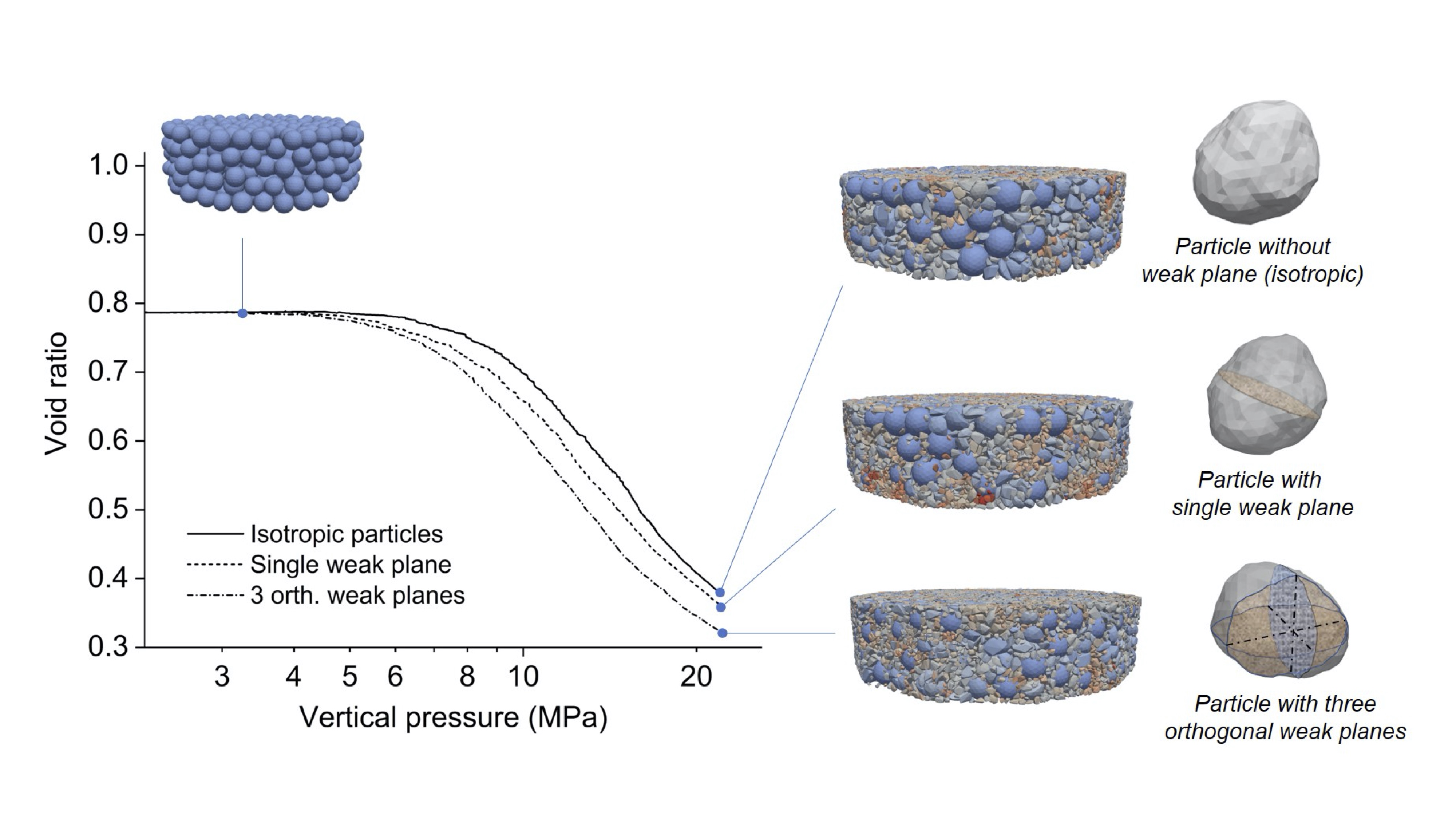
Weak planes dominate grain crushing
Weakness and defects in a granular grain may dominate its crushing. In this new paper by Fan recently appearing in Computational Particle Mechanics, we examined how weak planes dictate the evolution of grain crushing during 1D compression, based on coupled non-smooth contact dynamics and peridynamics. Weak microstructural planes in a grain are simulated by breaking a fraction of peridynamic bonds as an initial condition. Our simulation results show that anisotropic particles containing weak planes may result in larger number of fragments and exhibit relatively higher fractal dimension with respect to particle size than perfect particles without defects.The paper has been published online.
D-Day
It's D-Day! Two lab members, Yong and Weijian, have successfully defended their Ph.D. theses via Zoom! Yong's thesis is entitled "COMPUTATIONAL MODELING AND ANALYSIS OF MULTIPHASE GEOPHYSICAL FLOWS INTERACTING WITH RESISTING STRUCTURES", and Weijian's thesis title is "MULTISCALE MODELING LARGE DEFORMATION IN GRANULAR MEDIA". Very warm congratulations to both! Well done. It's a pity the COVID-19 outbreak prevents us for a celebration dinner.
New Lab Members
The Lab warmly welcomes a new member, Dr Yiqiu Zhao, to join as a postdoc research fellow. Yiqiu obtained his Ph. D. in physics from Duke University, USA, in May 2020. His expertise lies in experimental testing and physical interpretation of non-equilibrium phase transitions in granular media. He will work closely with the lab members to combine his experimental and physical insights with our strength in computational granular mechanics to tackle various problems on granular media.
Two more members will be joining the lab in August, Quan Ku from Huazhong University of Science and Technology, and Terry Leung from HKUST, as a Ph.D. student and a MPhil student, respectively. Welcome all of you!.

Promotion Season!
It is promotion season! Jidong has officially been promoted to full professor at HKUST. The group's first Ph.D. graduate, Dr Zhiwei Gao, has been promoted to Senior Lecturer in geotechnical engineering in the James Watt School of Engineering at the University of Glasgow. (see his website).
Zhiwei joined the Soil Mechanics Group within the Research Division of Infrastructure and Environment at the University of Glasgow as a lecturer in 2013. His current research interests include micromechanics of granular materials, micromechanics-based constitutive modelling of granular materials and experimental and constitutive modelling of fibre-reinforced sand.
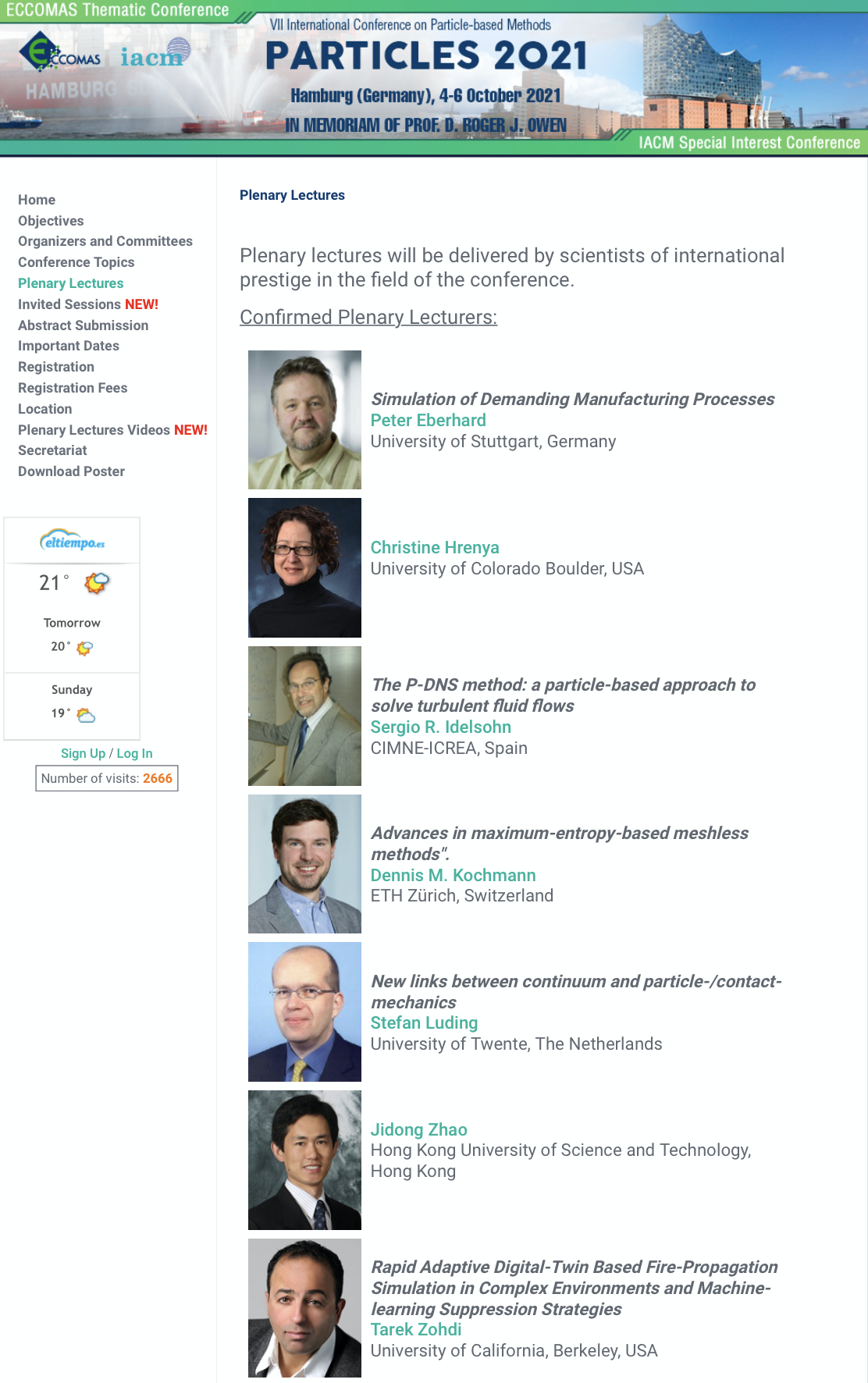
Invited plenary keynote for PARTICLES 2021
Jidong has been invite to give a plenary lecture for the upcomging PARTICLE 2021 conference to be held in Hamburg, Germany, 4-6 Oct 2021.
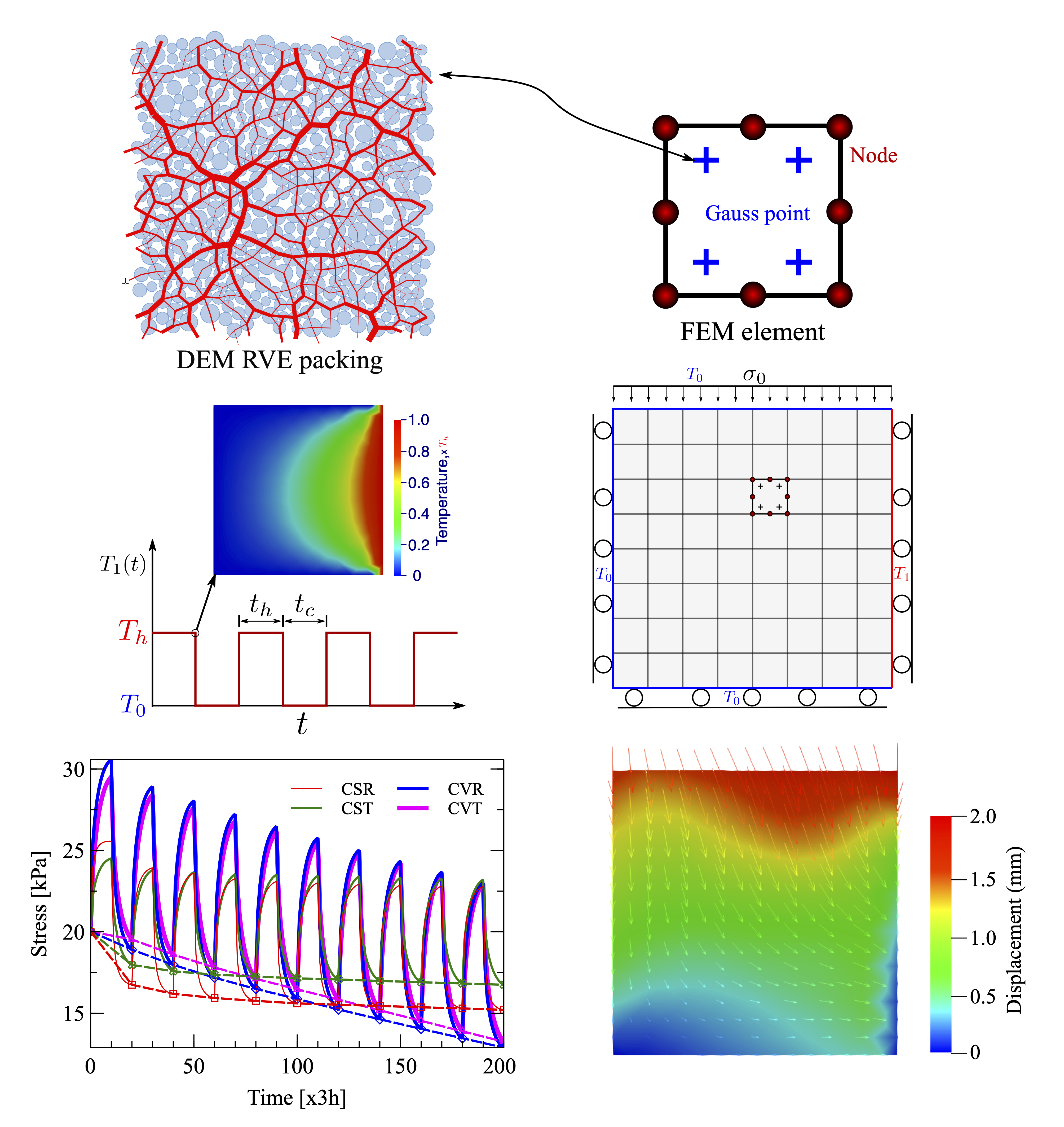
[New Paper]Thermo-mechanical multiscale modeling
New paper by Shiwei on multiscale modeling of thermo-mechanical behavior in Granular Media has been accepted by Computer Methods in Applied Mechanics and Engineering. We couple dual FEMs hierarchically with DEM considering grain contact heat conduction at shared Gauss Points to solve BVPs.
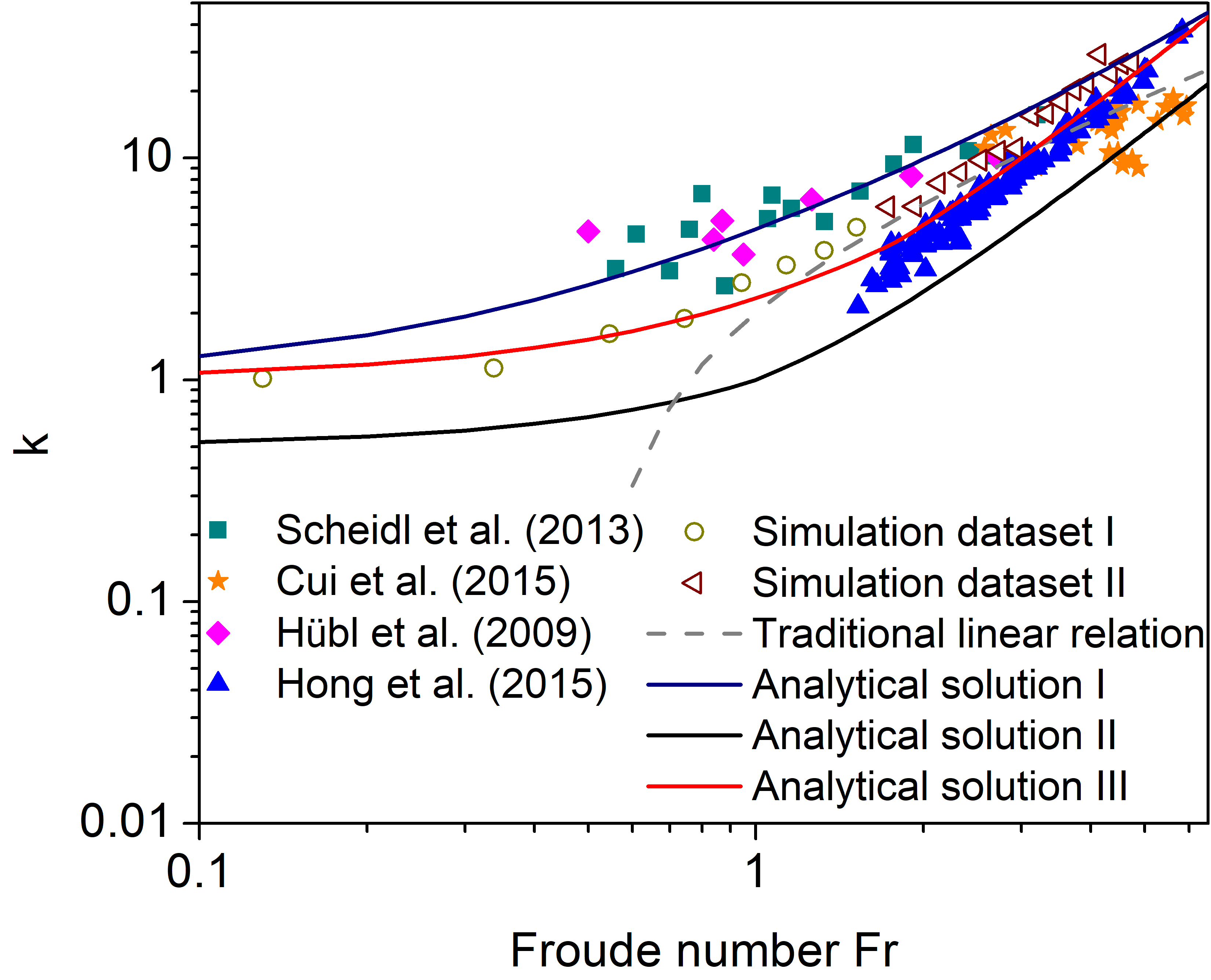
New debris impact model
We derived a new peak impact model for debris flow resisting barrier design, including both dynamic and static contribution. Model validated by experimental, field & CFD-DEM simulation data. This is a collaborative work by Xingyue (now EPFL), Jidong and Kenichi (UC Berkeley) recently accepted by Geotechnique (Read paper).

HKPFS Award
Lab member, Tao YU, has been awarded a prestigeous Hong Kong Ph.D. Fellowship (HKPF). The Hong Kong PhD Fellowship Scheme (HKPFS) aims at attracting the best and brightest students in the world to pursue their PhD studies in Hong Kong's universities. Over eighty percent of nominations by HKUST won the 2020 HKPFS. Tao will work on powder-based laser-melting 3D printing for his Ph.D.
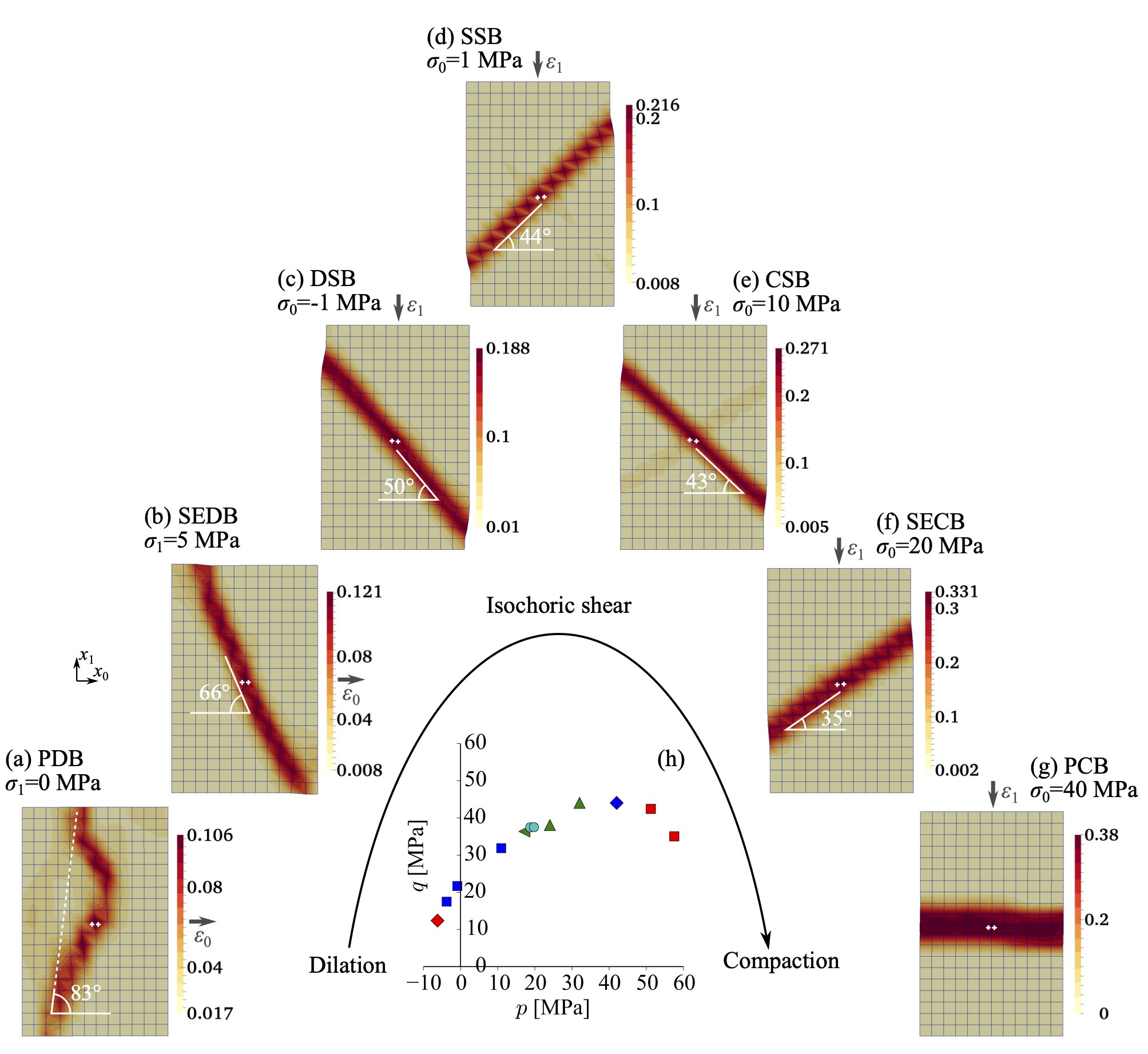
New paper on compaction band
New paper accepted by Rock Mechanics and Rock Engineering (Springer) on multiscale modeling of full spectrum of deformation bands in porous sandstone, from pure dilatant band, dilative & compactive shear band to pure compaction band. A new classifier defined & corroborated by cross-scale analyses.
Huanran joined Chongqing University
Huanran accepted an offer from Chongqing University of China and has joined the School of Civil Engineering under the prestigious “Hongshen Faculty Program”. We wish Huanran all the best for his career.
IAS International Workshop
The Lab has successfully held the IAS Workshop on Emerging Scales in Granular Media, 14-16 Jan 2020. It featured 41 invited speakers from France, UK, USA, Canada, mainland China and Hong Kong with 50+ audiences. The workshop was proudly supported by IAS of HKUST, Department of Civil and Environmental Engineering of HKUST, Croucher Foundation, K.C. Wong Education Foundation and TC105 Micro to Macro Geomechanics of ISSMGE.
Xiusong won "1000 Young Talent Program" award (国家青年千人) and became Professor at Hohai
Xiusong was awarded the 2019 "1000 Young Talent Program" (国家青年千人) and has left HKUST to assume his professorship at Hohai University. He will continue his collaboration with the Lab on a GRF project. Well done Xiusong and best of luck for your career at Hohai!.
New Editor for Computers and Geotechnics
Jidong has assumed duty of co-editor for Computers and Geotechnics, a Q1 Elsevier journal of over 35 years history.
2019
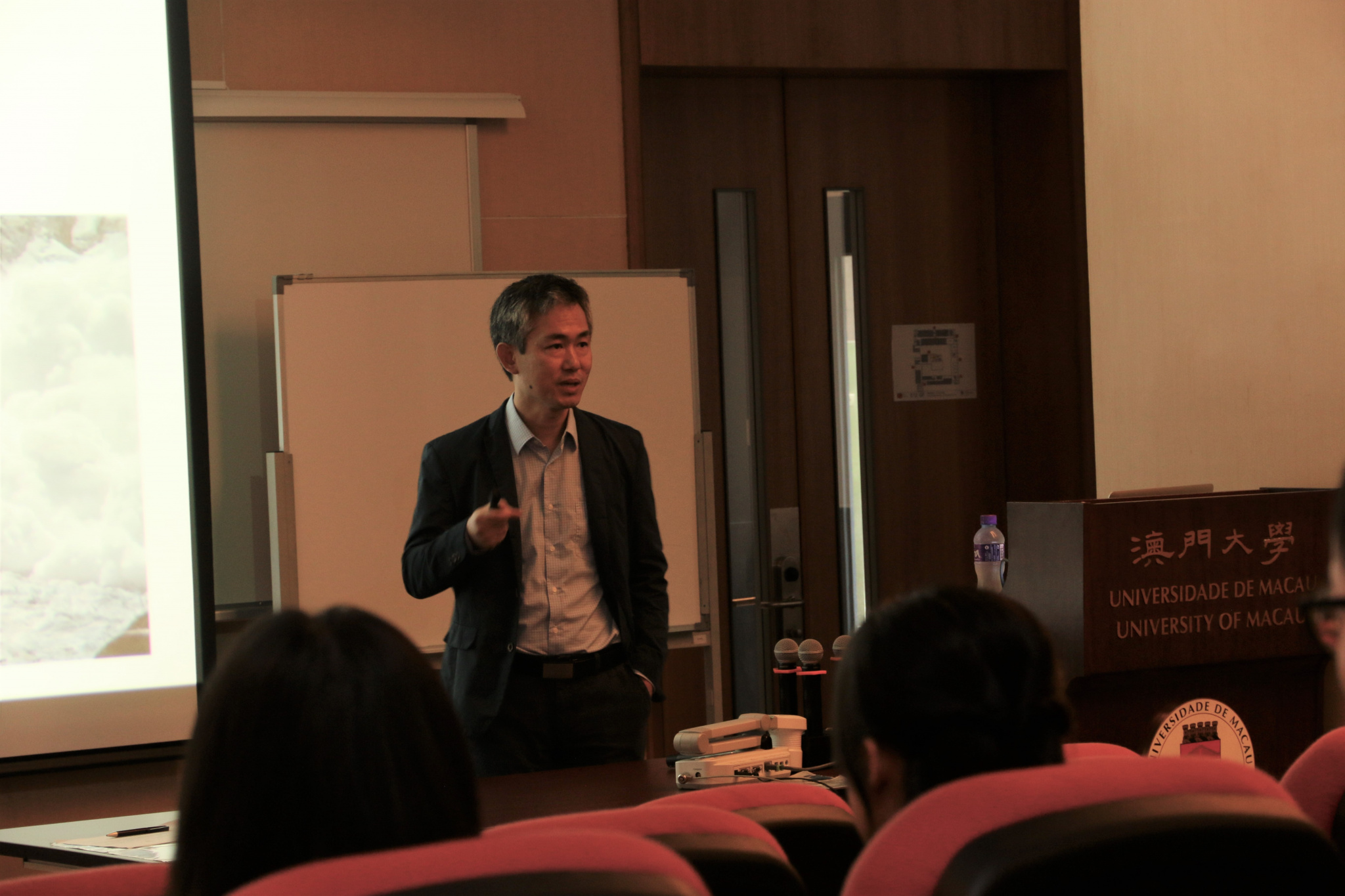
Jidong gave IAPME seminar at University of Macau
Jidong was invited to give an IAPME seminar at the University of Macau on 30 Dec 2019. He appreciates the kind invitation and hospitality by Prof Zongjin Li and Prof Guoxin Sun. His talk was hosted by Prof Hannah Zhou of the Department of Civil and Environmental Engineering at UoM.
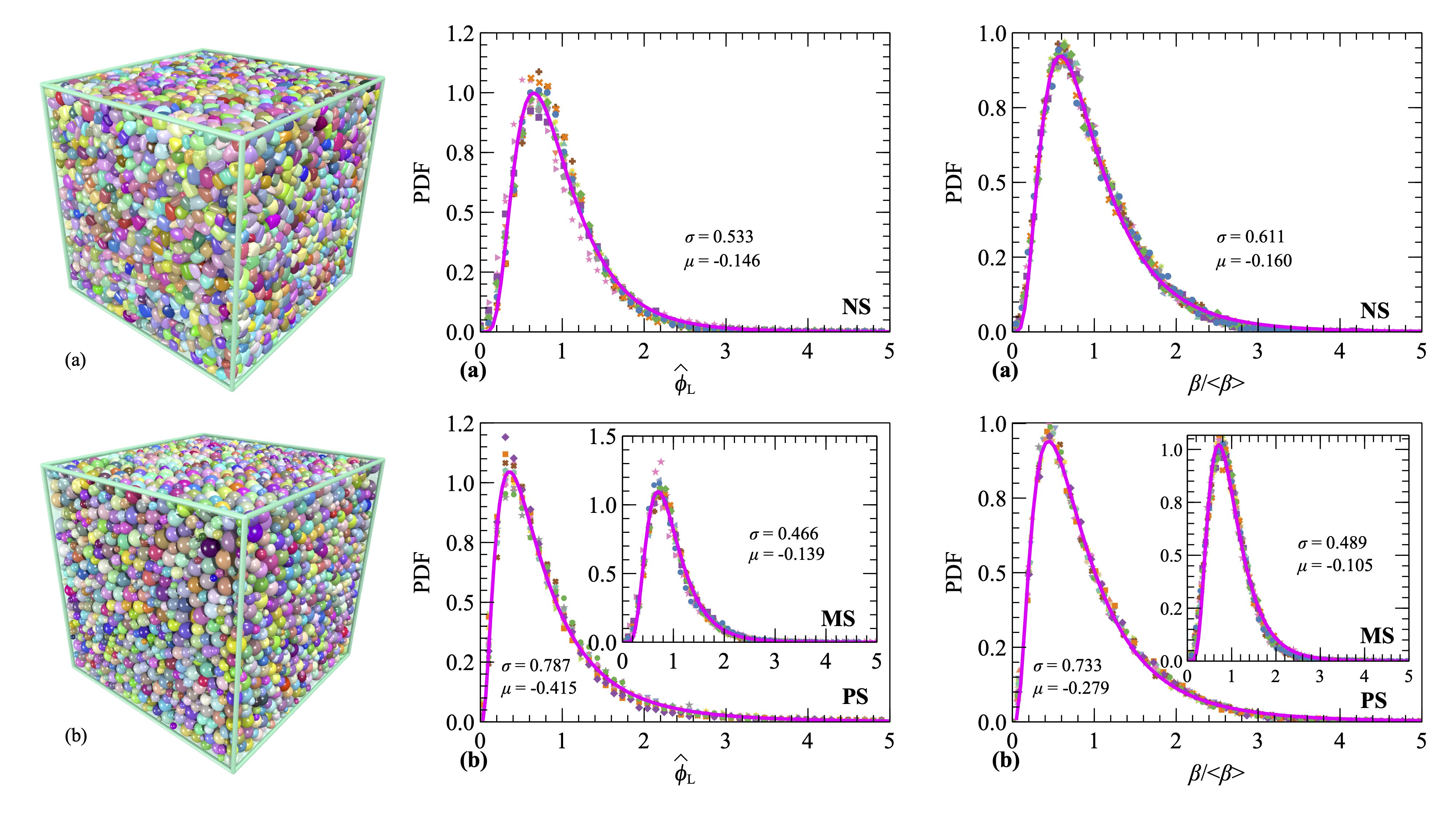
Structural universality in granular media
New paper by Shiwei accepted by Physical Review E. We quantified persistent structural signatures of granular packings under shear using radial distribution function & set Voronoi tessellation. Solid fraction & local anisotropy found to follow inverse Weibull & lognormal distributions.
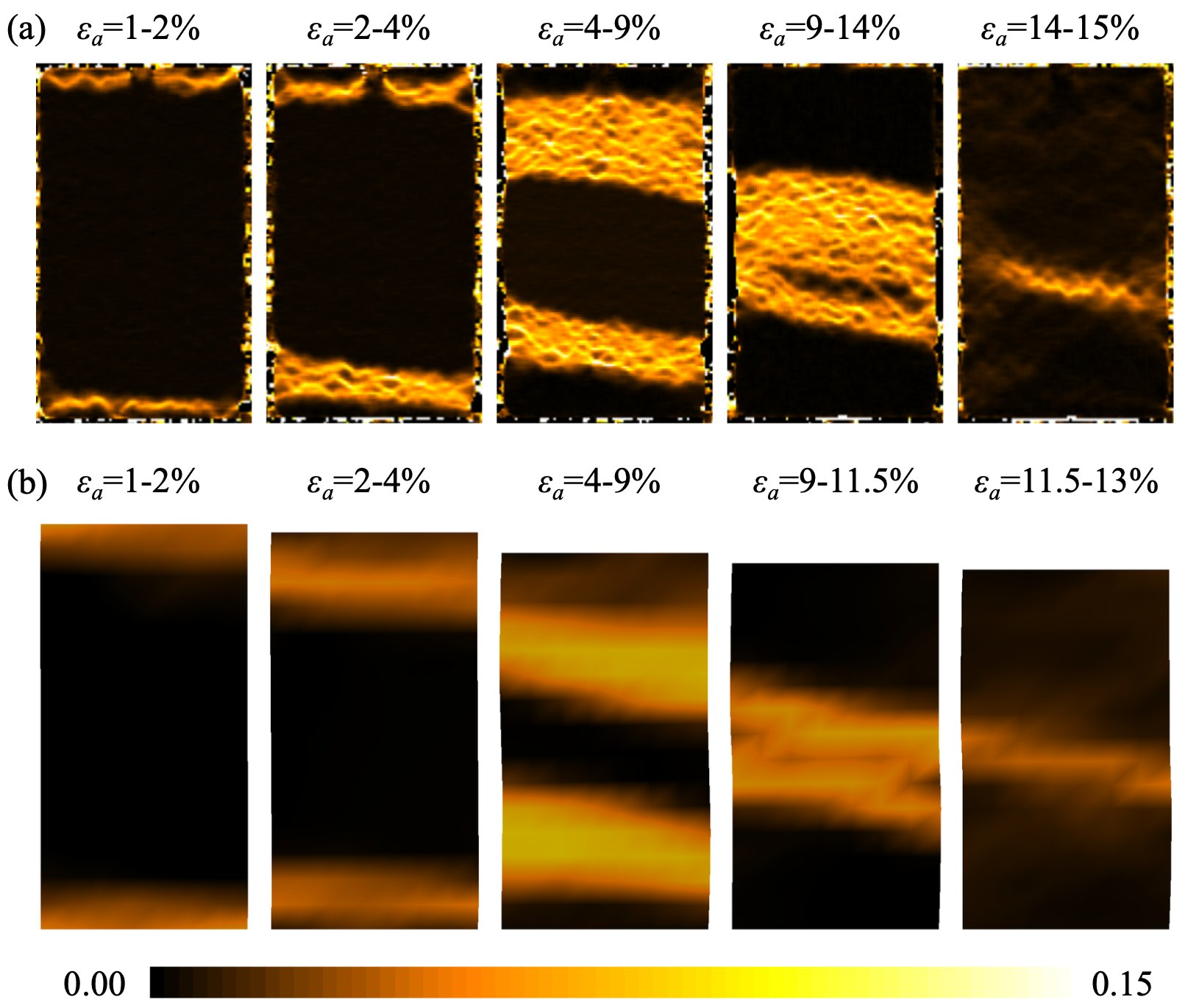
[New Paper]Compaction front in limestone
New paper accepted by Acta Geotechnica shows multiscale modeling of compaction fronts (b) in Tuffeau de Maastricht, a high-porosity limestone, match remarkably well with X-ray CT observations (a) - a recent collaborative work with Cino Viggiani of Grenoble.
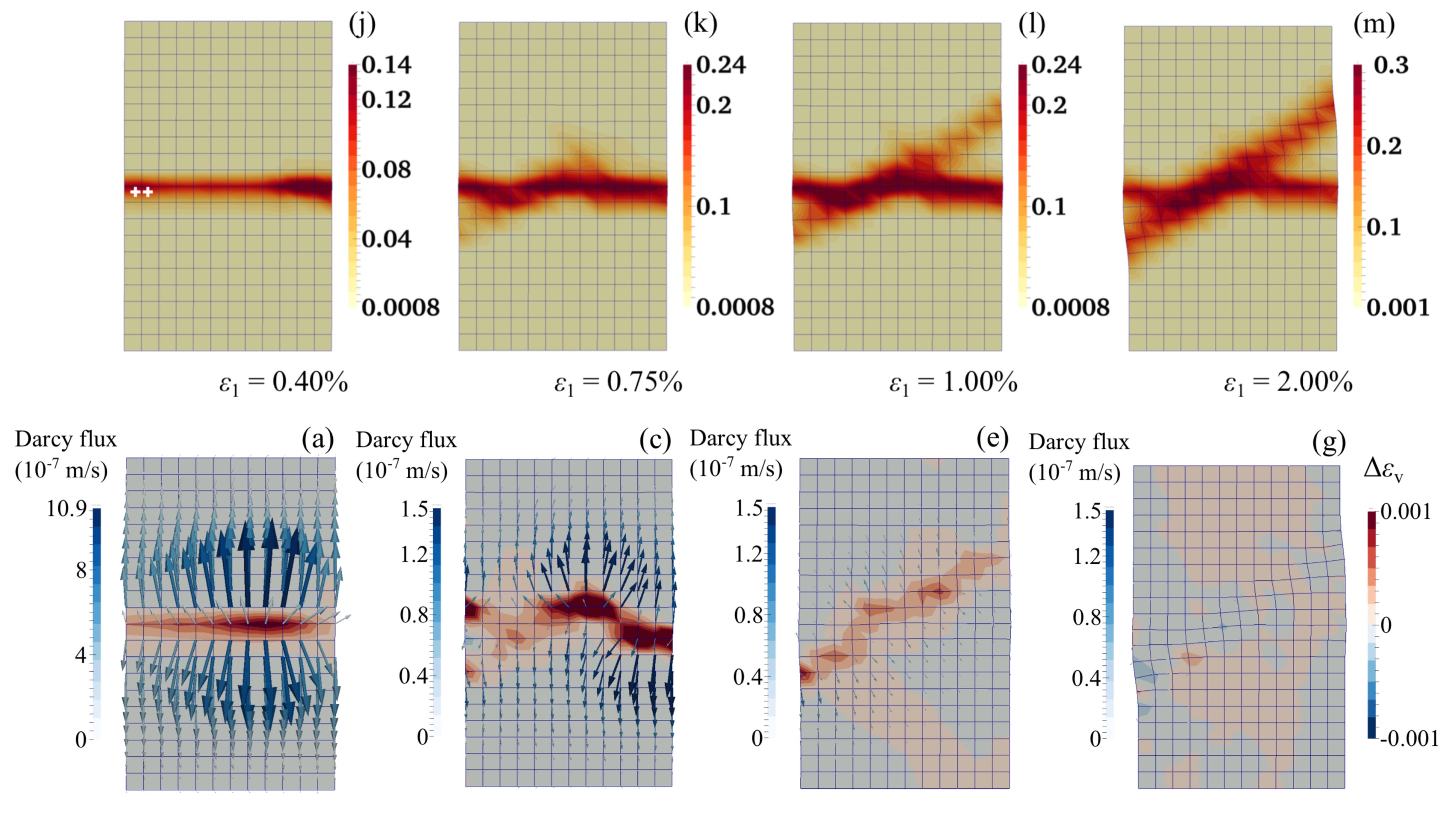
[New Paper]Compaction band and pore fluid
New multiscale paper by Huanran accepted by Engineering Geoloogy shows excess pore pressure can result in transitional evolution of deformation band patterns in saturated sandstone, e.g., from compaction band to shear band as shown above. We demonstrate that the classic effective stress in soil mechanics should be counted as an important state variable in conjunction with porosity in the study of compaction bands for saturated sandstone.
Fan officially becomes Doctor
Fan on his congregation day to receive his Ph.D. and can officially put a "Dr." before his name now. Congratulations Fan!.

Weijian on research exchange to UC Berkeley
Weijian has started a 6-month research exchange to Prof. Kenichi Soga's group at UC Berkeley working on a joint project on multiscale modeling of large deformation problems in geomechanics.
Zhijie defended his M.Phil. thesis
Zhijie has successfully defended his M.Phil. thesis and will obtain his master degree soon. Congratulations Zhijie!.
New Lab Member
Our geomechanics lab warmly welcomes the addition of a new member, Tao YU, as a research student. Tao was a top graduate from Southeast University, China, collecting all major awards during his undergraduate study. He will work with me on multiphysics modeling of 3D printing.
Fan defended his Ph.D.
Fan (middle) has successfully passed his Ph.D. thesis examination and will be granted with a doctoral title in the coming Nov's congregation. Well done and congratulations, Fan! He will stay in the group for a brief time as a postdoc fellow while exploring all opportunities. Above is a group photo of his thesis examination committee after his defence.
Jidong gave talks in Beijing and Hangzhou
Jidong has been invited to give a talk at Beijing Jiaotong University on 19 June 2019 hosted by Prof. Guoqing Cai. He also gave the 34th Lecture in Geotechnical Forum (岩土论道) in the Center of Coastal and Urban Geotechnical Engineering at Zhejiang University on 21 June 2019. The talk was invited by Prof Zhongxuan Yang and Dr. Ning Guo. Had some really stimulating discussions with faculty members and students in both schools after my talks.

Xingyue joined EPFL as Postdoc
Xingyue has left the Lab and joined Prof Johan Gaume's SLAB at EPFL working on challenging snow avalanche simulations. Best of luck, Xingyue!.
Huanran and Xingyue presented conferences
Huanran attended the 5th International Workshop on Rock Physics (23-26 April 2019, Hong Kong) and gave a poster on compaction band simulations. Xingyue gave a talk on debris flow simulations at the International Conference on Silt-road Disaster Risk Reduction and Sustainable Development held in Beijing from 11-12 May 2019.
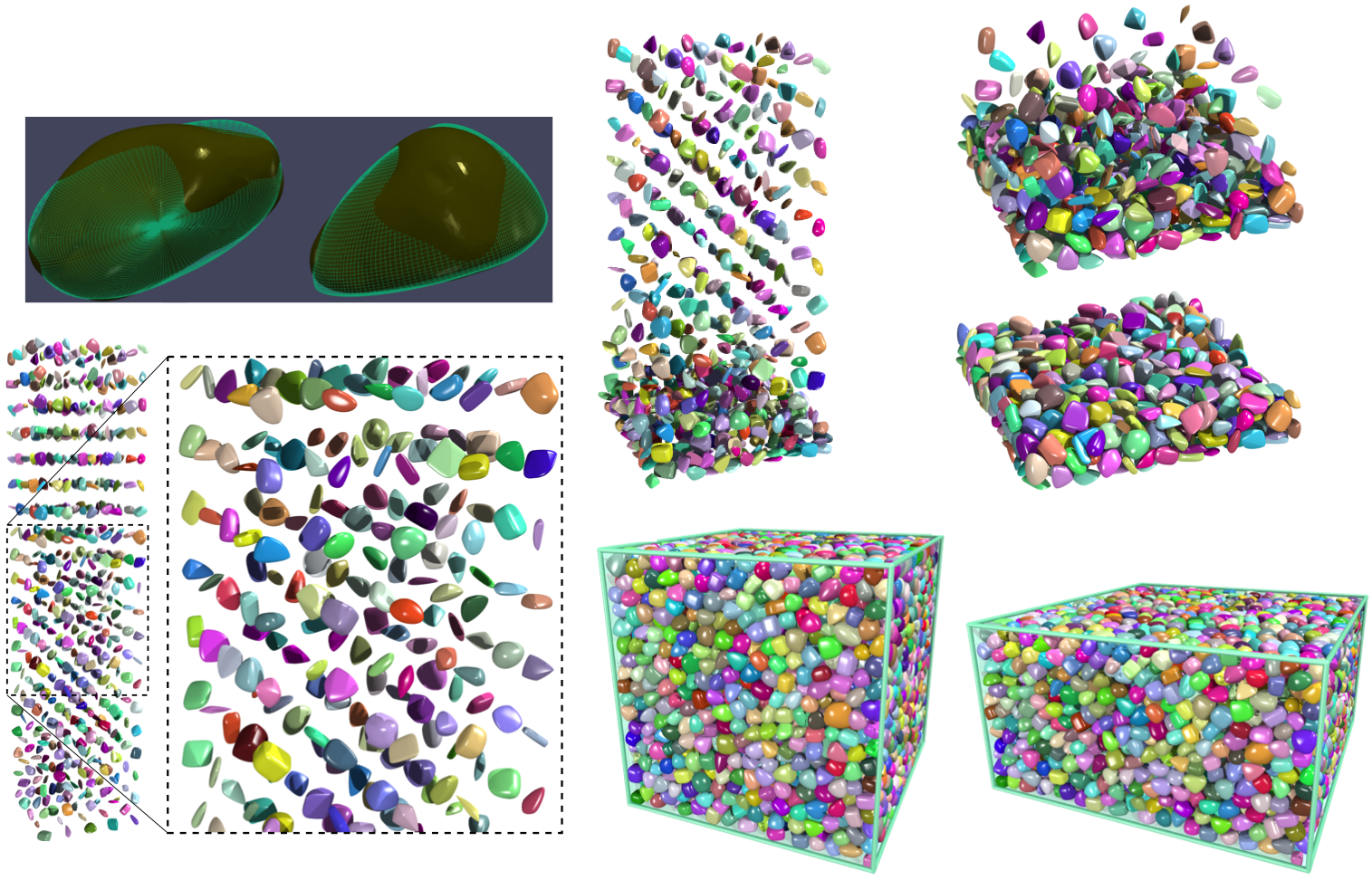
Poly-superellipsoids for DEM
Shiwei has developed a new methodology on DEM modeling of granular particle shapes based on poly-superellipsoids. The new approach offers a unified mathematical description of 3D poly-superellipsoidal surface for representation of realistic granular particles, which is shown to be versatile and effective in reproducing major shape features (such as elongation, flatness, angularity and asymmetry). This description is further combined with novel optimization techniques based on hybrid Levenberg-Marquardt (LM) and Gilbert-Johnson-Keerthi (GJK) algorithms for efficient and robust contact detection in DEM modeling. The study has been accepted for publication in NAG. (read paper).

Prof Xikui Li of Dalian University of Technology visited the Lab
Prof Xikui Li of Dalian University of Technology, a pioneer in computational granular mechanics in China, visited HKUST and the Geomechanics Lab from 6-9 May 2019. He gave a talk on "Concurrent Computational Homogenization Method for Saturated Granular Materials" at the Department and engaged stimulating discussion with the Lab members.
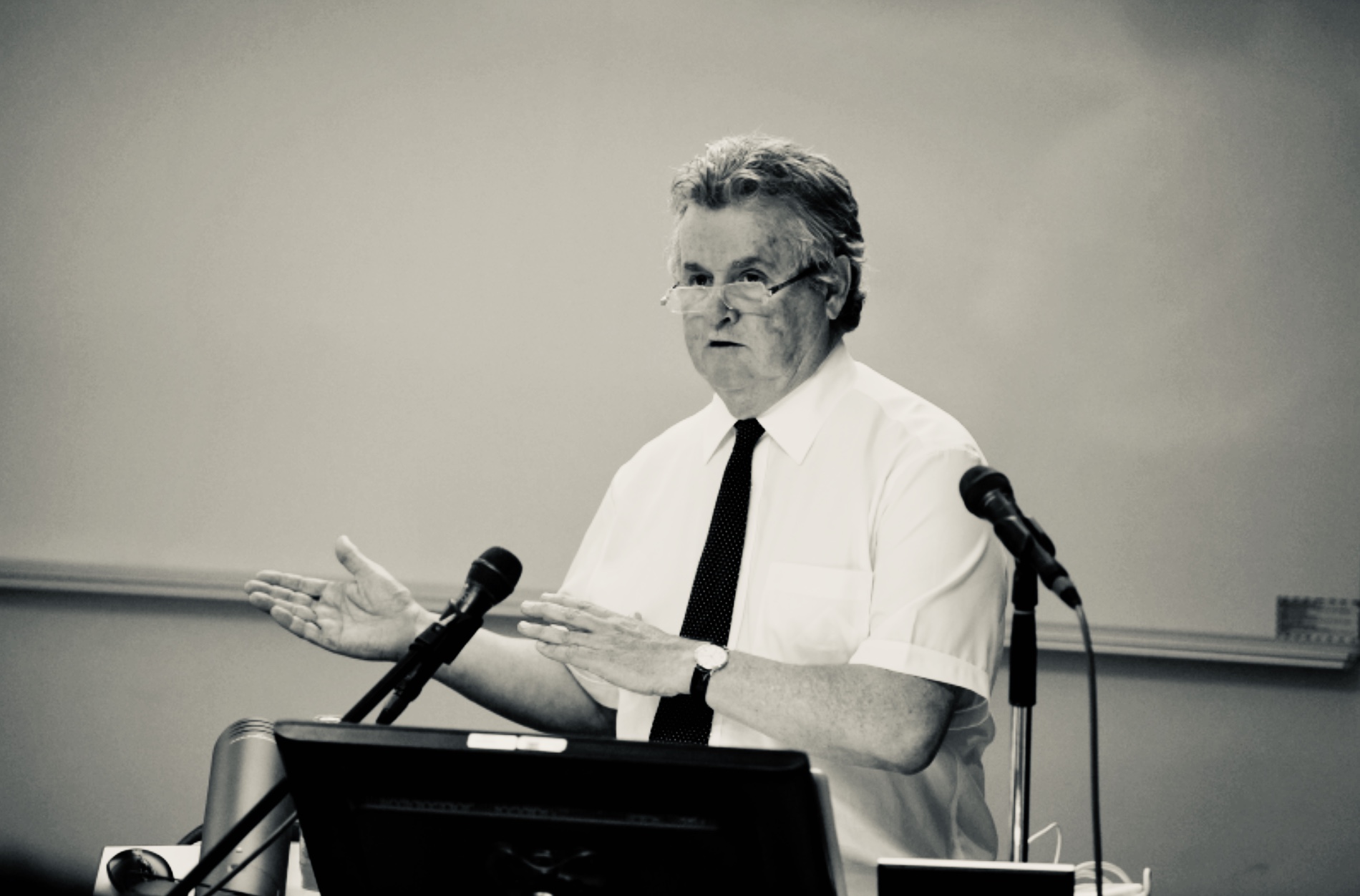
Geotechnical giant Prof Scott W. Sloan passed away
Deeply shocked and saddened by the sudden passing of Prof. Scott W. Sloan, Laureate Professor of Australia, FRS, FREng, FAA, FTSE, 51th Rankine Lecturer. The geotechnical community sadly loses one of the finest, prominent authority and giant in computational geomechanics who was internationally known by his many original, pioneering contributions on computational limit analysis, mesh generation and explicit stress integration algorithms. Personally, Scott has been such a supportive and inspiring mentor over my 5-year stay at Newcastle, and has never hesitated to offer help after I relocated to Hong Kong. Fond memories over his last visit to HKUST in Oct 2017 are still vivid. Thank you Scott! You are missed.
Associate Editor for J. Eng. Mech. ASCE
Jidong has been nomiated by the editor-in-chief of ASCE Journal of Engineering Mechanics and approved by Board of Governors of EMI to join the Editorial Board of JEM as an associate editor. He is grateful for the strong support from the EIC and BOG members and will work hard to serve the community.
Jidong gave invited lecture in Germany Workshop
Jidong has been invited to give a talk at the Chinesisch-Deutschen Zentrum für Wissenschaftsförderung (Sino-Germany Science Center, 中德科学中心) Workshop on "Granular Phase Transitions" held in Kloster Banz, Germany, from 14-17 April 2019. It was a nice experience mingling with experimentalists and theoreticians working on granular flow in micro gravity relating to space exploration. Appreciate the full support provided by Chinesisch-Deutschen Zentrum für Wissenschaftsförderung.

Jidong invited as keynote speaker for Powders & Grains 2021
Jidong has been invited as one of 11 keynote speakers at the 9th International conference on Powders and Grains to be held in Buenos Aires, Argentina, 2021. Since 1989, the Powders and Grains Conferences held every four years and have become a major event gather active researchers and practitioners working on all areas relevant to powders, grains, and granular media. It holds a tradition of single plenary session for all audiences. The keynote speakers were nominated and voted by the scientfic committee and members of the AEMMG (Association pour l'Etude de la Micromécanique des Milieux Granulaires).
Jidong presented talk at Lorentz Center
Jidong has been invited to present a keynote talk at the 2019 Lorentz Center Workshop on "Granular Matter Across Scales" which gathered a total of over 40 researchers from both engineering and sciences working on granular matter. It features half-day talk and half-day discussion for its 5-day conference. The discussions were really intensive and deep. It was quite a unique experience.
Ke SHI won Hong Kong PhD Fellowship
Current Lab student Miss Ke SHI has been awarded a prestigious Hong Kong PhD Fellowship (HKPFS). The HKPFS is a scholarship scheme funded by Hong Kong government to attract the brightest students from around the world to study in Hong Kong towards a PhD. It is highly competitive, with only around 250 awards each other for all disciplines of Hong Kong universities. The awardee of HKPFS receives a generous scholarship of HK$25,000 per month plus $12,000 conference travel support for four years. HKUST will provide an extra entrance award of HK$40,000 for each sucssessful awardee. For more information of the HKPFS, please visit the: HKPFS official website.

Joint HKUST-Waterloo PhD position for 2019/2020
The Geomechanics Lab has an opening of PhD position in the coming 2019 or 2020 under the HKUST and University of Waterloo (Canada) Joint PhD Program scheme. Successful candidate admitted to this scheme has the chance to study two years at HKUST and two years at Waterloo, the top university in Canada, with a final thesis for two PhDs from both universities. The candidates should be of caliber of HKPFS (and may apply for HKPFS to sponsor your joint program study too). The PhD topic will be on multiscale, multiphysics modeling of gas shales. please contact Jidong as soon as possible to explore the possibility.

Jidong joins editorial board of NAG
Jidong has been invited by chief editors of International Journal for Numerical and Analytical Methods in Geomechanics (IJNAMG) to join its editorial board as a member. IJNAMG is widely considered one of the top journals on geomchanics publishing top-quality, rigorous and innovative research on the frontiers of geotechnics and geomechanics. It has a prestigious editorial board . The researches of this board collectively represent the major breakthroughs and achievements in geomechanics and geotechnical engineering for the past 50 years or so. It is really a great honour and previlege for Jidong to join this board and work with these leading researchers to promote geomechanis research.
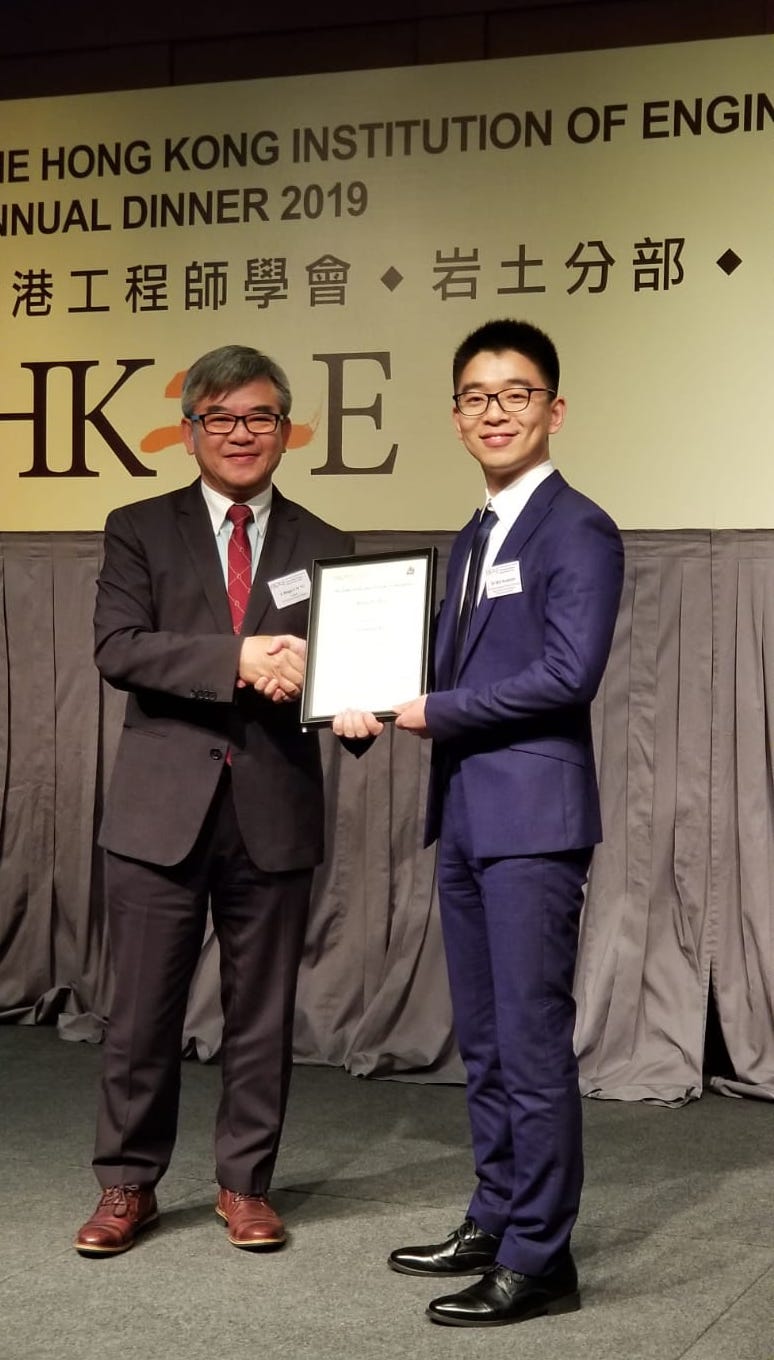
Huanran won Ringo Yu Prize for Best PhD Thesis
Huanran has been selected to receive the 2018 Ringo Yu Prize for Best PhD Thesis in Geotechnical Studies. This award was established by HKIE Geotechnical Division to commend the best PhD thesis in geotechnical studies in Hong Kong. The following is Huanran receiving the award during the award ceremoney in the 2019 HKIE Geotechnical Division Annual Dinner on 22 March 2019.
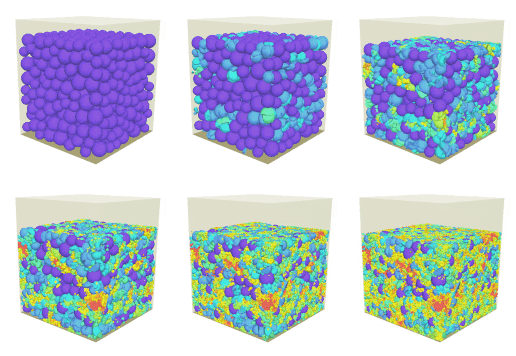
Grain breakage - a new way to model
Grain crushing is important to multiple engineering disciplines. We have developed an exciting new approach based on hybrid Peridynamics and Physics Engine to simulate grain crushing more objectively (crushing criteria) and realistically (shape). We use Peridynamics to treat the crushing of each individual grain, and allow Physics Engine to effectively handle irregualar grains in an assembly during the crushing process. The following animation captures the continuous crushing process by our new method for a typical 1D consolidaiton test. The work is done by Fan (Zhu) as part of his Ph.D. thesis. It has been accepted by Computer Methods in Applied Mechanics and Engineering ( See a preprint here ).